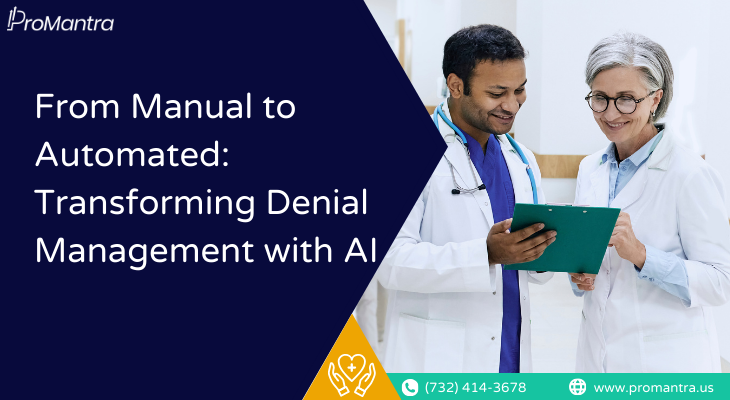
AI-Powered Denial Management Is Transforming Healthcare Revenue
If your billing team is still chasing claim denials with spreadsheets, sticky notes, and follow-up calls, you’re not alone. But you are leaving serious money on the table.
Claim denials are one of the most persistent revenue leaks in healthcare. And for most providers, the process of managing them is still painfully manual. Staff spend hours reviewing Explanation of Benefits (EOBs), identifying denial reasons, correcting claims, and resubmitting only to get denied again.
The good news? That cycle is breakable. AI-powered denial management is changing how healthcare organizations recover revenue faster, smarter, and with far less human effort.
In this blog, you’ll learn:
- Why manual denial management is no longer sustainable
- What AI-powered denial management actually does (without the jargon)
- The measurable impact it has on your bottom line
- And what to look for when choosing the right RCM partner
Let’s get into it.
The Denial Management Crisis No One Talks About Enough
Healthcare claim denials aren’t a new problem. But the scale of it? That’s what’s alarming.
According to a Commonwealth Fund-supported study published in Health Affairs, physician practices in the U.S. spend nearly $83,000 per physician annually on administrative costs related to billing, insurance interactions, and prior authorizations, nearly four times more than their Canadian counterparts. And according to the AMA’s 2024 Prior Authorization Physician Survey, physicians and their staff are spending an average of 13 hours per week just completing prior authorization requests.
The Advisory Board reports that roughly 9% of submitted claims are initially denied, and up to 65% of denied claims are never reworked or resubmitted.
That last number is the one that should keep revenue cycle leaders up at night.
What the Numbers Are Really Telling Us
The denial problem isn’t just about incorrect codes or missing information. It’s a systemic issue driven by:
- Increasing payer complexity and ever-changing billing rules
- Understaffed billing departments overwhelmed with volume
- Lack of real-time visibility into denial trends
- Reactive (not proactive) workflows that address denials after they happen
Manual processes simply can’t keep pace with this reality anymore. And that’s where AI-powered denial management enters the picture.
Why Manual Denial Management Is Quietly Killing Your Revenue
Let’s be direct: manual denial management is slow, inconsistent, and error-prone. It was designed for a simpler era, one where payer rules were fewer, staff turnover was lower, and claim volumes were manageable.
None of those conditions exist today.
Most billing teams are working with a patchwork of systems, a practice management system here, a spreadsheet tracker there, and a lot of institutional knowledge sitting in the heads of staff who could leave at any time.
The Hidden Costs of a Manual Workflow
Beyond the obvious (underpaid claims), manual denial management carries hidden costs:
- Staff time: Teams spend 15–20 minutes per denial on average, just investigating and documenting
- Rework errors: Manual re-entry increases the chance of introducing new errors into corrected claims
- Missed timely filing deadlines: Without automated tracking, denials slip through the cracks
- Low appeal success rates: Without denial pattern analysis, appeals are often generic and unsuccessful
- Burnout and turnover: High-volume, repetitive work drives staff attrition which compounds the problem
What AI-Powered Denial Management Actually Looks Like
Let’s cut through the buzzwords. When people say “AI-powered denial management,” what does that actually mean in practice?
At its core, it means using machine learning and predictive analytics to automate and optimize the entire denial lifecycle from prevention to resolution.
Key Capabilities of an AI-Driven System
Here’s what a mature AI-powered denial management solution does:
- Predictive Denial Prevention The system analyzes historical claim data to identify which claims are likely to be denied before they’re even submitted. It flags issues in real time so your team can fix them upstream.
- Automated Denial Categorization Instead of manually reading each EOB, AI automatically categorizes denials by type (clinical, administrative, coding, eligibility), payer, and priority level. What used to take hours now happens in seconds.
- Root Cause Analysis AI identifies patterns across thousands of denials to pinpoint why denials are happening not just what’s being denied. Is it always payer X with modifier 25? Is a specific provider triggering prior auth denials? The system surfaces that.
- Intelligent Workflow Routing Based on denial type, dollar value, and recovery likelihood, the system automatically routes work to the right staff member with the right context, eliminating triage delays.
- Automated Appeals Generation Some AI platforms can draft appeal letters using the denial reason, payer rules, and clinical documentation, dramatically cutting the time to appeal and improving success rates.
- Real-Time Dashboards and Reporting Instead of monthly denial reports that are already outdated, AI-powered denial management gives you live visibility into denial trends, recovery rates, and payer performance.
Real-World Impact: What Changes When You Automate
The shift from manual to AI-powered denial management isn’t just operational, it’s financial.
Here’s what healthcare providers typically experience after making the switch:
Before vs. After: A Side-by-Side Comparison
| Metric | Manual Process | AI-Powered Process |
| Denial rate | 9–12% | 3–5% |
| Days to work a denial | 5–10 days | 24–48 hours |
| Appeal success rate | 30–40% | 60–75% |
| Staff time per denial | 15–20 minutes | 2–5 minutes |
| Claims never reworked | Up to 65% | Less than 10% |
| Revenue recovered | Unpredictable | Measurably improved |
These aren’t hypothetical numbers. Providers who adopt AI-powered denial management consistently report faster recovery cycles, improved cash flow, and reduced administrative overhead.
How AI Identifies Denial Patterns Humans Often Miss
Here’s where it gets genuinely impressive.
Human reviewers are great at handling individual denials. What they can’t do effectively is analyze 50,000 claims simultaneously to find subtle patterns across payers, providers, service lines, and time periods.
For example, an AI system might detect that:
- Payer X is systematically denying a specific CPT code when billed with a particular diagnosis, a pattern that only shows up when you look at 6 months of data across all providers
- A specific front-desk staff member’s eligibility verification process has a gap that’s causing downstream denials 3 weeks later
- Claims submitted on Monday mornings have a 14% higher denial rate due to weekend coverage gaps in prior authorization
These are insights that would take a human analyst weeks to uncover, if they ever did at all. AI-powered denial management surfaces them automatically, enabling you to fix systemic issues rather than just playing whack-a-mole with individual denials.
Common Objections to Automation (And Why They Don’t Hold Up)
We hear these often. Let’s address them honestly.
“Our team already handles denials well.” If your denial rate is under 5% and your appeal success rate is above 60%, that may be true. For most providers, the data tells a different story. The question isn’t whether your team is working hard, it’s whether the system they’re working in is working for them.
“We can’t afford to implement new technology right now.” Consider the cost of not automating. If your practice is losing $500K+ annually to unworked or unsuccessfully appealed denials, a technology investment pays for itself quickly. AI-powered denial management isn’t a cost center, it’s a revenue recovery engine.
“We’d have to rebuild our entire workflow.” Most modern AI-powered denial management solutions are designed to integrate with your existing EHR and practice management system. Implementation doesn’t mean starting over, it means layering intelligence on top of what you already have.
“Our staff will resist the change.” Staff who spend their days doing repetitive, manual denial work are often the first to embrace automation. It frees them to focus on complex cases, appeals strategy, and payer relationships, work that’s more impactful and more satisfying.
What to Look for in an AI-Powered Denial Management Partner
Not all solutions are created equal. Here’s what to evaluate when choosing a partner:
- Denial prevention capabilities, not just denial resolution The best AI-powered denial management platforms catch problems before claims are submitted, not just after they’re denied.
- Payer-specific intelligence Payers have different rules, timelines, and quirks. Your solution should have deep, up-to-date payer data built in, not generic rule sets.
- Seamless EHR and PM integration Avoid solutions that require manual data exports. Bi-directional integration is non-negotiable.
- Transparent reporting You should be able to see exactly which denials are being worked, what’s being recovered, and where your biggest leakage points are, in real time.
- Human expertise alongside the AI Technology alone isn’t enough. The best outcomes come when AI tools are supported by experienced RCM professionals who understand the nuances of healthcare billing.
- Proven track record with similar providers Ask for case studies, denial rate benchmarks, and references from organizations similar to yours in size and specialty.
How ProMantra Is Helping Providers Make the Shift
At ProMantra, we’ve spent years in the trenches of healthcare revenue cycle management and we understand that denial management is where revenue is won or lost.
Our AI-powered denial management approach combines advanced automation with hands-on RCM expertise. We don’t just give you a software dashboard and wish you luck. We work alongside your team to:
- Analyze your current denial patterns and identify your highest-impact recovery opportunities
- Implement predictive workflows that catch claim issues before submission
- Manage end-to-end denial resolution from categorization and root cause analysis to appeal drafting and payer follow-up
- Provide real-time reporting that gives your leadership team full visibility into revenue performance
Whether you’re a single-specialty practice or a multi-location health system, ProMantra’s RCM services are built to scale with you and to deliver measurable results, not just promises.
Our clients have seen denial rates drop by as much as 40% within the first 90 days of engagement. That’s not a coincidence, it’s what happens when you combine the right technology with the right expertise.
Stop Managing Denials. Start Preventing Them.
The era of manual denial management is ending. Providers who continue relying on spreadsheets, siloed systems, and reactive workflows will find it increasingly difficult to sustain healthy revenue cycles as payer complexity grows and margins tighten.
AI-powered denial management isn’t a futuristic concept, it’s a present-day competitive advantage. And the providers adopting it now are building revenue cycles that are faster, more resilient, and significantly more profitable.
The question isn’t whether to make the shift. It’s when and with whom.
Ready to Transform Your Denial Management?
If your organization is losing revenue to unresolved denials, ProMantra can help you turn that around fast. Request a Free Denial Analysis.
Our RCM experts will review your current denial data, identify your biggest revenue leakage points, and show you exactly how AI-powered denial management can improve your bottom line.