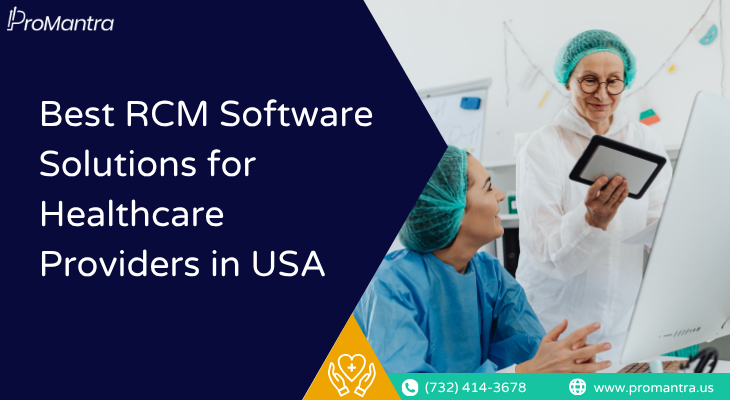
If you’re a healthcare provider in the USA, you already know how much revenue slips through the cracks from coding errors to claim denials to delayed reimbursements.
The solution? The right RCM software.
In this guide, we break down the best RCM software solutions for healthcare providers in the USA like what they offer, what to look for, and how to decide what’s right for your practice. Whether you run a solo clinic or a large hospital network, this blog will help you make a smarter, more profitable decision.
Let’s get into it.
What Is RCM Software and Why Does Your Practice Need It?
Revenue Cycle Management (RCM) software automates the financial processes that keep a healthcare organization running from patient registration and insurance eligibility checks to claims submission, denial management, and payment collection.
Without it, your team is manually handling hundreds (or thousands) of transactions every month leaving enormous room for error.
The impact? Claim denials alone cost hospitals approximately $262 billion annually in the US. That’s not a billing problem, that’s a business crisis.
The good news: the right RCM software doesn’t just reduce errors. It transforms your entire revenue cycle into a streamlined, automated engine that works while your clinical teams focus on patient care.
The State of RCM Software in the USA: What the Numbers Say
The demand for robust RCM tools is growing fast and for good reason.
- The healthcare RCM outsourcing market size reached $30.52 billion in 2024, reflecting how seriously providers are taking financial performance.
- Epic Systems leads the market with 48.6% market share and over 3,456 installations, followed by Oracle Cerner at 26.4% and MEDITECH at 18.6%.
- Optum’s RCM platform identifies an average of $1.1 million in unbilled revenue per client, per year revenue that would otherwise be left on the table.
These numbers tell a clear story: the best RCM software solutions for healthcare providers in the USA aren’t a luxury, they’re a financial necessity.
Must-Have Features in Any RCM Software Solution
Before reviewing specific platforms, here’s what every strong RCM software solution should include:
- Automated Claims Submission & Scrubbing
The software should automatically check claims for errors before submission reducing the rejection rate significantly. - Real-Time Eligibility Verification
Know whether a patient’s insurance is active before they walk in the door. This alone prevents a huge volume of claim issues. - Denial Management & Appeals Workflow
A strong denial management module tracks rejected claims, flags reasons, and automates the appeals process. - EHR/EMR Integration
Your RCM platform must integrate cleanly with your existing electronic health records system to eliminate data silos and manual re-entry. - Analytics & Reporting Dashboard
Real-time KPIs like Days in AR, net collection rate, and denial rate help you make data-driven financial decisions. - Patient Payment Tools
Features like payment portals, automated billing reminders, and flexible payment plans improve collections on the patient side. - Scalability
Whether you’re a single-provider practice or a multi-specialty hospital group, the software should grow with you.
Top RCM Software Solutions for Healthcare Providers in USA
Here’s a breakdown of the leading platforms currently dominating the US market.
1. Epic Resolute : Best for Large Hospital Systems
Epic is the undisputed heavyweight of healthcare RCM software.
Epic’s Resolute platform remains the gold standard for large-scale integration, and organizations utilizing Epic’s full-suite “One Patient, One Record” approach see a 15.4% faster Days Sales Outstanding (DSO) compared to multi-vendor environments.
2. Waystar : Best for Claims Management & Analytics
Waystar is one of the fastest-growing names in healthcare payments and claims management.
Waystar’s AI-driven platform processes $1.8 trillion in annual claims, covering 50% of U.S. patient volume, and serves over 30,000 clients including 16 of the top 20 U.S. News Best Hospitals.
Waystar earned a KLAS score of 91.8/100 for Claims Management in 2025, making it one of the most trusted names in the space.
3. Oracle Health (Cerner) : Best for Enterprise-Level Integration
Oracle Health (formerly Cerner) brings together clinical and financial data under one roof.
With 1,880 installations and a market share of 26.4%, Oracle Cerner remains a dominant force especially among enterprise health systems that need clinical and financial operations tightly connected.
Cerner helps providers improve reimbursement rates and minimize revenue leakage through automated claims tracking and coding accuracy, though heavy customization can require significant IT support.
4. Athenahealth (athenaOne) : Best for Ambulatory & Physician Groups
Athenahealth takes a cloud-first, continuously-updated approach to RCM.
Athenahealth’s athenaOne platform combines EHR, practice management, billing, and RCM, making it particularly suited for ambulatory practices and physician groups with a cloud-based model that allows for scalability and continuous updates.
5. Optum RCM : Best for End-to-End Revenue Optimization
Optum offers a comprehensive, enterprise-grade RCM ecosystem backed by UnitedHealth Group’s scale.
Optum has been designated a leader in the Everest Group RCM Platforms Peak Matrix Assessment 2025, the IDC MarketScape U.S. RCM Services Solutions, and the Frost & Sullivan Frost Radar™ RCM Operations in North America 2025.
RCM Software vs. Managed RCM Services: Which Is Right for You?
This is one of the most common questions healthcare providers ask and the answer depends entirely on your internal capacity.
| RCM Software | Managed RCM Services | |
|
Who runs it? |
Your in-house team | Outsourced RCM specialists |
|
Best for |
Practices with strong billing staff |
Practices with limited billing resources |
| Cost model | Monthly subscription or % of collections |
% of collections (typically 3–10%) |
|
Implementation time |
2–4 months | 6–12 months for full end-to-end |
| Control | High |
Moderate |
| Performance accountability | Internal |
External partner |
Healthcare RCM services cost 3–10% of collections, with most practices paying 5–10%, while flat-rate models range from $300 per provider or $3,000–$6,000 in administrative fees based on practice size.
Here’s the honest truth: many healthcare providers benefit most from a hybrid model using purpose-built software powered by experienced RCM professionals who understand payer rules, coding updates, and compliance requirements.
That’s exactly what companies like ProMantra deliver.
How ProMantra Helps Healthcare Providers Maximize Revenue
Choosing the best RCM software is only half the battle. The other half is having the expertise to use it effectively.
ProMantra is a specialized Revenue Cycle Management services partner for healthcare providers across the USA. We don’t just implement software, we manage your entire revenue cycle with a team of certified medical coders, billing specialists, and denial management experts who work as an extension of your practice.
Here’s what sets ProMantra apart:
- End-to-end RCM services : From patient registration and eligibility verification to claims submission, denial appeals, and payment posting
- Specialty-specific expertise : We understand the nuances of billing across multiple clinical specialties. Know more about all the speciality pages.
- Technology-enabled workflows : Our team works with leading RCM software platforms to maximize clean claim rates and accelerate reimbursements
- Transparent reporting : Real-time dashboards give you full visibility into your financial performance
- Compliance-first approach : We stay current with CMS guidelines, ICD-10 updates, and payer policy changes.
Whether you’re struggling with rising denial rates, slow AR days, or simply don’t have the internal bandwidth for a full-time billing team, ProMantra delivers measurable results without the overhead.
How to Choose the Right RCM Software for Your Practice
Not every platform is the right fit. Here’s a quick decision framework:
Step 1: Assess your practice size and complexity
A solo practitioner has very different needs from a 200-bed hospital system. Start by understanding the volume and complexity of your billing workflows.
Step 2: Evaluate your existing tech stack
What EHR or EMR are you already using? Choose an RCM platform that integrates cleanly, not one that creates new data silos.
Step 3: Prioritize your biggest pain points
Is it claim denials? Slow collections? Patient billing confusion? Match your software choice to your most urgent problems.
Step 4: Consider total cost of ownership
Monthly licensing fees are only part of the story. Factor in implementation, training, ongoing support, and the cost of managing the platform in-house.
Step 5: Ask about performance guarantees
The best RCM partners whether software vendors or managed service providers should be willing to show you real outcomes data from existing clients.
Frequently Asked Questions (FAQs)
Q1. What is the best RCM software for small medical practices in the USA?
For small to mid-size practices, platforms like Athenahealth are excellent starting points. They’re cloud-based, affordable, and come with integrated EHR and billing tools. However, if your team lacks dedicated billing staff, partnering with a managed RCM services provider like ProMantra can deliver stronger financial outcomes without the in-house overhead.
Q2. How does RCM software reduce claim denials?
RCM software reduces denials through automated claim scrubbing (catching errors before submission), real-time eligibility verification, and built-in denial management workflows. AI-powered platforms can also predict which claims are at higher risk of denial and route them for review before submission, significantly improving first-pass acceptance rates.
Q3. What is the difference between RCM software and RCM services?
RCM software is a technology tool your internal team operates to manage billing workflows. RCM services, on the other hand, are managed by an external team of specialists who handle the entire revenue cycle on your behalf including coding, billing, denial management, and collections. Many providers use a combination of both for optimal results.
Q4. How long does it take to implement RCM software?
Implementation timelines vary by solution. Software-only solutions typically take 2–4 months to implement, while full end-to-end outsourced RCM solutions can take 6–12 months, with AI-powered platforms averaging 3–6 months. A good implementation partner will work closely with your team to minimize disruption during the transition.
Final Thoughts: Don’t Let Revenue Slip Through the Cracks
The best RCM software solutions for healthcare providers in the USA share one common goal: making sure you get paid accurately and on time for every service you deliver.
Whether you go with an enterprise giant like Epic or Optum, a growth-friendly platform like Athena, or a fully managed service partner, the right choice comes down to your practice’s size, needs, and internal capabilities.
If you’re unsure where to start or if your current RCM setup just isn’t delivering, ProMantra is here to help.
Ready to Optimize Your Revenue Cycle?
Talk to a ProMantra RCM Specialist today.
Our team will audit your current billing performance, identify revenue leakage points, and recommend a tailored RCM strategy that fits your practice at no obligation.
Contact ProMantra for a Free RCM Consultation and start recovering the revenue your practice deserves.