

Running a healthcare practice today means wearing more hats than ever. You are managing patient care, regulatory compliance, staff retention, and somewhere in the middle of all that; a revenue cycle that feels like it is constantly on the verge of breaking down.
That is exactly why so many providers are turning to hybrid RCM models as a potential solution. The idea sounds appealing: keep control of the functions you do well in-house, and hand off the complex or resource-heavy tasks to specialized experts. Best of both worlds, right?
But like most things in healthcare, the reality is a little more nuanced. In this blog, we break down what hybrid RCM models actually look like in practice, the real benefits they offer, the challenges that can catch you off guard, and how to make the model work for your organization.
What Are Hybrid RCM Models?
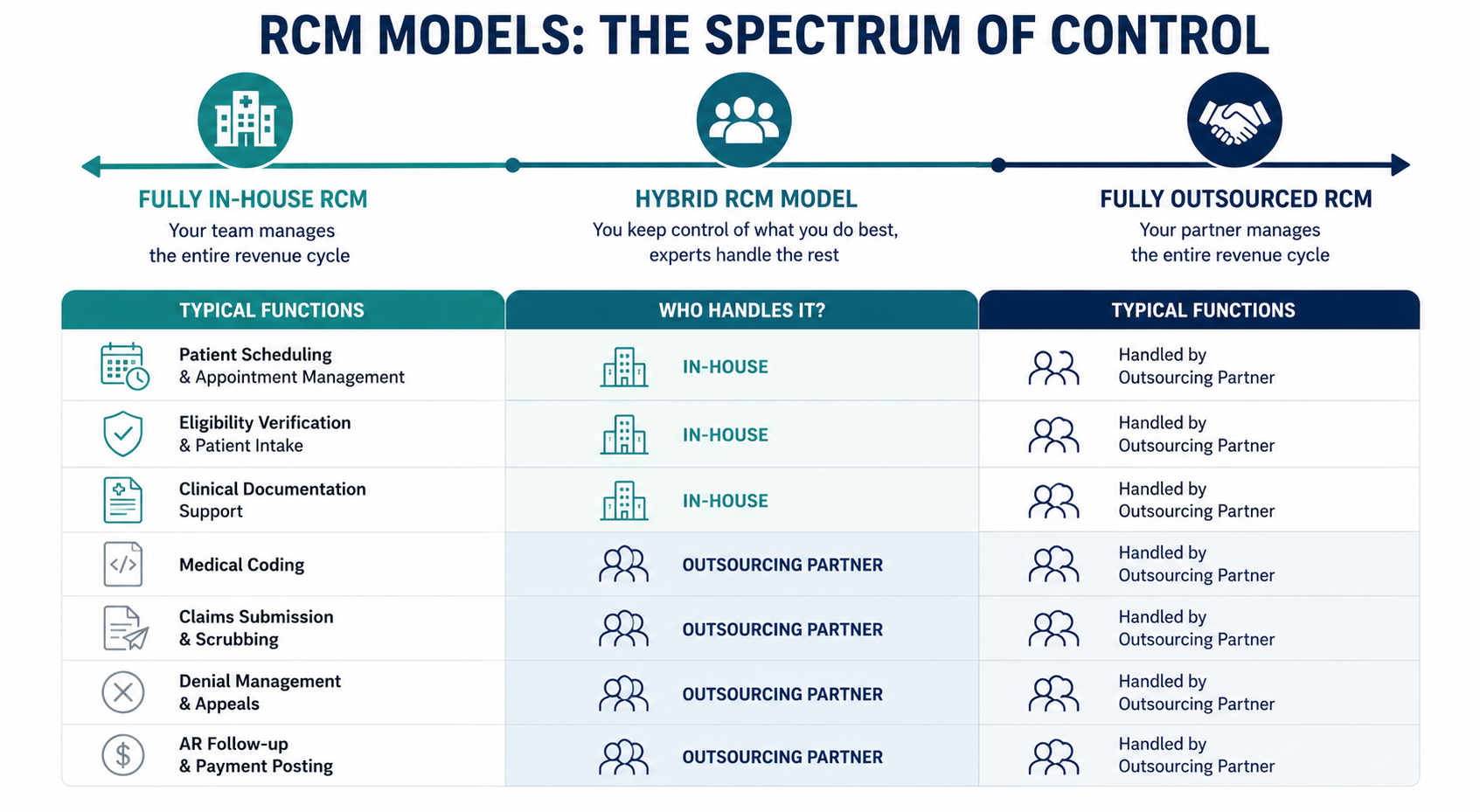
A hybrid RCM model is an approach where a healthcare organization manages certain revenue cycle functions internally while outsourcing others to a third-party partner.
Think of it as a spectrum. On one end, you have a fully in-house RCM, your staff handles everything from patient registration and coding to claims submission and denial management. On the other end, full outsourcing means an external vendor owns the entire cycle.
Hybrid RCM models sit in the middle. For example:
- Your in-house team may handle front-end tasks like scheduling, eligibility verification, and patient intake
- While your outsourced partner manages coding, claims submission, denial management, and AR follow-up
Or it could be the reverse, internal coders stay on staff while complex denial appeals and payment posting go to a specialist vendor.
There is no single template. The split depends entirely on your practice’s strengths, gaps, and goals.
Why Healthcare Providers Are Moving Toward Hybrid RCM
The numbers tell a clear story. According to ResearchAndMarkets.com (2025), the US healthcare RCM market was valued at $141.61 billion in 2024 and is projected to hit $272.78 billion by 2030 growing at over 11% annually. That kind of growth reflects the sheer complexity of modern revenue cycle operations.
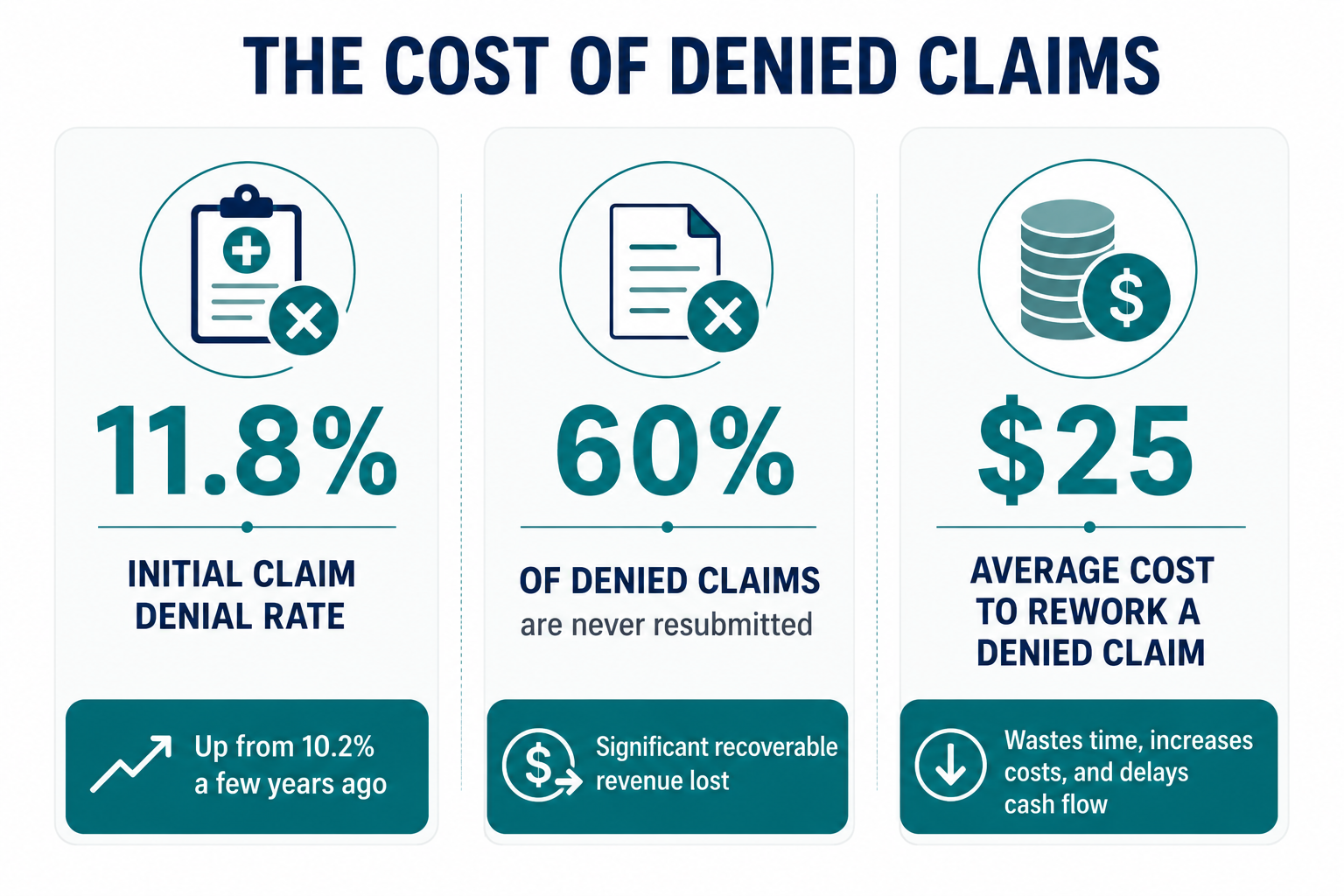
At the same time, initial claim denial rates hit 11.8% in 2024, up from 10.2% just a few years ago. Payers are getting stricter, documentation requirements are tighter, and staffing shortages are not going away.
The result? Providers are landing somewhere in between. Hybrid RCM models give them a way to reduce administrative burden without completely giving up control.
The Benefits of Hybrid RCM Models
Cost Efficiency Without Sacrificing Control
Full in-house RCM is expensive. You need to hire, train, and retain billing specialists, coders, AR managers, and compliance staff. Full in-house RCM is expensive; beyond salaries, there are hidden costs of in-house RCM that CFOs often overlook from technology overhead to compliance risk exposure. Outsourcing specific functions especially high-volume or specialized tasks like denial management or coding can significantly reduce overhead.
Healthcare administrative costs currently account for 15 to 25% of total expenditures. Hybrid RCM models allow providers to direct those savings toward patient care while still keeping oversight of the functions that matter most to their operations.
Access to Specialized Expertise
One of the strongest arguments for hybrid RCM models is expertise. Outsourcing partners who specialize in RCM stay current on payer rules, coding updates, and compliance changes full time. That is their only job.
For in-house teams stretched thin across multiple responsibilities, that depth of specialization is hard to match. Bringing in external experts for high-risk areas like complex denials or prior authorization management can directly improve clean claim rates and reduce write-offs.
Scalability When You Need It
Patient volumes fluctuate. New payer contracts come in. You open a new location. A hybrid model gives you the flexibility to scale outsourced support up or down without hiring or laying off staff.
This is especially valuable for mid-size practices and growing health systems that cannot justify full-time headcount for every RCM function but still need consistent performance. Learn how to reduce AR days without adding headcount while keeping performance consistent.
Stronger Denial Management
According to a 2024 Experian Health “State of Claims” report, 76% of denials are caused by missing, incomplete, or inaccurate data issues that happen at the front end but blow up in the back end. And 60% of denied claims are never resubmitted, costing practices significant recoverable revenue.
Hybrid RCM models that pair your in-house clinical knowledge with an outsourced denial management team can be highly effective here. Your staff understands the clinical side; your partner handles the appeals workflow. Together, that combination catches what neither can do alone.
The Challenges of Hybrid RCM Models (The Management Nightmare Side)
Here is where the conversation gets honest. Hybrid RCM models are not a plug-and-play solution. Without the right structure, they can create more problems than they solve.
Coordination and Communication Gaps
When two teams; one internal, one external are working on different pieces of the same revenue cycle, hand-offs become critical. A breakdown at any transition point can delay claim submission, cause duplicate work, or result in claims slipping through the cracks entirely.
If your in-house eligibility team does not communicate clearly with your outsourced billing partner, you will see errors at submission. If your coding team and your external AR team are not aligned, you lose visibility into denial root causes.
Clear communication protocols, shared reporting dashboards, and regular performance reviews are not optional in a hybrid setup, they are the foundation.
Accountability Gray Zones
Who is responsible when a claim is denied? When AR ages past 90 days? When a compliance error slips through?
In a hybrid model, accountability can get blurry. Internal staff may assume the vendor is handling follow-up. The vendor may assume your team escalated a flagged claim. Without clear SLAs (Service Level Agreements) and defined ownership of each step, these gray zones become revenue leaks.
Data Security and Compliance Risks
Sharing patient data with any external vendor introduces risk. The Change Healthcare breach of 2024 was a stark reminder of what can happen when a critical outsourcing partner suffers a security failure practices went months without being able to process claims.
In a hybrid RCM model, you need to verify that every vendor partner maintains HIPAA compliance, robust data encryption, and documented disaster recovery protocols. Due diligence here is non-negotiable.
Technology Integration Challenges
Your practice management system, EHR, and billing platform all need to talk to each other and to your external partner’s systems. Integration failures lead to duplicate data entry, incomplete records, and reporting blind spots.
As noted by MD Clarity, some outsourced providers use different software platforms that do not mesh smoothly with existing systems, causing delays and errors that can take months to untangle.
How to Make Hybrid RCM Models Work
The difference between a high-performing hybrid RCM model and a management nightmare often comes down to how deliberately it was designed. Here are the key elements that make hybrid arrangements succeed:
- Start with an honest audit Before deciding what to outsource, map your current revenue cycle performance. Where are your denial rates highest? Where is AR aging? Where are your staffing gaps? This data tells you where external expertise will have the most impact.
- Define ownership at every step Create a written workflow that documents exactly who owns each function and what happens when something goes wrong. There should be no ambiguity about escalation paths.
- Demand unified reporting Your in-house team and your external partner should be working off the same dashboards and KPIs. You cannot manage what you cannot see. Analytics-driven RCM organizations report up to 40% fewer denials and 93% first-pass claim rates but only when data visibility is shared across teams.
- Choose a partner, not just a vendor The best outsourcing relationships in hybrid RCM models feel like an extension of your team not a separate company you call when things go wrong. Look for an RCM partner who proactively flags issues, provides regular performance reviews, and adapts to your practice’s specific needs.
- Build in regular governance reviews A hybrid model is not “set and forget.” Schedule quarterly reviews of performance metrics, SLA compliance, and workflow alignment. The model should evolve as your practice grows.
Is a Hybrid RCM Model Right for Your Practice?
Not every practice is at the same starting point. Here is a quick way to think about it:
A hybrid RCM model is likely a strong fit if:
- You have a capable in-house front-end team but struggle with denial management and AR recovery
- You are growing and cannot scale in-house headcount fast enough to keep up
- You want outsourced expertise for complex coding without giving up day-to-day billing oversight
- You experienced disruptions from a fully outsourced model and want more internal visibility.
If you’re rebuilding after a failed outsourcing arrangement, read our guide on transitioning from in-house to outsourced RCM without revenue disruption.
It may not be the right fit if:
- Your current in-house team is already underperforming and adding a hybrid layer would create more confusion
- Your technology infrastructure cannot support clean data sharing with an external partner
- You lack the internal bandwidth to manage vendor oversight and governance
In those cases, working with a full-service RCM partner who takes ownership of the entire cycle while still keeping you informed may actually deliver more predictable results.
How ProMantra Supports Hybrid and Full-Service RCM
At ProMantra, we have worked with healthcare providers across the spectrum from practices building their first hybrid RCM models to health systems looking to transition from a broken outsourcing arrangement to something that actually works.
We understand that no two practices are alike. That is why we do not offer a rigid one-size-fits-all service. Whether you need end-to-end revenue cycle management or targeted support for specific functions like denial management, medical coding, prior authorizations, or AR recovery, we build around your workflow.
Our approach combines deep domain expertise with technology-driven processes and transparent, real-time reporting. You always know where your revenue stands. And you always have a dedicated team that treats your financial performance as seriously as you do.
If you are evaluating whether a hybrid RCM model is right for your organization, we are happy to start with a no-obligation review of your current revenue cycle performance.
FAQs
Q1: What is the difference between a hybrid RCM model and fully outsourced RCM?
In fully outsourced RCM, a third-party vendor manages your entire revenue cycle from registration to payment posting. In a hybrid RCM model, your in-house staff handles certain functions (often front-end tasks or clinical documentation) while an external partner manages others (such as coding, billing, denial management, or AR follow-up). The split varies based on your practice’s needs.
Q2: What functions are most commonly outsourced in a hybrid RCM model?
The most commonly outsourced functions include medical coding, denial management and appeals, AR follow-up for aging claims, payment posting, and prior authorization management. Front-end tasks like patient scheduling, eligibility verification, and patient intake are often retained in-house because they require direct patient interaction.
Q3: How do I measure whether my hybrid RCM model is performing well?
Track these KPIs consistently: clean claim rate (target above 95%), initial denial rate (industry average is 11.8%, so anything lower is a win), days in AR (under 40 is generally strong), first-pass resolution rate, and net collection rate. If your hybrid model is working, these numbers should trend in a positive direction quarter over quarter.
Q4: What are the biggest risks of implementing a hybrid RCM model?
The most common risks are accountability gaps between in-house and outsourced teams, data security vulnerabilities when sharing PHI with a vendor, technology integration challenges between different platforms, and communication breakdowns that delay claims or cause revenue leakage. These risks are manageable with proper governance, clear SLAs, and a reliable outsourcing partner.
Ready to Build an RCM Strategy That Actually Works?
Whether you are exploring hybrid RCM models for the first time or rethinking a model that is not delivering results, ProMantra can help you find the right fit.
Schedule a Free RCM Performance Review with ProMantra Today and let us show you what a smarter revenue cycle looks like for your practice.