Promantra’s RCM AI development services combine 23 years of live revenue cycle operations with deep healthcare AI engineering expertise designing, building, and deploying custom AI models, automation workflows, and intelligent RCM platforms that are trained on real billing data, built to HIPAA standards, and engineered to generate measurable financial outcomes from the first day of operation.
Get In Touch
Fill out the form below and we'll get back to you as soon as possible.

RCM AI development services are specialized software engineering engagements that design, train, integrate, and deploy artificial intelligence systems purpose-built for healthcare revenue cycle workflows. Unlike off-the-shelf RCM software, custom RCM AI development produces models trained on your specific claims data, payer contracts, coding patterns, and operational workflows delivering AI that performs for your environment rather than requiring your environment to conform to someone else’s product.
Health systems that want a proprietary competitive advantage, RCM companies seeking to productize intelligent automation, health tech vendors building billing software, and PE-backed provider groups demanding platform-level revenue intelligence. Custom RCM AI development is the right choice when your revenue cycle workflows are too complex, too specialized, or too strategically important to outsource to a generic platform.
The healthcare organizations investing in custom RCM AI development today are building a compounding competitive advantage proprietary denial prediction models that improve with every claim processed, coding engines trained on their own clinical documentation, and revenue intelligence platforms that give their CFOs a level of financial foresight no off-the-shelf tool can replicate. The global healthcare AI market will exceed $110 billion by 2030.
Promantra’s development services cover the full build lifecycle from AI strategy and data architecture through model training, EHR integration, testing, and production deployment with RCM domain expertise embedded at every engineering stage. Delivery is measured by demonstrated improvement in your revenue metrics, not by software functionality checklists.

Promantra’s RCM AI development practice covers every AI capability your revenue cycle operation could require from standalone denial prediction models to fully integrated, multi-module intelligent billing platforms built from the ground up.
Promantra builds proprietary NLP-powered coding engines trained on your clinical documentation like physician notes, operative reports, discharge summaries, and radiology reads to auto-assign ICD-10-CM, CPT, HCC, and E/M codes at scale. Each engine is trained on your specialty-specific documentation patterns, payer edit requirements, and historical coding data, producing a coding AI with accuracy rates exceeding 95%.
Promantra trains custom denial prediction models on your historical claims, payer responses, and denial root cause data, creating a machine learning system that scores every outgoing claim for denial risk before it reaches the payer. Because the model is trained on your specific denial history, it identifies the exact patterns, payer behaviors, and documentation gaps that generate denials in your specific billing environment.
Promantra engineers intelligent prior authorization bots that identify authorization requirements at scheduling, submit requests to payer portals automatically, monitor approval status in real time, and escalate exceptions to clinical staff based on configurable urgency rules. Custom bots are built for your specific payer mix, service lines, and EHR submission workflows eliminating the manual phone calls and portal navigation that consume hours of front-end staff time per day.
Promantra develops custom eligibility verification AI that queries payer eligibility APIs in real time at the point of scheduling, processes benefit responses through intelligent parsing models, and surfaces coverage gaps, coordination of benefits conflicts, and high-balance patient liability flags directly within your patient intake workflow eliminating manual coverage checks and preventing front-end errors that generate downstream claim denials.
Promantra builds custom claim scrubbing engines that apply your payer-specific edit libraries, specialty coding rules, and contractual requirements to every claim before submission. Unlike vendor-licensed scrubbing tools with fixed rule sets, custom-built scrubbing AI is trained on your actual denial history identifying the specific error patterns that generate rejections in your payer portfolio and correcting them at the point of claim creation.
Promantra builds custom machine learning models that analyze your A/R aging inventory and score every unpaid account by net recovery probability, time-sensitivity, and optimal follow-up channel directing your billing team’s effort toward the accounts that generate the most revenue per hour of follow-up activity. Custom A/R intelligence models are trained on your payer payment patterns, improving prioritization accuracy continuously.
Promantra’s AI development practice combines best-in-class machine learning frameworks, healthcare-specific NLP libraries, and cloud-native infrastructure with deep revenue cycle domain knowledge producing systems that are accurate, scalable, and maintainable by your engineering team after handoff.
Clinical documentation is the most information-dense and structurally inconsistent data source in healthcare requiring NLP architectures specifically tuned for medical language, abbreviations, negation handling, and specialty-specific terminology. Promantra’s NLP development practice uses transformer-based language models fine-tuned on clinical corpora, custom named entity recognition pipelines, and documentation structure parsing models trained on your specific physician documentation styles.
Promantra’s revenue cycle ML development uses gradient boosting ensembles, neural network architectures, and time-series forecasting models to build denial prediction engines and revenue intelligence platforms trained on your historical claims data. Our feature engineering pipeline extracts hundreds of clinically and financially meaningful signals from claim records, payer response histories, and documentation quality metrics.
Not every revenue cycle workflow requires machine learning; some require precise, fast, reliable execution of rule-based processes at scale. Promantra’s RPA development practice designs and deploys intelligent bots for prior authorization portal navigation, eligibility API querying, claim status monitoring, ERA file processing, and payer follow-up workflows freeing your staff from high-volume repetitive tasks while maintaining complete audit trails of every automated action.

Denial Rate Reduction
Days in A/R
Coding Accuracy
Days to ROI
Every RCM AI system Promantra builds is engineered against specific, measurable financial targets. Here is what clients consistently achieve after deploying custom-built RCM AI.
Custom coding AI models trained on your specific clinical documentation and denial history consistently outperform generic coding tools. Because the model has learned from your documentation patterns and your payer’s specific adjudication behavior, it identifies and corrects the exact coding errors that generate denials in your environment delivering denial rate reductions of 35–50% within the first six months of production operation.
Custom A/R intelligence systems prioritize your follow-up workload using models trained on your payer payment behavior directing billing team effort toward accounts with the highest recovery probability and alerting on accounts approaching timely filing limits. Clients consistently report 20–35% compression in average A/R days within 90 days of deploying custom AI prioritization.
Custom NLP coding engines trained on your clinical documentation consistently identify billable diagnoses, procedures, and comorbidities that manual coding workflows miss under production volume pressure. Clients deploying custom-built coding AI report net revenue increases of 15–25% within the first plan year driven entirely by more complete, more accurate code assignment from existing clinical documentation.
Promantra occupies a position no other AI development firm holds 23+ years of live RCM operations running in parallel with an active healthcare AI engineering practice. That combination defines every system we build.
Promantra is the inverse of most software firms entering healthcare AI our AI engineers work alongside certified coders, RCM directors, and denial management specialists who have processed billions of claims across every major specialty and payer type. Every model architecture decision, every training dataset curation choice, and every validation protocol is informed by people who understand what the AI must actually do to improve revenue cycle performance.
Promantra’s RCM AI development process is governed by financial performance targets, not feature delivery milestones. Before a single line of code is written, we define the specific revenue cycle KPIs the AI must improve denial rate reduction, first-pass acceptance improvement, A/R compression, or coding accuracy and validate every architectural decision against those targets.
Promantra’s RCM AI development services do not end at deployment. We provide post-launch model monitoring, retraining schedules as new claims data accumulates, payer rule updates, performance drift detection, and quarterly optimization reviews ensuring the AI you build with us continues to improve in accuracy and financial impact long after go-live.
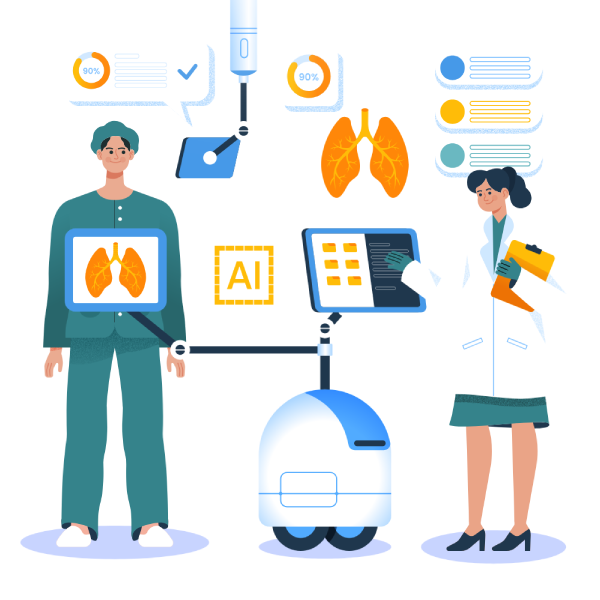
Deep knowledge of specialty-specific coding, compliance requirements, and payer rules to maximize your reimbursements
Need a custom RCM solution?
We serve 45+ medical specialties - Contact us to learn more
Deploying artificial intelligence in the healthcare revenue cycle means operating at the convergence of protected patient data, federal billing regulations, and payer compliance obligations simultaneously, in real time, at scale. Every component of Promantra’s AI revenue cycle management platform is architected from the ground up to satisfy the compliance requirements that healthcare organizations, their legal teams, their payers, and their auditors demand.
Every patient record, clinical document, billing transaction, and payer communication processed through Promantra’s platform operates under strict HIPAA Privacy and Security Rule compliance with AES-256 encryption applied to all PHI in transit and at rest, role-based access controls enforcing the minimum-necessary standard, and immutable audit logs capturing every data access and workflow action across the complete revenue cycle.
Promantra’s AI revenue cycle management platform continuously evaluates billing patterns against OIG compliance benchmarks automatically identifying outlier coding frequencies, potential upcoding risk indicators, documentation specificity gaps, and modifier usage anomalies before they accumulate into the patterns that trigger federal audit scrutiny. Your compliance team sees issues flagged in Promantra’s compliance dashboard in real time before any external auditor would.
When a payer disputes a code assignment or questions a denial appeal rationale, Promantra’s platform delivers a complete, document-level audit trail that maps every AI-generated action every code assigned, every claim scrubbing edit applied, every denial classification made directly back to the specific clinical text, payer policy language, or billing guideline that supported it.




Our certifications and compliance standards ensure your revenue cycle operations meet the highest industry benchmarks for security, accuracy, and regulatory adherence.
Getting started with custom RCM AI development does not require a lengthy procurement process. Promantra’s engagement model is designed for speed, transparency, and zero risk before project kickoff.
Schedule a no-obligation strategy consultation with Promantra’s RCM AI development team. We analyze your current revenue cycle performance, your existing technology stack, and your AI development objectives to define exactly what needs to be built, and why, before any project scoping begins.
Within five business days of your consultation, Promantra delivers a tailored AI development roadmap including recommended AI system architecture, training data requirements, EHR integration approach, compliance framework, estimated build timeline, and projected revenue KPI improvement targets based on your current billing performance data.
Before project kickoff, Promantra models the projected financial impact of each AI component showing your CFO, CTO, and RCM leadership the specific denial rate reductions, A/R compression, and revenue capture improvements the custom AI is expected to deliver, using your own historical claims data as the input.
Complete the form and our RCM experts will contact you within 24 hours
Schedule a personalized demo to see how Promantra’s Healthcare AI Solutions can reduce denials, accelerate reimbursements, and maximize your revenue.
Find Your Revenue Leakage Today