Healthcare finance leaders keep hearing the same three letters everywhere: AI, RPA, and ML. Vendors use them almost interchangeably, which makes it hard to know what you are actually buying. Understanding how these technologies combine is exactly what separates real revenue cycle transformation from another point solution sitting unused six months after go-live.
This guide breaks down what each technology does, where they intersect across the revenue cycle, what 2026 industry data says about the return on AI and RPA in revenue cycle management, and what to watch for before committing a budget. By the end, you will know which questions to ask a vendor and where convergence delivers the biggest financial impact first.
Why AI, RPA, and ML Are Converging Now
For years, RPA in healthcare billing meant simple task automation: bots that clicked through payer portals or copied data between systems. It was useful, but rigid. Change one field on a payer website, and the bot breaks.
What has shifted in 2026 is that RPA bots are increasingly paired with AI and machine learning models that read unstructured documents, predict outcomes, and make judgment calls the old scripts never could. The result is often called intelligent automation, and it is quickly becoming the default expectation. A few forces are driving this: federal prior authorization rules now require faster payer turnaround, denial volumes keep climbing faster than manual review can keep pace, and staffing shortages in billing departments mean fewer hands are available for repetitive work.
To see how these forces translate into practical workflow redesign, explore ProMantra’s healthcare automation solutions.
RPA, AI, and Machine Learning: What Each One Does
Before evaluating the convergence, it helps to separate the three layers. They solve different problems, and a vendor that blurs the distinction is usually selling one and calling it all three.
RPA, the “doing” layer, follows fixed, rules-based logic to move data between systems that were never built to talk to each other: eligibility lookups, claim status checks, copying data from a portal into a billing system. RPA does not think. It executes the same steps every time, which makes it fast and cheap, but brittle when a payer changes a website layout.
AI, the “thinking” layer, handles ambiguity. It reads unstructured clinical notes, interprets denial letters, and makes probabilistic judgments, such as flagging which claims are likely to be denied before submission. Natural language processing and generative models fall here, drafting appeal language in seconds.
Machine learning, the “learning” layer, is a subset of AI that improves its own accuracy by studying historical claims, payer behavior, and denial patterns over time. An ML model gets better at predicting which claims need extra documentation, or which payers tend to underpay a service line, without a human rewriting the rules each time a pattern shifts.
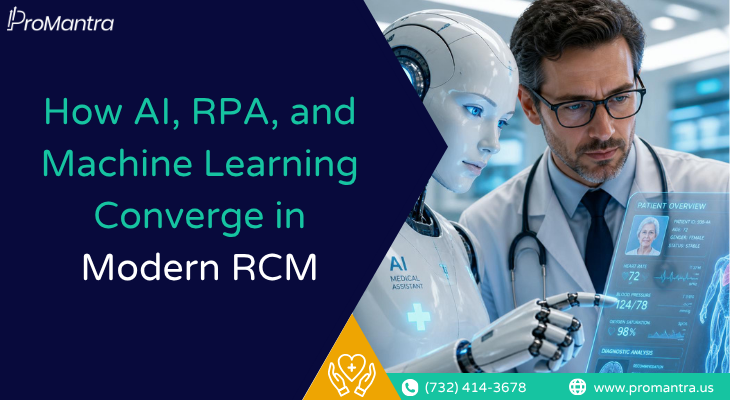
Stitched together properly, RPA executes the transaction, AI interprets the nuance, and ML sharpens the predictions feeding both. That is the real story behind AI and RPA in revenue cycle management, and it is different from running three separate tools side by side with no shared data layer connecting them.
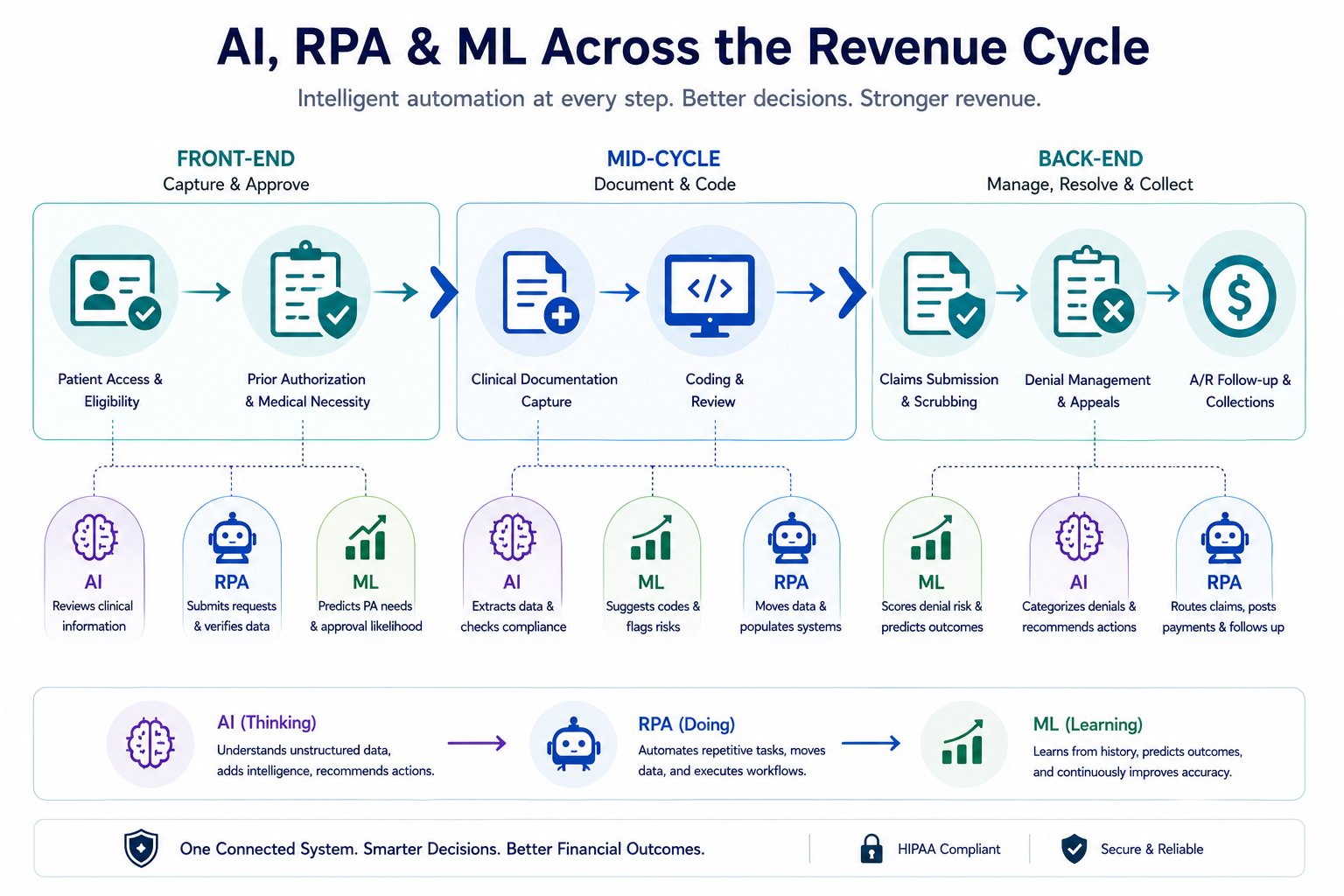
Where Convergence Shows Up Across the Revenue Cycle
AI and RPA in revenue cycle management converge at specific points in the claims lifecycle, and each point carries a different financial payoff worth understanding before the budget gets allocated.
At the front end, machine learning models can flag, before a visit even happens, which cases are statistically likely to need prior authorization based on payer, service, and diagnosis history. RPA then submits the request electronically, while AI reviews clinical documentation to confirm medical necessity criteria are met beforehand. This is one of the fastest-growing use cases in 2026 as CMS rules push payers toward electronic prior authorization.
If prior authorization delays are already a bottleneck for your team, this piece on fixing prior authorization delays is worth a read before evaluating any vendor.
Moving into the mid-cycle, intelligent document processing tools now read discharge summaries, operative notes, and referral documents to extract the service-level detail coders need, cutting manual chart review time. AI-assisted coding tools flag missing documentation before a claim reaches the payer, catching errors that used to surface only after a denial arrived weeks later.
For a closer look at how this document layer works in practice, ProMantra’s blog on intelligent document processing for medical records walks through the mechanics, including where the technology still needs a trained coder reviewing the output.
At the back end, claims scrubbing, denials, and accounts receivable are where convergence pays off most visibly. RPA bots move claims and remittance data between systems. Machine learning models score each claim for denial risk before submission, based on prior payer behavior. When a denial occurs, AI can categorize the reason, recommend the correct corrective action, and in many workflows draft the appeal letter, with a human reviewing before it goes out.
Zero-touch claims workflows depend on exactly this layered structure. ProMantra’s blog on building a zero-touch claims processing workflow goes deeper into how providers are structuring this today.
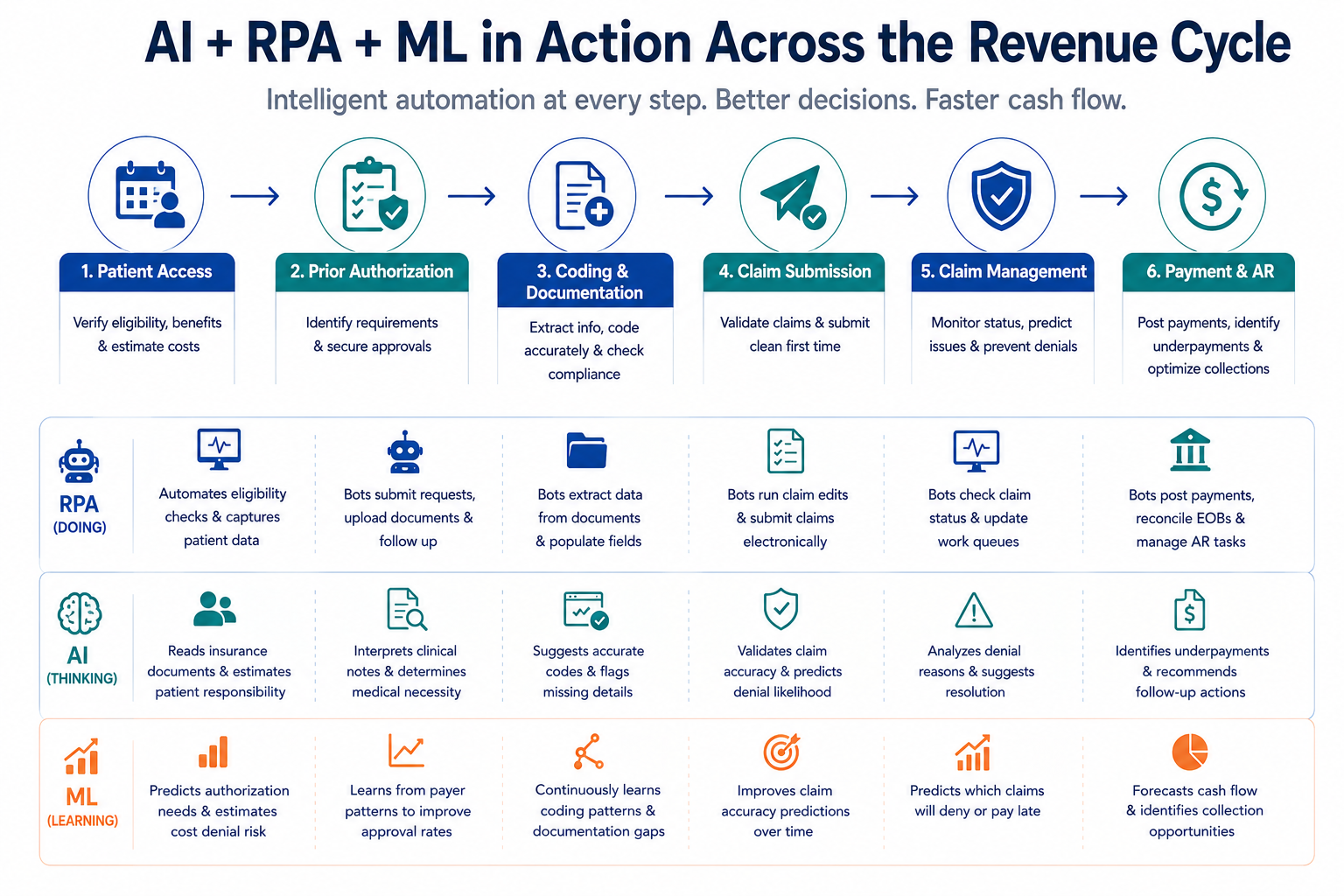
What 2026 Data Says About AI and RPA in Revenue Cycle Management
The financial case for convergence, rather than isolated point tools, is getting clearer with each new industry report. A few figures worth knowing:
- The 2025 CAQH Index, released in early 2026, found that electronic transactions and improved data exchange helped U.S. healthcare avoid an estimated $258 billion in administrative costs, reflecting a 17 percent year-over-year increase in cost avoidance.
- The same index found that more than 50 percent of health plans and 25 percent of provider organizations now use AI tools in administrative workflows, with electronic prior authorization adoption climbing to roughly 40 percent of transactions.
- Despite that progress, CAQH estimates the industry still leaves close to $18.7 billion in medical administrative savings on the table from processes that remain manual or only partially automated, prior authorization chief among them.
- A 2026 MGMA Stat poll found that automation and process fixes together made up more than half of practice leaders’ planned cost-cutting moves for the year, ranking ahead of hiring freezes or new vendor contracts.
Put together, these figures point to one conclusion: the return is real, but it depends on connecting the pieces rather than deploying automation in isolated pockets. Denial management is a good example of a workflow that only pays off once AI and rules-based automation share the same data, and ProMantra’s blog on AI-powered denial management covers what that looks like in practice.
Guardrails: What Convergence Does Not Solve Alone
Layering AI, RPA, and machine learning together is not a plug-and-play fix, and providers who treat it that way tend to be disappointed within the first year.
Physician trust is still building, and recent surveys show a meaningful share remain concerned that AI-driven review could raise denial rates rather than reduce them, which is why human oversight on appeals still matters. Governance also lags adoption in many medical groups, with a formal AI policy often missing even as individual departments use these tools informally. Data quality determines model accuracy above almost everything else, since machine learning is only as reliable as the historical claims it learns from. And fully autonomous claims processing, with no human review at any stage, is still maturing rather than a realistic near-term goal for most organizations.
Data classification and cleansing sit underneath all of this, since even the smartest model cannot compensate for inconsistent, duplicate, or mislabeled source records flowing in from a dozen disconnected systems. ProMantra’s AI data classification and cleansing service exists precisely to solve that upstream problem before any predictive layer gets built on top of it, so the results hold up at production volume instead of degrading within a few months.
None of this is purely a technical decision, either. A CFO evaluating this investment may also want to review our playbook for a proactive revenue cycle strategy, which frames these decisions in board-ready financial terms rather than technical ones.
How ProMantra Brings AI and RPA Together in Revenue Cycle Management
This is the gap ProMantra was built to close. Rather than selling a single automation tool and leaving integration to your internal team, ProMantra combines RPA-driven workflow automation, AI-assisted document and coding review, and machine learning-based denial prediction inside one service, backed by HIPAA and ISO 27001 compliant data handling throughout.
Eligibility checks, prior authorization support, coding accuracy reviews, and denial management all run on the same connected foundation, supported by ProMantra’s own automation platform, RevvPro, instead of disconnected point tools that leave your staff reconciling the gaps manually. Clinical documentation feeds into that same foundation through RPScribe, ProMantra’s dictation and documentation tool, so the data entering the revenue cycle is clean before any predictive model or bot ever touches it.
Practices considering this shift rarely need to rebuild everything at once. The underlying integration work, connecting eligibility systems, EHR data, clearinghouses, and denial workflows into one pipeline, is handled by ProMantra’s healthcare IT solutions team, so your staff are not left stitching point tools together on their own.
Frequently Asked Questions
- What is the difference between RPA and AI in revenue cycle management? RPA follows fixed, rules-based steps to move data between systems, such as checking claim status or eligibility. AI interprets unstructured information and makes probabilistic decisions, such as predicting whether a claim is likely to be denied. RPA does the repetitive work; AI adds judgment.
- Does machine learning replace human coders and billers in RCM? No. Machine learning models flag risk and surface patterns, but a trained coder or biller still reviews edge cases, confirms medical necessity, and handles appeals that require clinical or payer-specific judgment. The goal is fewer manual touches on routine claims, not zero human oversight.
- How long does it take to see ROI from this convergence? Timelines vary by organization size and data quality, but front-end use cases like eligibility verification and prior authorization tend to show measurable savings faster than back-end predictive denial models, which need more historical claims data to train accurately.
- Is AI-driven automation in RCM secure and compliant? It can be, provided the vendor maintains HIPAA and ISO 27001 compliant infrastructure with clear audit trails for every automated decision. Ask any vendor exactly how PHI is handled at each stage before signing.
- Where should a mid-sized practice start with intelligent automation? Most practices see the fastest, most measurable wins by starting at the front end, eligibility verification and prior authorization, before expanding into back-end denial prediction, since front-end automation has clearer data inputs and a shorter learning curve.
Ready to see where AI and RPA in revenue cycle management could reduce denials and speed up your cash flow? Request a free RCM assessment from ProMantra and get a clear, no-obligation look at where intelligent automation would have the biggest financial impact on your organization.