

If you run revenue cycle operations at an Academic Medical Center, you already know one thing: your RCM is not like everyone else’s.
You are not just billing for patient visits. You are managing teaching physician rules, clinical trial billing, graduate medical education (GME) compliance, multi-entity fund flows, and a faculty structure that makes standard billing workflows look simple by comparison. Add to that the constant pressure of payer audits and rising claim denials, and it is easy to see why RCM outsourcing for Academic Medical Centers has become one of the most strategically important decisions a healthcare CFO can make today.
This blog will walk you through exactly what makes AMC revenue cycle management unique, the specific risks you face when outsourcing, what to look for in an RCM partner, and how the right outsourcing strategy can actually strengthen your financial performance without compromising compliance.
What Makes Academic Medical Centers Different from Typical Healthcare Providers
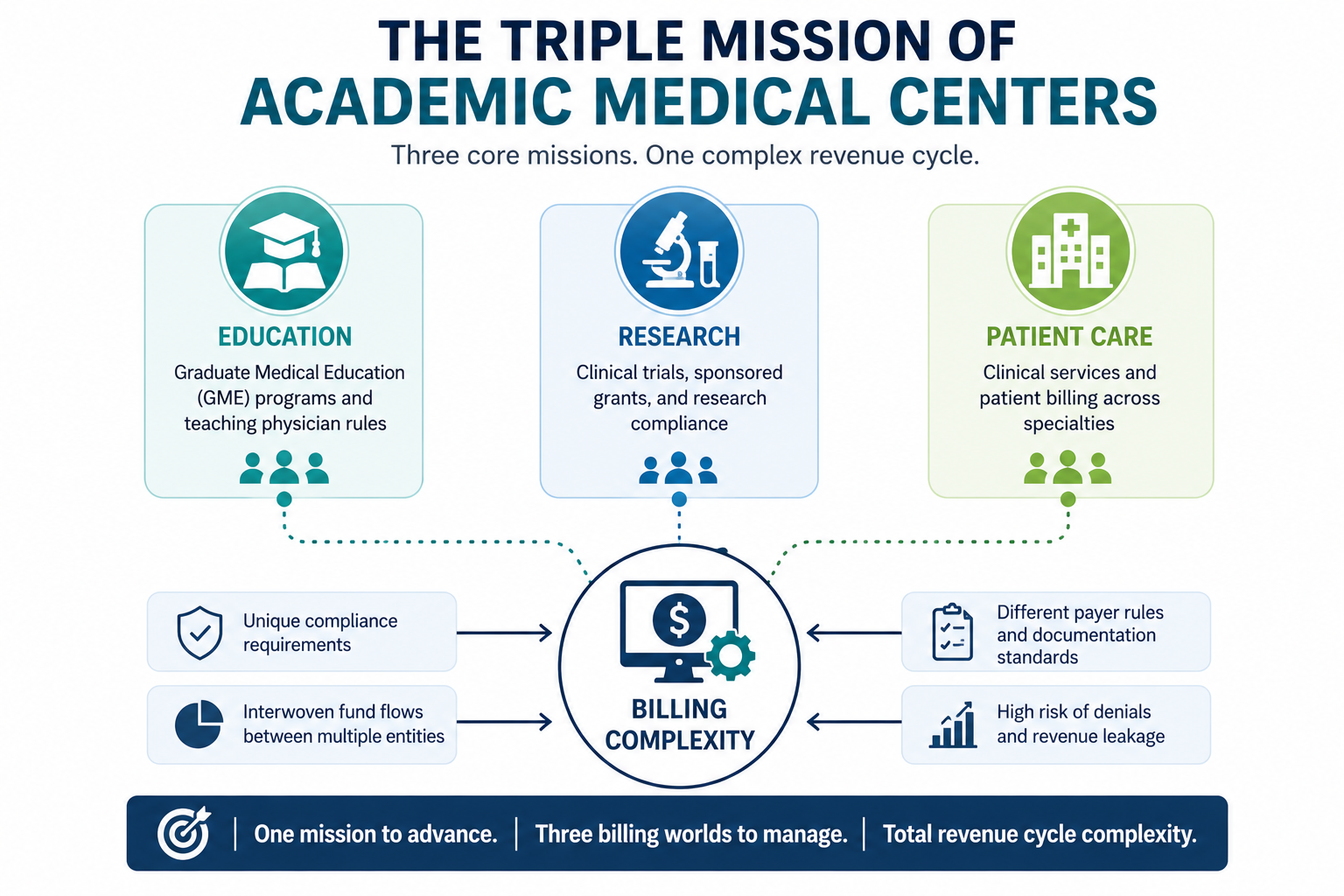
Most hospitals deal with billing, collections, and denial management. AMCs deal with all of that, plus a triple mission that creates complexity at every level of the revenue cycle.
Academic Medical Centers and teaching hospitals operate in an environment with a number of risk areas, including research compliance, financial reporting, and grants management. They are often connected with large universities or medical schools and maintain a mission that includes education, research, and patient care.
This triple mission creates three distinct billing worlds that must coexist under one roof:
- Clinical care billing for patient services
- Research billing tied to clinical trials and sponsored grants
- Educational billing governed by GME and teaching physician rules
Each of these has its own compliance framework, its own set of payer rules, and its own documentation requirements. When any one of them overlaps with another, the billing risk multiplies fast.
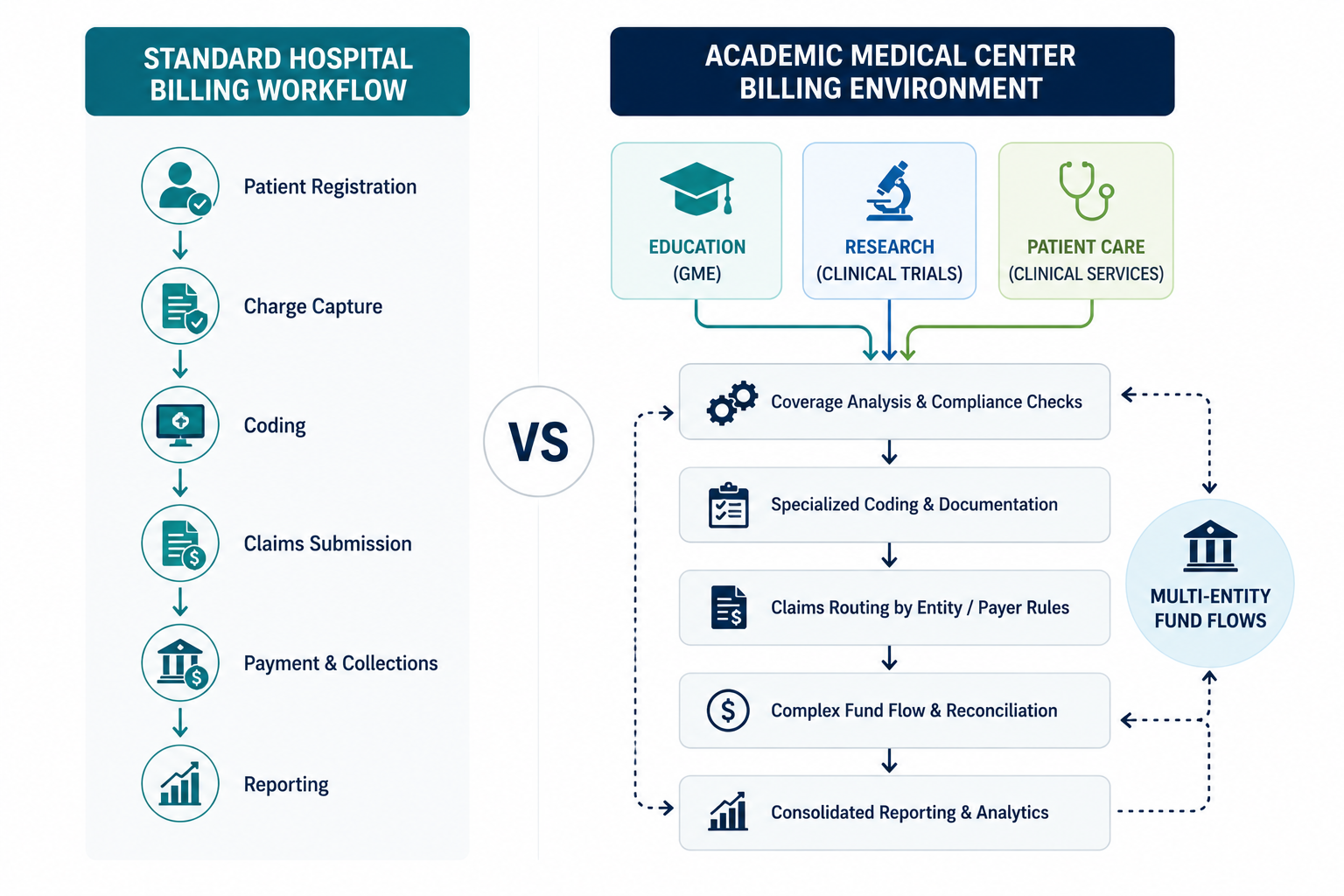
Financial arrangements within this interwoven structure present a unique challenge: funds flow between the health system, medical group, and school of medicine is complex, and reliable benchmarks for these types of funding arrangements are scarce. AMCs also operate in a highly regulated environment with compliance considerations that range from healthcare fraud and abuse laws to IRS insurance regulations to rules governing Medicaid supplemental payments.
The 5 Unique RCM Challenges at Academic Medical Centers
Understanding these five pressure points is essential before you even begin evaluating an RCM outsourcing partner.
1. Teaching Physician Billing Rules
Graduate Medical Education programs create a billing layer that most commercial RCM vendors are simply not equipped to handle.
Medicare makes GME payments to support new physicians’ residencies and training but does not allow additional payment to attending or supervising physicians unless they are involved in direct patient care and meet certain requirements. These requirements are often known as teaching physician billing rules. One medical school in Texas and its partners recently agreed to pay the government $15 million to settle allegations that teaching physician rules were not met.
This is not a theoretical risk. It is a compliance exposure that requires your RCM partner to have coders and billing specialists with deep, specific experience in teaching physician guidelines, including the distinction between general supervision and direct supervision during concurrent procedures.
2. Clinical Trial Billing Compliance
This is one of the most technically complex areas of AMC billing, and one of the most scrutinized by Medicare and other third-party payers.
Academic Medical Centers face a weighty regulatory compliance risk in billing Medicare and other third-party payers for clinical trial services. The culture and structure of many AMCs present significant challenges when attempting to coordinate the necessary information and operations to determine whether clinical trial services can be billed to payers or should be charged to an internal research account that tracks the sponsorship monies or grant award.
The core rule is straightforward: payers should not be billed for services that are either being paid by a research sponsor or that are not part of direct patient care. In practice, applying that rule across dozens of active clinical trials with different sponsors, IRB protocols, and coverage analysis requirements is anything but simple.
An RCM outsourcing partner that does not understand clinical trial billing compliance is not just underperforming, it is a liability.
3. Multi-Entity and Multi-Specialty Billing Complexity
The intricate web of billing rules, faculty compensation structures, compliance requirements, and internal or outsourced revenue cycle management teams that lack specialized experience all add to the challenges that make optimizing revenue difficult for Academic Medical Centers.
AMCs typically bill through multiple legal entities: a hospital, a faculty practice plan, and often multiple subspecialty groups. Each entity may have separate payer contracts, different EHR configurations, and distinct charge capture workflows. Coordinating all of these under a single outsourced RCM model requires deep operational expertise and strong governance.
4. Specialty Coding Depth
AMCs are referral centers. They see the most complex cases, perform rare procedures, and treat high-acuity patients across highly specialized service lines. Coding for cardiology, oncology, neurosurgery, pediatric subspecialties, and transplant programs demands expertise that generic RCM vendors do not carry.
Diligence in clinical documentation, medical coding, and acuity capture has become increasingly more important as payers continue to heavily scrutinize specialty procedures, including those involving pediatrics, cardiology, and orthopedics.
At an AMC, inaccurate coding does not just cost you reimbursement. It also distorts your quality scores, impacts your case mix index, and puts you at greater risk during a Medicare RAC audit.
5. Decentralized Organizational Culture
Academic environments are inherently decentralized. Departments operate with significant autonomy. Faculty physicians have loyalties to their research, their trainees, and their clinical programs, not necessarily to billing workflows.
Even highly regarded AMCs have struggled for years with highly decentralized research activity, with little central support and oversight, creating problems ranging across billing compliance and data integrity.
An RCM outsourcing model that does not account for this culture will face resistance, poor documentation workflows, and inconsistent charge capture across departments.
Why RCM Outsourcing is Still the Right Move for Most AMCs
Despite all of this complexity, Academic Medical Centers RCM outsourcing continues to grow, and for good reason.
A KPMG report highlights that 56% of providers are outsourcing non-core functions like RCM to prioritize clinical excellence. Third-party vendors bring specialized expertise in billing, coding, and collections, along with advanced technologies like automation and AI, which improve efficiency and reduce errors.
Internal RCM teams at AMCs are often stretched thin, dealing with staff turnover, outdated systems, and a growing volume of payer rule changes. Internal RCM teams at AMCs are often stretched thin, dealing with staff turnover, outdated systems, and a growing volume of payer rule changes.The case for outsourcing becomes compelling when you look at what it delivers:
- Reduced administrative burden on faculty and clinical staff
- Faster claims submission and cleaner claim rates
- Specialized expertise in GME, research billing, and multi-specialty coding
- Access to denial management analytics and root-cause reporting
- Scalability during high-volume periods or new program launches
The RCM outsourcing market hit $32 billion in 2024, with projections showing it could reach almost $109 billion by 2033, reflecting a structural shift in how healthcare organizations think about their billing operations.
For AMCs specifically, the question is not whether to outsource. It is who to outsource with and how to structure the engagement to protect compliance while maximizing revenue performance.
What to Look for in an RCM Outsourcing Partner for Academic Medical Centers
Not every RCM vendor is qualified to work with an AMC. Here is a practical checklist to evaluate any prospective partner. Here is a practical checklist to evaluate any prospective partner.
AMC-Specific Experience
Ask directly: have they worked with other Academic Medical Centers? Do they have documented experience with teaching physician billing, clinical trial billing coverage analysis, and GME compliance? Generic healthcare billing experience is not enough.
Specialty Coding Expertise
Your outsourcing partner must have certified coders (CPC, CCS, or specialty-specific credentials) with hands-on experience in the service lines your AMC operates. This includes rare procedure coding, evaluation and management (E/M) documentation, and complication/comorbidity capture for accurate DRG assignment.
Compliance Infrastructure
HIPAA compliance, SOC 2 Type II certification, and enterprise-grade cybersecurity practices are baseline requirements, not differentiators, for any RCM outsourcing partner.
For AMCs, compliance requirements go even further. You need a partner with a documented Business Associate Agreement (BAA), clear audit response protocols, and staff who are trained on healthcare fraud and abuse laws including Stark Law and Anti-Kickback Statute implications in an academic setting.
EHR and Technology Integration
Many AMCs rely on Epic, Cerner, or other large enterprise EHR platforms. Your RCM partner must be able to integrate seamlessly with your existing technology stack, eliminating data gaps between clinical documentation and billing.
Many AMCs rely on outdated or fragmented electronic health record systems that do not integrate seamlessly with billing platforms, leading to inadequate documentation and coding errors that result in underbilling or claim denials.
Transparent Reporting and Governance
You need real-time visibility into key performance indicators: clean claim rate, first-pass resolution rate, denial rate by payer and service line, days in accounts receivable, and net collection rate. A good outsourcing partner provides dashboards, regular performance reviews, and a dedicated account management structure.
Common Mistakes AMCs Make When Outsourcing RCM
Avoid these errors that often derail AMC outsourcing engagements:
- Choosing a vendor based on price alone. Cheap RCM services almost always mean missing compliance expertise, high error rates, and long-term revenue leakage.
- Not defining scope clearly. AMC billing spans hospital billing, professional billing, research billing, and GME-related billing. Your contract must specify which functions are included.
- Underestimating the change management challenge. Faculty and department administrators need to be aligned from day one. Poor internal communication is a common reason outsourcing projects fail.
- Skipping a transition audit. Before going live with a new RCM vendor, audit your existing billing backlog, open AR, and denial inventory so nothing falls through the cracks during the handoff.
- Ignoring clinical trial billing as part of scope. Many RCM vendors explicitly exclude research billing. If your AMC runs active clinical trials, this cannot be an afterthought.
How ProMantra Supports Academic Medical Centers with RCM Outsourcing
At ProMantra, we understand that Academic Medical Centers are not just large hospitals. They are complex, mission-driven organizations where every billing decision carries both financial and compliance weight.
Our Revenue Cycle Management services are built for the kind of complexity AMCs face every day. We bring deep experience in multi-specialty coding, teaching physician documentation review, denial management analytics, and payer contract optimization. We work directly with your clinical and administrative teams to understand your fund flow structure, your active clinical programs, and your compliance priorities before we design your RCM solution.
We do not offer a one-size-fits-all model. We offer a partnership model built on transparency, accountability, and measurable revenue performance.
Whether you are dealing with rising denial rates, compliance gaps in your teaching physician billing, or a fragmented billing infrastructure across multiple entities, ProMantra has the expertise to help you close those gaps and build a stronger financial foundation.
Frequently Asked Questions (FAQs)
Q1. What is the biggest compliance risk in Academic Medical Centers RCM outsourcing?
The biggest compliance risks are teaching physician billing violations and clinical trial billing errors. Both are subject to heavy federal scrutiny and can result in significant financial penalties if not handled by experienced, AMC-specialized RCM staff. Your outsourcing partner must have documented expertise in both areas.
Q2. Can a single RCM vendor handle both hospital billing and faculty practice plan billing for an AMC?
Yes, but it requires careful scope definition and strong technology integration. Many AMCs have separate billing entities for the hospital and the faculty practice group. A qualified vendor can manage both under a coordinated model, provided they have experience with dual-entity billing structures and the compliance requirements for each.
Q3. How does GME affect RCM billing at Academic Medical Centers?
Graduate Medical Education introduces teaching physician billing rules, which govern when and how attending physicians can bill for services performed with residents and fellows in training. Billing for these encounters incorrectly is a common source of compliance violations and over- or under-billing at AMCs. RCM teams must be specifically trained in CMS teaching physician guidelines.
Q4. How do we know if our current RCM model is underperforming at our AMC?
Key warning signs include: denial rates consistently above 10%, days in AR exceeding 50 days, frequent undercoding on complex cases, inability to generate service-line-level billing reports, and recurring compliance findings in internal audits. If any of these apply, an RCM assessment with a specialized vendor like ProMantra can quickly identify where revenue is being left on the table.
Final Thoughts
Academic Medical Centers RCM outsourcing is not a simple procurement decision. It is a strategic choice that touches your compliance posture, your faculty relationships, your clinical programs, and ultimately your ability to sustain the research and education mission that defines your institution.
The right partner will not just process your claims faster. They will bring specialized expertise across teaching physician billing, clinical trial compliance, multi-specialty coding, and denial analytics that your internal team may simply not have the bandwidth to manage alone.
If you are ready to evaluate whether your current RCM model is serving your AMC’s full potential, we would love to start that conversation.
Ready to strengthen your Academic Medical Center’s revenue cycle?
Schedule a Free RCM Assessment with ProMantra today and let our AMC-experienced team identify exactly where your revenue is leaking and how to stop it.