

Your operating margins are shrinking. Denials are piling up. And your AR days are creeping well past the 50-day mark.
If that sounds familiar, you are not alone.
According to the Kaufman Hall National Hospital Flash Report: March 2026 Data, the national year-to-date hospital operating margin stands at just 1.7%, with operating margins down 9% year-over-year and bad debt and charity care per calendar day up 8% over the same period. Drug expenses have climbed 10% year-over-year, and total expenses per calendar day are running 7% higher, while gross revenue continues to outpace net revenue, signaling an accelerating erosion of the payer mix. These are not isolated data points. They represent the financial reality that every healthcare CFO is now managing in real time.
The good news? You have more control than you think.
Revenue Cycle Management is one of the most powerful and immediate levers available to healthcare finance leaders during a cash flow crisis. Unlike capital investments or payer contract renegotiations that take months, targeted RCM interventions can produce measurable results within days or weeks.
In this blog, you will learn exactly which RCM levers to pull, in what order, and how each one directly impacts your bottom line. Whether you are leading a large health system or a multi-specialty group practice, these strategies apply immediately.
RCM Lever 1: Attack Your Denial Backlog : Starting Today
Denials are the single biggest controllable cash flow drain in most healthcare organizations.
If your denial rate is above 5%, you have a recoverable revenue problem sitting right in your own backlog.
What to Do Immediately
Triage by dollar value, not volume. Most billing teams work denials on a first-in, first-out basis. That is a mistake during a cash flow crisis. Sort your denial queue by dollar amount and prioritize the highest-value claims first.
Identify your top denial reasons. Categorize denials by reason code. Are they coding errors? Missing prior authorizations? Eligibility issues? Knowing your top three denial categories lets you target root causes rather than endlessly reworking claims.
Set a 48-hour appeals workflow for high-value denials. Time is money. The longer a denied claim sits, the harder it becomes to collect. High-value denials should have a dedicated appeals path with a 48-hour response target.
Track your denial overturn rate. Best practice is a denial overturn rate above 60%. If yours is lower, you need better documentation and stronger appeal templates.
At ProMantra, our denial management teams are trained to identify denial patterns at the payer level, not just the claim level. That means we fix root causes, not just individual claims.
RCM Lever 2: Compress Your AR Days Aggressively
Days in Accounts Receivable (AR) is your cash flow speedometer.
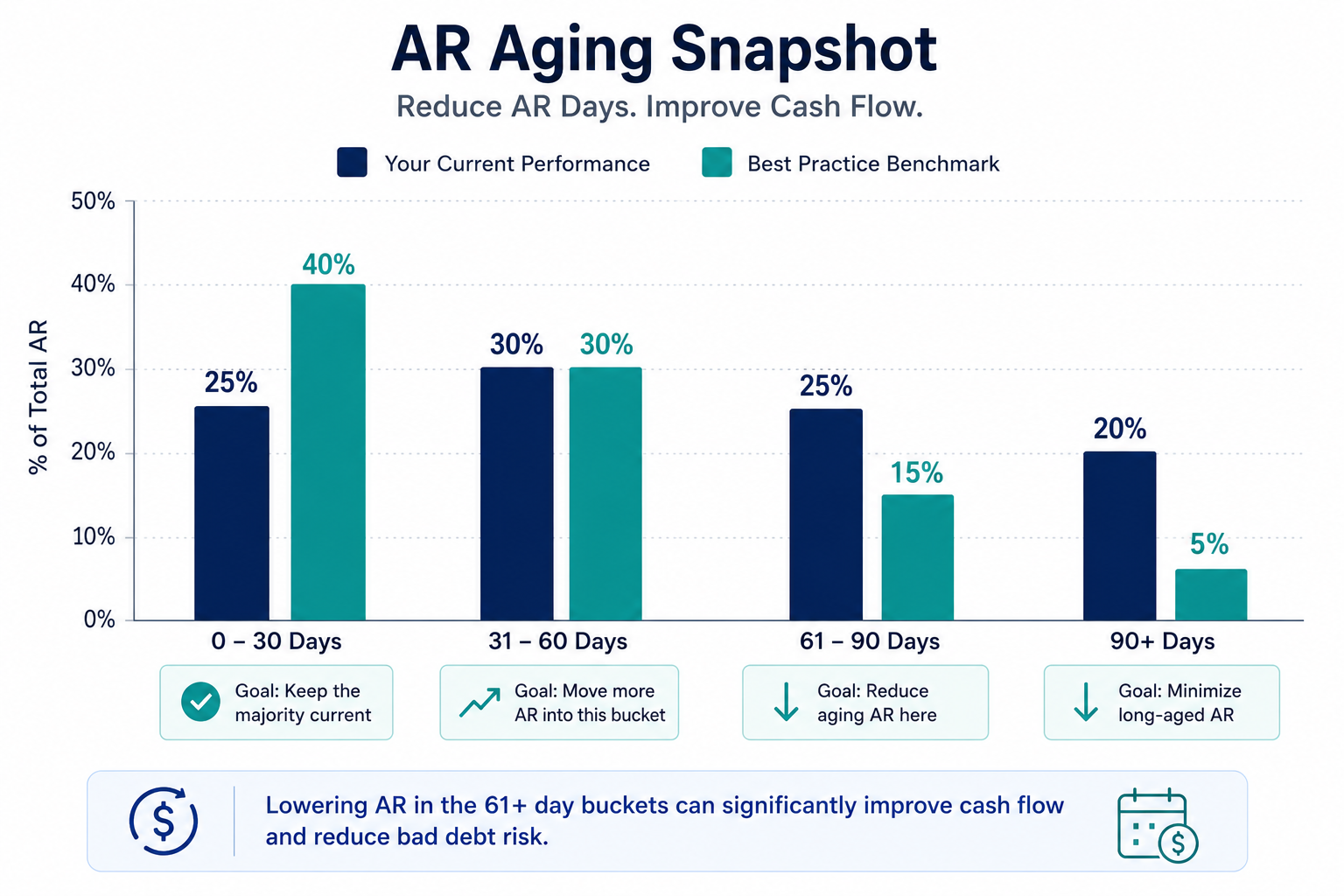
The national average for AR days in healthcare is approximately 30 to 60 days. But high-performing practices consistently maintain sub-30-day AR. If yours is above 50 days, you are sitting on cash that should already be in your account.
Immediate AR Reduction Strategies
- Segment your AR by payer and age bucket. Focus first on claims in the 60 to 90-day bucket before they age beyond timely filing limits.
- Automate claim status follow-up. Manual phone calls to payers are one of the biggest time wasters in billing. Automated claim status tools reduce follow-up time by up to 40%.
- Submit clean claims on the first pass. A Clean Claim Rate above 95% indicates billing accuracy and reduces delays in reimbursement by 15 to 30 days. Getting the claim right the first time is always faster than correcting and resubmitting.
- Write off uncollectable AR correctly. Inflated AR numbers from uncollectable old claims give you a false picture of your financial health. Clean your AR buckets so your reporting is accurate and actionable.
RCM Lever 3: Fix the Front End Before Claims Are Submitted
Here is a truth most CFOs learn too late: most denials are caused at the front end of the revenue cycle, not in the billing department.
Eligibility errors, missing authorizations, and incorrect patient demographics are all upstream issues that create massive downstream revenue problems.
Front-End Fixes That Pay Off Fast
Run real-time eligibility verification at scheduling. Confirming coverage before the patient arrives prevents the most common denial type, which is eligibility and coverage issues. This is a same-day fix with immediate impact.
Implement prior authorization tracking workflows. Payers are tightening prior authorization requirements across the board, especially for imaging, specialty procedures, and elective care. Physicians and their staff now spend an average of 12 to 14 hours per week navigating authorization protocols. Automating this workflow reduces both administrative burden and denial risk.
Collect patient financial responsibility upfront. With high-deductible health plans now the norm, patient collections have become a major cash flow variable. Collecting copays, deductibles, and estimated balances at the point of service dramatically reduces your post-service collection burden.
Verify provider credentialing and payer enrollment. Credentialing gaps are a silent revenue killer. A single provider credentialing issue can result in weeks of unpaid claims.
RCM Lever 4: Accelerate Patient Collections Without Damaging Relationships
The shift to high-deductible health plans means a larger portion of your revenue now depends on collecting directly from patients.
More than 40% of Americans report having medical debt, and 25% say they have no way to pay it. That is a collection environment that demands both urgency and empathy.
Smart Patient Collection Tactics
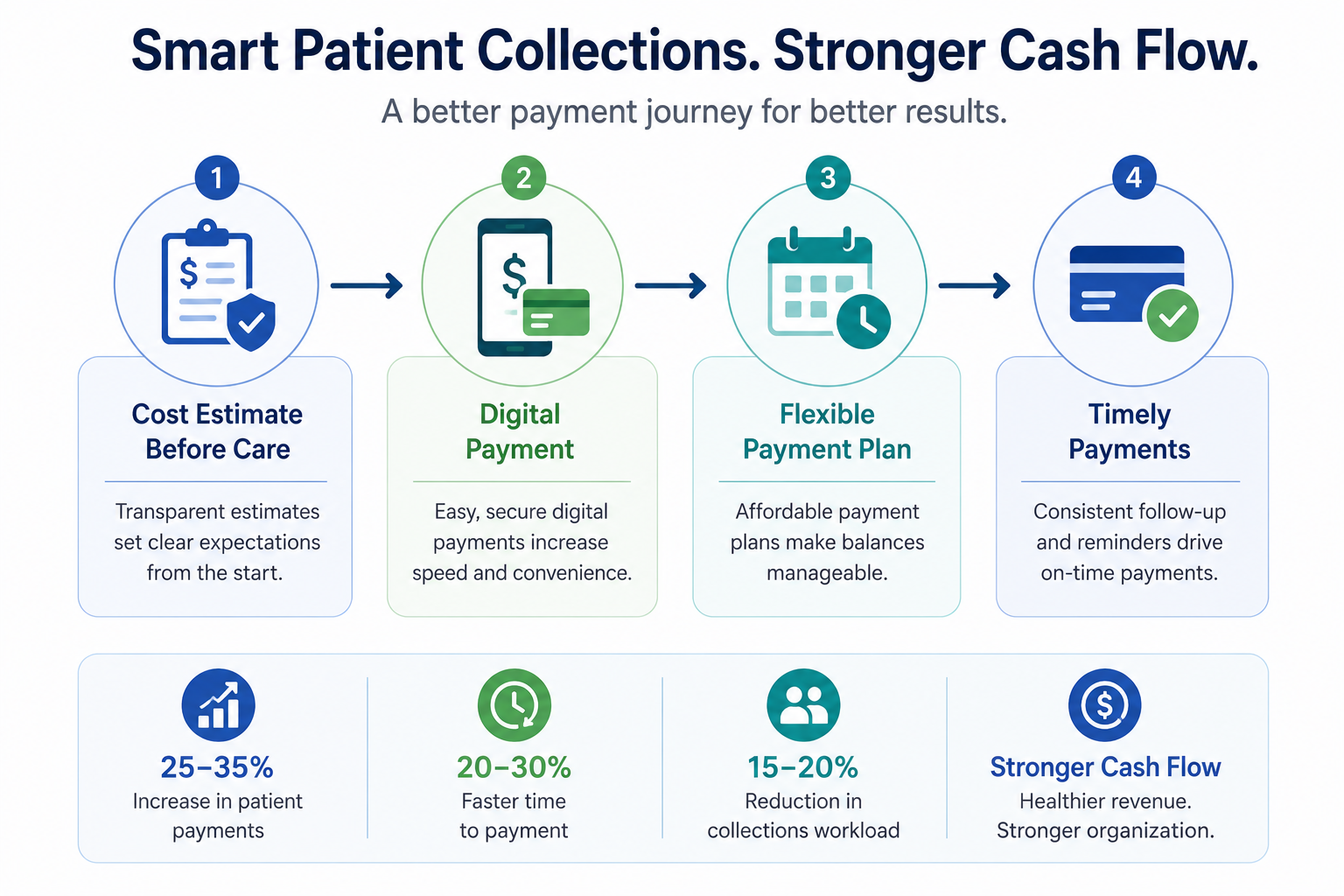
- Offer transparent cost estimates before care. Patients who are surprised by bills are far less likely to pay them. Pre-service financial counseling and accurate cost estimates improve collection rates and patient satisfaction simultaneously.
- Launch digital payment options immediately. Text-to-pay, online patient portals, and automated payment reminders significantly increase patient payment rates with minimal staff effort.
- Introduce flexible payment plans. Breaking large balances into manageable monthly payments converts unpaid balances into predictable cash flow rather than write-offs.
- Use automated payment reminder sequences. A well-designed communication cadence (day 7, day 14, day 30) consistently outperforms one-time paper statements.
These are not just patient experience improvements. They are direct cash flow interventions.
RCM Lever 5: Use Data to Identify Where Revenue Is Leaking
You cannot fix what you cannot see.
Most healthcare organizations experiencing a cash flow crisis are operating with lagging, incomplete financial data. Across the industry, a significant majority of CFOs say their current RCM analytics are insufficient for revenue predictability decisions at the executive level.
That gap between the data you have and the data you need is costing you real money.
What to Measure Right Now
Focus on these six KPIs as your cash flow crisis dashboard:
| KPI | Best Practice Benchmark |
| AR Days | Under 30 days |
| Clean Claim Rate | Above 95% |
| Denial Rate | Below 5% |
| Net Collection Rate | Above 96% |
| Denial Overturn Rate | Above 60% |
| Cost to Collect | 3 to 5% of net revenue |
If any of these metrics fall outside best practice ranges, you have found a cash flow lever. Pull it.
ProMantra provides CFOs with real-time RCM dashboards that track all of these KPIs across every payer, specialty, and location. No more waiting for end-of-month reports to discover problems that started four weeks ago.
RCM Lever 6: Consider Outsourcing High-Volume, Low-Complexity Billing Tasks
During a cash flow crisis, every resource needs to be deployed where it creates the most value.
If your internal billing team is spending the majority of their time on routine claim submission and follow-up, they are not available to focus on high-value denial appeals, payer escalations, and revenue integrity work.
Industry data shows that a growing majority of health system revenue cycle leaders are actively restructuring outsourcing contracts in favor of technology-first solutions. The case for strategic outsourcing has never been stronger.
Outsourcing routine RCM tasks to a specialized partner like ProMantra gives you:
- Immediate capacity to handle claim backlogs
- Access to specialized payer knowledge and denial expertise
- Scalability without the cost of hiring and training new staff
- Technology-enabled workflows that reduce manual errors
- Performance accountability tied to actual collection outcomes
The goal is not to hand off your revenue cycle. It is to use the right resources for each part of it.
RCM Lever 7: Renegotiate Payer Contracts Armed With Data
Most healthcare CFOs renegotiate contracts on a schedule. During a cash flow crisis, you may not have that luxury.
If a specific payer is consistently denying claims at a rate above your overall average, that data is a negotiation asset. Use it.
How to Approach Payer Contract Reviews During a Crisis
- Pull denial data by payer for the last 90 days.
- Identify payers with denial rates significantly above your average.
- Document the financial impact in dollar terms.
- Request a payer relations meeting with denial data in hand.
- Use the data to push for reimbursement adjustments, streamlined authorization processes, or revised documentation requirements.
This is not a confrontational approach. It is a data-driven business conversation. Payers respond to documentation. Give it to them.
Putting It All Together: A 30-Day Cash Flow Crisis Action Plan
Here is a practical sequence for implementing these RCM levers immediately:
Week 1 : Stop the Bleeding
- Triage and prioritize your denial backlog by dollar value
- Activate real-time eligibility verification
- Identify your top three denial reason codes
Week 2 : Accelerate Cash In
- Launch digital patient payment options
- Implement 48-hour appeals workflows for high-value denials
- Begin AR segmentation by payer and aging bucket
Week 3 : Fix the Root Causes
- Address front-end eligibility and authorization gaps
- Clean up inflated AR by correctly writing off uncollectable balances
- Establish weekly denial tracking by payer
Week 4 : Build Visibility and Accountability
- Deploy a real-time RCM KPI dashboard
- Review payer contracts using denial data
- Evaluate outsourcing options for high-volume billing tasks
Thirty days is enough time to see measurable movement in your cash flow, if you take action on the right levers in the right sequence.
FAQs: Cash Flow Crisis Management in Healthcare RCM
Q1: What is the fastest RCM lever a CFO can pull during a cash flow crisis? Denial management delivers the fastest cash flow impact because you are recovering revenue that has already been earned. Prioritize your highest-dollar denied claims, implement a 48-hour appeals workflow, and track overturn rates weekly. Most organizations see measurable improvement within two to four weeks.
Q2: What is a healthy AR days benchmark for healthcare providers? High performers maintain AR days below 30, with 31 to 40 days considered acceptable by industry benchmarks. Anything above 50 days signals a cash flow problem that requires immediate attention to claim submission speed, denial follow-up, and patient collections.
Q3: How does front-end RCM work affect cash flow? Front-end RCM, including eligibility verification, prior authorization, and patient financial counseling, is responsible for preventing the majority of downstream denials. Fixing upstream issues is more cost-effective and faster than appealing denials after the fact. A clean claim rate above 95% is the goal, and most of that improvement starts before the patient even arrives.
Q4: When should a healthcare CFO consider outsourcing RCM during a cash flow crisis? Outsourcing becomes a strong option when your internal team is overwhelmed by volume, denial backlogs are growing faster than staff can address them, or your technology infrastructure is limiting performance. A specialized RCM partner like ProMantra can deploy immediately without the time cost of hiring and onboarding, providing both capacity relief and expertise where you need it most.
Conclusion: Your Cash Flow Crisis Is a Revenue Cycle Problem and Revenue Cycle Has Solutions
A cash flow crisis in healthcare is serious. But it is also fixable.
The RCM levers described in this blog are not theoretical strategies. They are proven, actionable interventions that healthcare CFOs across the country are using right now to recover revenue, compress AR days, reduce denial rates, and stabilize financial performance.
The key is moving quickly and in the right sequence, starting with the interventions that produce the fastest cash flow impact and building toward long-term structural improvements.
ProMantra specializes in helping healthcare providers activate these exact levers. From denial management and AR optimization to full-cycle RCM outsourcing, our teams are built to deliver measurable financial results, not just operational activity.
Ready to Stabilize Your Cash Flow?
If your organization is facing a cash flow crisis, the time to act is now, not next quarter.
Request a Free RCM Assessment with ProMantra and let our revenue cycle experts identify exactly where your revenue is leaking and what we can do to recover it fast.