The Change Healthcare ransomware attack did not just make headlines. It permanently changed how the entire U.S. healthcare industry thinks about vendor risk. When it hit, 94% of hospitals reported financial impact, and 33% said it disrupted more than half of their revenue. Claims stopped. Cash flow froze. And thousands of providers were left scrambling for answers.
Two years on, the ripple effects are still being felt. Healthcare CFOs who once treated data security as an IT concern now understand it as a boardroom issue.
If you are considering outsourcing your revenue cycle management, or you already have a vendor in place, this blog is for you. Data security in outsourced RCM is no longer just an IT checkbox. It is a financial and legal risk that lands squarely on the CFO’s desk.
In this guide, you will learn exactly what to verify, what questions to ask, and what red flags to watch for before you hand over your most sensitive patient and financial data to a third-party RCM partner.
Why Data Security in Outsourced RCM Deserves a CFO’s Full Attention
Most CFOs focus on cost reduction, clean claim rates, and days in accounts receivable when evaluating an RCM partner. Security often gets delegated down the chain. That is a costly mistake.
The numbers paint a sobering picture of just how much is at stake:
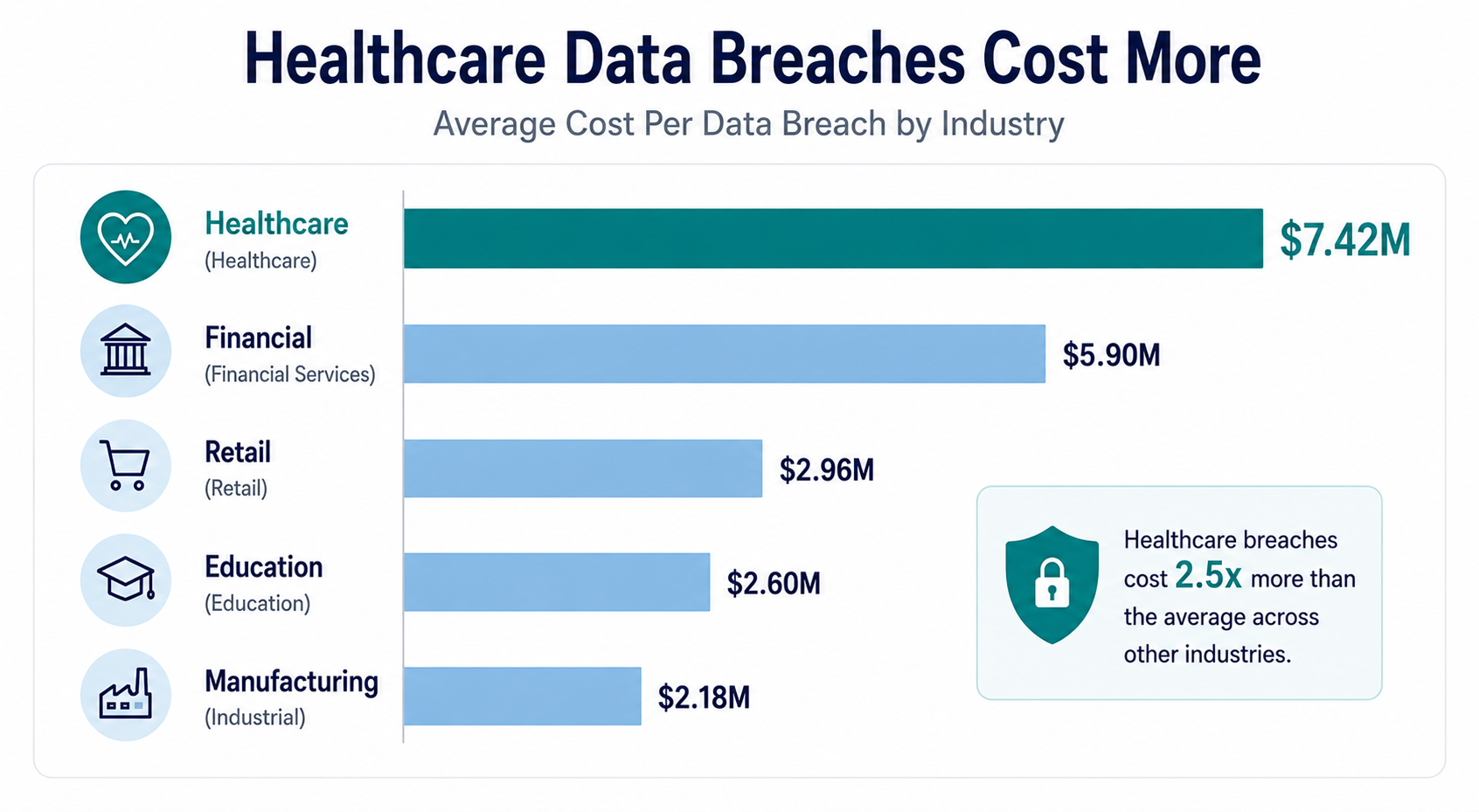
- The average healthcare data breach now costs $7.42 million per incident, with total industry losses exceeding $21.9 billion from ransomware downtime in a single year.
- PHI records sell for up to $1,200 each on the dark web, making them 80 times more valuable than stolen credit card data.
- Healthcare has recorded more than 700 large data breaches annually for three consecutive years, as reported to the HHS Office for Civil Rights, and the trend shows no signs of slowing.
- 94% of healthcare organizations report that vendors have access to their internal systems, and 72% grant high-level permissions.
That last point is the most telling. Your RCM vendor sits deep inside your data environment. They touch patient billing records, insurance data, clinical codes, and financial transactions every single day. If they are not securing that data to the highest standard, your organization carries the legal and financial consequences.
The Real Risk: Third-Party Vendors Are Now the Primary Attack Target
Cybercriminals have shifted strategies. Rather than attacking a single hospital, they now target the vendors who serve thousands of providers simultaneously.
The Russian ransomware group ALPHV BlackCat used this exact playbook with Change Healthcare. They breached a single Citrix remote access portal that lacked multi-factor authentication, sat undetected for nine days, and then encrypted systems that processed 15 billion healthcare transactions annually.
More recently, Horizon Healthcare RCM, a revenue cycle management firm in Indiana, disclosed a ransomware attack, where a threat group exfiltrated sensitive claims processing data affecting patients across multiple provider accounts.
The message is clear. An RCM vendor is not just a service provider. It is a potential attack surface. And without strong data security in outsourced RCM, that attack surface becomes your liability.
8 Things Every Healthcare CFO Must Verify Before Signing an RCM Contract
1. Confirm They Have a Signed Business Associate Agreement (BAA)
Before any PHI changes hands, a Business Associate Agreement must be in place. This is not optional under HIPAA. It is the law.
A BAA legally binds your RCM vendor to protect your patient data. But not all BAAs are created equal. When reviewing the agreement, make sure it includes:
- Specific permitted uses and disclosures of PHI
- Security obligations aligned with HIPAA’s administrative, physical, and technical safeguards
- Breach notification timelines (many organizations now push for 24 to 72 hours rather than the HIPAA maximum of 60 days)
- Right-to-audit provisions
- Data return or secure disposal procedures at contract end
- Controls over subcontractors or downstream processors
If your vendor hesitates to sign a detailed BAA or pushes back on audit rights, walk away. For a broader look at cybersecurity best practices for RCM, see our detailed guide.
2. Ask for Their ISO 27001 Certification and HIPAA Compliance Documentation
Certifications tell you that an independent third party has verified the vendor’s security controls, not just what the vendor claims on their website.
The two things you should ask for are:
- ISO 27001 Certification:
This internationally recognized standard verifies that a vendor has built and maintains a structured Information Security Management System. It covers physical, technical, and organizational controls that protect sensitive data like PHI and financial records. Certification is only granted after a rigorous independent audit and must be renewed regularly to stay valid. - HIPAA Compliance Documentation:
Ask for their Security Risk Assessment, a corrective action plan addressing any identified gaps, and written confirmation of how their controls align with HIPAA’s administrative, physical, and technical safeguard requirements.
When you review these documents, do not just accept a certificate. Ask about the scope: Were PHI-handling systems included? When was the certification last renewed? What findings or non-conformities were identified, and how were they resolved?
3. Verify End-to-End Encryption Protocols
Every piece of Protected Health Information that moves between your systems and your RCM vendor should be encrypted, both in transit and at rest.
Ask your vendor specifically:
- Do you use AES-256 encryption for data at rest?
- Is all data transmission secured with TLS 1.2 or higher?
- How are encryption keys managed and rotated?
- What happens to data stored on portable devices or cloud environments?
Vendors who cannot answer these questions clearly are not ready to handle your data. As more RCM workflows shift to automated platforms, robust encryption becomes even more critical across ProMantra’s healthcare automation solutions.
4. Review Their Access Control and Role-Based Permissions Model
Not every employee at your RCM vendor should have access to your full patient dataset. A strong security posture requires what is known as the “minimum necessary” standard, a core HIPAA principle.
Ask how they implement access controls:
- Do they use Role-Based Access Control (RBAC), where each employee can only see data relevant to their specific job function?
- Is multi-factor authentication (MFA) enforced for all system access?
- How are access permissions reviewed and revoked when an employee changes roles or leaves?
- Do they maintain audit logs of who accessed what data and when?
The Change Healthcare attack succeeded partly because a single access portal lacked multi-factor authentication. That one missing control cost the entire U.S. healthcare system billions of dollars. Do not let a similar oversight expose your organization.
5. Demand a Documented Incident Response Plan
When a breach happens, the speed and quality of the response directly determines the financial and legal damage. Your vendor must have a tested, documented incident response plan before you engage them.
The plan should clearly outline:
- How quickly they will notify you in the event of a breach or suspected breach
- Who the designated security officer is and how they are reached 24/7
- Their process for containing, investigating, and remediating an incident
- How they coordinate with your internal compliance and legal teams
- Their process for notifying affected individuals and regulatory bodies
A vendor without a documented and rehearsed incident response plan is leaving both of you exposed.
6. Evaluate Their Disaster Recovery and Business Continuity Capabilities
Data security in outsourced RCM is not only about preventing attacks. It is also about ensuring that your revenue cycle keeps running if something goes wrong.
Ask for documented evidence of their:
- Recovery Time Objective (RTO): How long before systems are back online after a disruption?
- Recovery Point Objective (RPO): How much data could be lost in the worst-case scenario?
- Frequency of backup testing and failover drills
- Geographic redundancy of data centers
After the Change Healthcare attack, 60% of affected hospitals required two weeks to three months to resume normal operations. That kind of downtime in your RCM operations means missed claims, delayed reimbursements, and a direct hit to cash flow.
Strong disaster recovery and business continuity planning is a core pillar of ProMantra’s healthcare IT solutions, ensuring your RCM operations stay resilient.
7. Check Their Employee Security Training and Background Screening Practices
Human error and insider threats remain among the top causes of data breaches in healthcare. Around 25% of healthcare employees lack adequate phishing awareness training, making staff the weakest link in many organizations.
When evaluating your RCM partner, ask:
- How often do they conduct security awareness training for all employees?
- Do they run simulated phishing exercises?
- What background screening is completed before hiring employees who will access PHI?
- How do they handle offshore or nearshore staff who may operate in different regulatory environments?
This is especially important if your RCM vendor operates any part of their team offshore. The security protocols need to be consistent regardless of where the work is performed.
8. Insist on Regular Security Audits and Your Right to Audit
Your vendor should not just complete one security audit when they onboard a client and then go silent for years. Data security in outsourced RCM requires ongoing, continuous verification.
The contract should give you:
- The right to request security documentation at any time
- Access to the results of penetration tests and vulnerability scans
- Notification if any third-party audit findings are material to your data
- Annual security attestations or updated SOC 2 reports
Industry best practices require vendors to conduct penetration testing and vulnerability scans regularly to identify and remediate weaknesses before attackers find them first.
The ProMantra Approach to Data Security in Outsourced RCM
At ProMantra, data security is not an afterthought. It is a foundational part of how we deliver Revenue Cycle Management services to healthcare providers across the United States.
We operate with strict HIPAA compliance protocols, maintain signed BAAs with all client engagements, and follow role-based access control standards to ensure that PHI is only accessible to authorized personnel working on your account.
Our team undergoes regular security awareness training, and our systems like RevvPro platform, are built on encrypted, access-controlled infrastructure designed to meet the security expectations of modern healthcare organizations.
When you partner with ProMantra, you are not just outsourcing your revenue cycle. You are partnering with a team that treats your patient data with the same responsibility and care you would.
Red Flags to Watch For During Vendor Evaluation
Not every RCM vendor has invested adequately in data security. Here are warning signs that should prompt serious concern:
- They cannot produce a current ISO 27001 certification or equivalent HIPAA-compliant documentation
- They are unwilling to sign a detailed BAA or negotiate audit rights
- They do not have a documented and tested incident response plan
- They use vague language like “we follow best practices” without any supporting evidence
- Their breach notification timeline defaults to 60 days rather than 24 to 72 hours
- They cannot describe their encryption standards or access control policies in clear terms
- They have no dedicated security officer or compliance team
Any one of these gaps should give you pause. Multiple gaps together should be a dealbreaker.
A Quick CFO Verification Checklist
Before finalizing your outsourced RCM partnership, use this checklist:
✔ Signed HIPAA-compliant BAA with full security obligations
✔ ISO 27001 certification
✔ AES-256 encryption for data at rest and TLS for data in transit
✔ Multi-factor authentication enforced across all access points
✔ Role-Based Access Control with audit logging
✔ Disaster recovery plan with tested RTO and RPO metrics
✔ Regular employee security training and phishing simulations
✔ Background checks for all staff accessing PHI
✔ Right-to-audit written into the service contract
✔ Documented subcontractor security obligations
✔ Documented incident response plan with breach notification under 72 hours
Frequently Asked Questions
Q1. What is the biggest data security risk when outsourcing RCM?
The biggest risk is vendor-side breaches, where a cyberattacker targets your RCM partner to gain access to thousands of provider records at once. The Change Healthcare attack is the most high-profile example. Vetting your vendor’s security posture before engagement is your strongest defense.
Q2. Is a Business Associate Agreement enough to protect my organization legally?
A BAA is a legal requirement under HIPAA, but it does not guarantee security. It defines responsibilities and assigns liability but does not prevent breaches. You need to combine a strong BAA with verified technical controls like encryption, MFA, and access logging to truly protect your organization.
Q3. How often should an RCM vendor’s security be reassessed?
At minimum, you should request updated security documentation annually, updated penetration test results, and confirmation that the incident response plan is current. Many healthcare compliance experts recommend a formal review every six months for high-risk vendor relationships.
Q4. What should offshore RCM teams be held to in terms of data security?
The same standards as domestic teams. HIPAA applies to all entities and their business associates regardless of geography. Your BAA must include obligations for any offshore team members, and you should verify that the same encryption, access control, and training protocols are applied globally across your vendor’s workforce.
The Bottom Line for Healthcare CFOs
Outsourcing your revenue cycle can deliver real operational and financial benefits. But data security in outsourced RCM is not something you can afford to gloss over during vendor selection.
The threat landscape has shifted. Attackers now specifically target RCM vendors because breaching one vendor means breaching hundreds of providers. The financial, legal, and reputational consequences of a single breach can dwarf the savings you achieve through outsourcing.
Your job as a CFO is not just to protect the bottom line today. It is to protect the organization from risks that could threaten its financial future.
Verify before you trust. Audit before you renew. And partner with vendors who treat data security as seriously as you do.
Ready to Talk to an RCM Partner You Can Trust?
At ProMantra, we help healthcare providers across the United States streamline their revenue cycle without compromising on data security or compliance.
Whether you are evaluating your current vendor’s security posture or looking to make a switch, our team is ready to walk you through exactly how we protect your patient data at every step of the revenue cycle.
Schedule a Free Consultation with ProMantra Today and discover how a security-first approach to outsourced RCM can protect your organization while improving your financial performance.