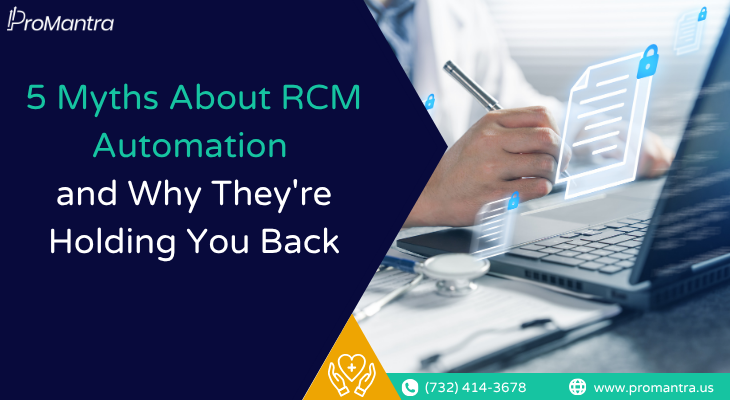
If you’ve put off automating your revenue cycle because of something you heard at a conference or read in a vendor pitch, you’re not alone. Plenty of healthcare leaders are working from outdated assumptions about what RCM automation actually does.
That hesitation has a cost. Recent industry survey data shows close to 60% of healthcare providers still haven’t implemented AI or automation anywhere in their revenue cycle operations, even though most executives agree it’s a top priority. The gap between intention and action usually comes down to myths, not facts.
In this post, we’re breaking down the five biggest myths about RCM automation and replacing them with what’s actually true in 2026. By the end, you’ll know exactly which assumptions are safe to drop and how to think about automation as a practical tool for your billing team, not a leap of faith.
Why These Myths Persist
Revenue cycle leaders aren’t wrong to be cautious. Healthcare finance is high-stakes, tightly regulated, and unforgiving of mistakes. A denied claim or a compliance slip isn’t a minor inconvenience; it’s real money and real risk.
But that caution has curdled into myths that no longer match how RCM automation actually works. Here’s what’s really going on with each one.
Myth #1: “RCM Automation Will Replace My Billing Staff”
This is the myth that stops conversations before they start. Practice administrators picture automation as a staff-reduction plan, and understandably, nobody wants to walk into that conversation with their team.
Here’s the reality: automation isn’t designed to replace your billing staff. It’s designed to take repetitive, rules-based tasks off their plates so they can focus on the work that actually needs human judgment.
Think about what eats up a biller’s day:
- Manually checking insurance eligibility for every patient
- Re-entering the same data across multiple systems
- Chasing down the status of claims that are just sitting in a queue
- Correcting simple coding or formatting errors before submission
None of that requires a trained biller’s expertise. What does require expertise is:
- Appealing a complex denial with payer-specific documentation
- Negotiating with patients on payment plans
- Investigating unusual reimbursement patterns
- Handling escalations that automation correctly flags but can’t resolve
According to a 2026 healthcare finance workforce survey, teams struggling with staffing shortages are turning to automation specifically to stretch existing staff further, not to shrink headcount. The billers who felt threatened by automation five years ago are often the same ones now saying they can’t imagine going back to manual eligibility checks.
Myth #2: “Automation Is Too Expensive for Smaller Practices”
This myth comes from picturing RCM automation as one giant, all-or-nothing software purchase. That’s not how it works anymore.
Modern RCM automation is modular. You don’t have to automate your entire revenue cycle on day one. Most practices start with a single high-volume, low-complexity task and expand from there.
A phased approach typically looks like this:
- Start with eligibility verification. It’s high-volume, rules-based, and delivers immediate time savings.
- Add claims status checks. Automating the “where is my claim” follow-up frees up hours every week.
- Layer in automated denial management worflows. Once the basics are running smoothly, automated denial workflows catch issues before they become write-offs.
- Expand to prior authorization and payment posting as your team gets comfortable with the technology.
CAQH Index research consistently shows that moving high-frequency, low-complexity transactions like eligibility checks from manual to electronic processes generates the fastest, most measurable savings, often before a practice ever touches its more complex workflows.
The bigger financial risk isn’t the cost of automation. It’s the ongoing cost of manual errors. One in three hospitals now reports bad debt levels exceeding $10 million, a clear signal of just how much revenue leaks out through inefficient, manual collection processes. Smaller practices bleed the same percentage, just in smaller dollar amounts that are easier to overlook until they add up.
Myth #3: “Automation Increases Compliance Risk”
This one seems logical on the surface. More technology touching patient financial data feels like more exposure. But the opposite is usually true.
Manual processes are where compliance risk actually lives. Human error accounts for a large share of billing mistakes, from mistyped codes to missed documentation requirements to inconsistent handling of payer rules that change constantly.
Well-implemented RCM automation platforms create something manual processes can’t: a complete, unchangeable audit trail for every action taken. That means:
- Every eligibility check is logged with a timestamp
- Every claim submission follows the same validated rule set every time
- Every payer policy update gets applied consistently across all claims, not just the ones a biller remembers to double-check
Consistency is the real compliance advantage. A machine doesn’t get tired at 4 p.m. on a Friday and skip a step. It applies the same validated logic to claim one and claim one thousand.
That said, automation isn’t a compliance guarantee on its own. It has to be built on a secure, HIPAA-compliant foundation with proper data governance. That’s why the vendor or partner you choose matters just as much as the technology itself. Look for ISO 27001 certification and demonstrated HIPAA compliance as baseline requirements, not nice-to-haves.
Myth #4: “Automation Doesn’t Work for Complex Specialties”
Practice administrators in specialties with intricate billing rules, think surgery centers, behavioral health, or physical therapy, often assume automation is built for simple, high-volume claims and won’t hold up against their complexity.
It’s true that early automation tools were often narrow, single-task solutions. That’s changed. Modern automation platforms are increasingly built around predictive analytics and machine learning models trained specifically on payer behavior patterns, not generic rule sets.
For complex specialties, automation now handles things like:
- Predicting which claims are likely to be denied before submission, based on historical payer patterns
- Flagging documentation gaps that are specific to specialty billing requirements
- Tracking prior authorization requirements that vary by procedure, payer, and even by patient plan
- Applying continuously updated payer rule changes without waiting for someone to manually research the update
A 2026 healthcare leadership survey found that improving documentation and coding accuracy is now one of the top two areas where revenue cycle leaders are prioritizing automation investment, specifically because of how much complexity these specialties carry.
The honest caveat here: automation for complex specialties works best when it’s paired with people who understand that specialty’s billing nuances. A tool that flags a potential denial is only useful if someone on your team, or your outsourced RCM partner, knows how to act on that flag correctly.
Myth #5: “We Can Just Buy Software and Set It Up Ourselves”
This might be the most expensive myth on the list. Automation is often sold as plug-and-play, and then practices discover it isn’t, usually after they’ve already spent the budget.
The real barrier to successful RCM automation usually isn’t the technology itself. It’s implementation. Common failure points include:
- Legacy system integration issues. Many practices run older EHR and billing systems that weren’t built to connect easily with modern automation tools.
- Underestimating change management. Staff need training and a clear understanding of new workflows, not just a login credential.
- Having no clear starting point. Practices that try to automate everything at once tend to stall out; the ones that succeed pick a specific, high-impact process first.
- No ongoing optimization. Automation isn’t “set it and forget it.” Payer rules change, and the system needs regular tuning to keep pace.
This is exactly where a lot of internal automation projects lose momentum. It’s not that the software fails. It’s that nobody budgeted the time for proper implementation, staff training, and ongoing maintenance.
A recent McKinsey-affiliated analysis estimated that AI and automation could unlock as much as $360 billion in annual savings across healthcare, but that figure assumes organizations actually implement these tools correctly, with the right governance and oversight in place. Buying the software is the easy part. Making it work inside your specific revenue cycle is where expertise matters.
What This Means for Your Practice
None of these myths hold up against how RCM automation actually functions today. What does hold true is this: automation delivers the best results when it’s implemented thoughtfully, with the right technology, the right sequencing, and the right expertise guiding the rollout.
That’s often where outsourcing part or all of your revenue cycle management makes more sense than building an in-house automation program from scratch. A growing number of hospitals and health systems are already expanding their RCM outsourcing relationships specifically to get access to automation expertise without the internal build-out cost and risk.
This is exactly the gap ProMantra fills for healthcare providers across the U.S. As a revenue cycle management partner, ProMantra combines automation-driven workflows, like real-time eligibility verification, denial prevention, and streamlined claims follow-up, with experienced RCM specialists who understand the nuances of specialty billing and payer behavior. Every process runs on a HIPAA-compliant, ISO 27001-certified infrastructure, so providers get the efficiency of automation without adding compliance risk.
If you’ve been holding off on RCM automation because of one of these five myths, the smarter move isn’t to keep waiting. It’s to talk to a partner who can show you exactly where automation fits your specific revenue cycle, and where experienced human judgment still needs to lead.
Ready to see what RCM automation could actually do for your practice? Contact ProMantra today to schedule a free revenue cycle assessment and find out where automation can start delivering results for you.
Frequently Asked Questions
- Does RCM automation eliminate the need for billing staff? No. RCM automation handles repetitive, rules-based tasks like eligibility checks and claims status follow-ups. Billing staff remain essential for complex denial appeals, patient communication, and judgment-based decisions that automation can’t make on its own.
- Is RCM automation only affordable for large hospital systems? Not anymore. Most practices start small, automating a single process like eligibility verification, and expand gradually. This phased approach keeps costs manageable for practices of any size.
- Can RCM automation handle complex specialty billing? Yes, when it’s built on predictive analytics trained for specific payer behavior and specialty requirements. It works best when paired with staff or a partner who understands the specialty’s billing nuances.
- Does adding automation increase compliance risk? Properly implemented automation actually reduces compliance risk by creating consistent, auditable processes. The key is choosing automation built on a secure, HIPAA-compliant, ISO 27001-certified foundation.
- Why do some in-house RCM automation projects fail? Most failures come down to implementation, not the technology itself. Common issues include poor legacy system integration, insufficient staff training, and lack of ongoing optimization as payer rules change.