Every denied claim is revenue that was already earned but never collected. Every undercoded encounter is money left on the table. Every delayed payment chips away at cash flow that your practice depends on to function.
The problem is that most revenue cycle teams are still fighting these battles after the fact. By the time a denial lands in the worklist, the opportunity to prevent it is gone.
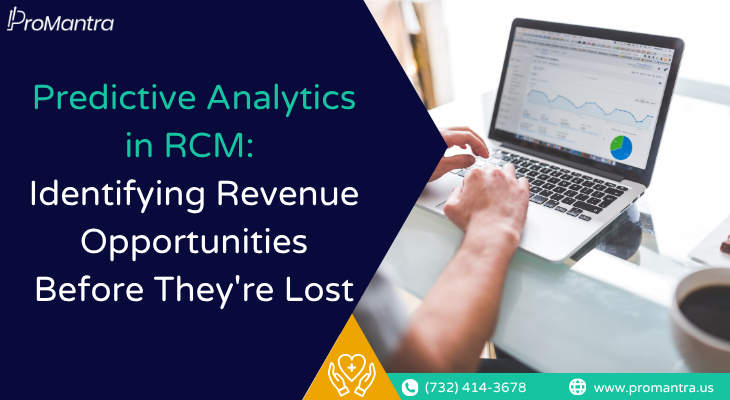
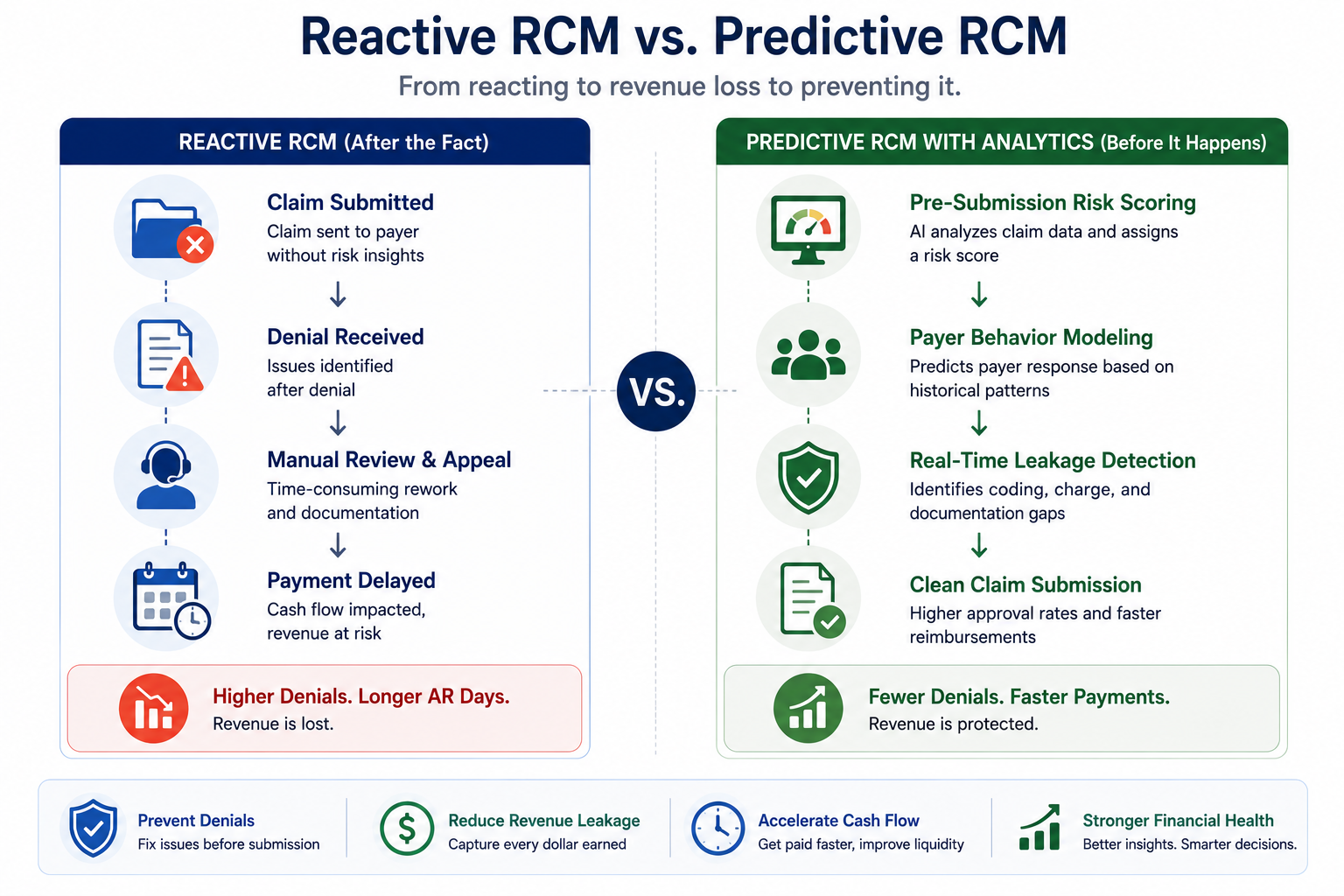
Predictive analytics in RCM changes that equation entirely. Instead of reacting to revenue loss, it helps you see it coming. Using historical data, machine learning models, and real-time claim signals, predictive tools identify exactly where revenue is at risk before a claim is ever submitted.
In this guide, you will learn what predictive analytics in RCM actually does, where it delivers the biggest financial impact, and how forward-thinking provider organizations are using it to protect revenue at every stage of the cycle.
The Scale of the Problem: Why Reactive RCM Is No Longer Enough
The financial pressure on U.S. healthcare providers in 2026 is significant. Clean claim rates, meaning the percentage of claims accepted without rework, average just 75 to 80 percent across the industry, according to HFMA benchmarks. That means roughly one in five claims requires some form of correction before it results in payment.
The cost compounds quickly. Premier has estimated that U.S. hospitals spend approximately $19.7 billion annually overturning denials, at roughly $57 per reworked claim. Meanwhile, a 2026 industry survey of revenue cycle leaders found that 76.47 percent ranked reducing denials and rework as their top operational priority for the year.
The underlying issue is structural. Traditional RCM workflows are designed to process claims and fix problems after submission. That approach made sense when payer rules were simpler and denial rates were manageable. In today’s environment, where initial denial rates have climbed to 10 to 15 percent at many organizations and payer complexity keeps increasing, reactive workflows create a permanent backlog.
Predictive analytics in RCM addresses the root cause rather than the symptom. It shifts the question from “why was this claim denied?” to “how do we prevent this claim from being denied in the first place?”
What Predictive Analytics in RCM Actually Does
At its core, predictive analytics in RCM combines historical claims data with machine learning models to estimate what will happen before it happens. The system learns from thousands of past claim outcomes and uses that learning to flag risk patterns in current claims, before submission.
In practical terms, this includes:
- Pre-submission claim risk scoring: Each claim in the submission queue receives a risk score based on payer history, coding patterns, documentation completeness, and prior authorization status. High-risk claims are flagged for human review before they go out.
- Payer behavior modeling: Machine learning models study how specific payers respond to specific procedure codes, diagnosis combinations, and modifier usage. The model predicts whether a given payer will deny, delay, or reduce payment on a claim.
- Revenue leakage detection: Automated systems audit charges in real time, catching undercoded encounters, missing charges, and duplicate billing before finalization.
- A/R prioritization: Rather than working accounts in chronological order, predictive tools score outstanding claims by their likelihood and timing of payment, allowing teams to focus energy where it generates the most return.
- Cash flow forecasting: Machine learning models analyze payer payment patterns, seasonal trends, and claim aging to project 30, 60, and 90-day revenue with far greater accuracy than static reports.
These capabilities aren’t theoretical; they’re built into platforms like RevvPro’s automation platform, which combines claim risk scoring with real-time payer behavior tracking. The result is a revenue cycle that anticipates problems instead of cataloguing them. The result is a revenue cycle that anticipates problems instead of cataloguing them.
Five Areas Where Predictive Analytics Protects Revenue
1. Denial Prevention Before Submission
This is the highest-value application. Industry research published in 2026 found that organizations adopting predictive analytics in healthcare RCM have reported 20 to 30 percent reductions in denial rates. The math is straightforward: preventing a denial at the front end costs far less than appealing one after the fact.
Predictive systems scan claims against hundreds of payer-specific rules, current authorization requirements, and historical denial reason codes. When a claim pattern matches a known denial trigger, the system flags it before submission and routes it for correction.
HFMA research from April 2026 confirms that AI-driven predictive denial analytics, combined with clean front-end processes, represents the most cost-effective approach to denial reduction available to providers today. For a deeper look at how AI is transforming denial management end-to-end, see our related breakdown.
2. Smarter Appeal Investment
Not every denied claim is worth appealing. Predictive analytics helps organizations determine which denials to chase based on historical overturn rates, appeal preparation costs, and claim dollar value.
According to RCM Trends data published in February 2026, organizations using predictive appeal analytics have improved their appeal success rates from the industry average of 40 percent to between 60 and 65 percent, simply by focusing resources on cases most likely to be overturned.
This is not about working harder. It is about working on the right accounts.
3. Real-Time Revenue Leakage Detection
Revenue leakage refers to lost or delayed income caused by errors, missed charges, or unaddressed payer issues in the billing process. It is often invisible without automated audit tools.
Predictive systems can identify undercoded encounters, unbilled procedures, and duplicate charges as they occur rather than during a monthly audit. For high-volume practices, this real-time detection can recover significant revenue that would otherwise slip through unnoticed.
According to a 2026 healthcare technology analysis, revenue leakage detection improves by up to 27 percent when data is unified across patient access, coding, and billing workflows a shift, closely tied to broader real-time claims processing capabilities reshaping the industry.
4. Accurate Cash Flow Forecasting
One of the most immediate benefits of predictive analytics in RCM is financial planning accuracy. Machine learning models can project revenue using current claim volume, payer mix, authorization approval rates, and historical collection timelines.
A June 2026 Black Book Research survey of 882 provider-side executives found that 66 percent said current RCM analytics are insufficient for CFO-level revenue predictability decisions. Predictive forecasting directly addresses this gap, giving finance leaders a reliable view of expected cash position weeks in advance rather than days after the fact. For PE-backed provider groups under pressure to show consistent EBITDA performance, this is where revenue cycle intelligence built for PE-backed provider groups becomes especially valuable.
This matters enormously for staffing decisions, capital expenditure planning, and negotiating positions with payers.
5. Patient Payment Propensity Scoring
Predictive analytics also applies to the patient side of the revenue cycle. By analyzing factors such as payment history, coverage type, balance size, and engagement patterns, systems can assign each patient account a propensity-to-pay score.
Collections teams can then prioritize outreach to accounts most likely to resolve, personalize the communication approach based on predicted responsiveness, and avoid spending disproportionate time on accounts unlikely to yield payment without escalation.
This targeted approach improves collection rates while reducing the administrative burden on staff.
The Four Types of RCM Analytics: Where Predictive Fits In
Predictive analytics does not operate in isolation. High-performing revenue cycles use all four analytics types together.
- Descriptive analytics looks backward. It answers: What happened? What were our denial rates last quarter? What was our average AR by payer?
- Diagnostic analytics digs into root causes. It answers: Why did our denial rate increase? Which CPT codes are generating the most write-offs?
- Predictive analytics looks forward. It answers: Which claims in today’s queue are likely to be denied? What will our cash collections look like next month?
- Prescriptive analytics recommends action. It answers: What should we do right now to fix the issue identified by the predictive model?
Organizations that invest only in descriptive reporting, which is the majority, are essentially driving while staring at the rearview mirror. Predictive and prescriptive analytics move the visibility to the windshield.
Common Mistakes Organizations Make Without Predictive Analytics
Healthcare organizations that rely on reactive RCM workflows tend to repeat the same costly mistakes.
- Working denials without pattern analysis. Teams rework individual claims without ever surfacing the systemic issue driving them. The same denial reason code reappears month after month.
- Treating all denied claims equally. Equal effort on every account ignores the reality that some denials have a 70 percent overturn rate and others have less than 15 percent. Without predictive scoring, teams waste time on unwinnable cases.
- Using static reports for financial planning. Month-end reports tell you what happened 30 days ago. Predictive forecasting tells you what will happen in the next 30 days, which is what CFOs actually need.
- Ignoring pre-submission risk. Submitting claims without pre-submission validation means finding out about documentation gaps and coding errors only after payers respond, which can be weeks later.
- Missing revenue leakage in real time. Quarterly charge audits catch errors far too late. Revenue that was never billed cannot be recovered after timely filing limits expire.
Each of these mistakes is preventable with the right analytics infrastructure in place.
How to Build a Predictive Analytics Capability in Your Revenue Cycle
You do not need to overhaul your entire RCM infrastructure on day one. The most effective implementations follow a phased approach.
Start with data quality. Predictive models are only as good as the data they learn from. Standardize denial categories, clean historical claims data, and establish baseline metrics including denial rate, write-off rate, AR days, and first-pass resolution rate. Providers with fragmented legacy data often need AI-driven data classification and cleansing before a predictive model can be trained reliably.
Identify high-impact pilots. Select one payer or one high-volume service line for initial deployment. Measure prediction accuracy, percentage of claims reviewed before submission, and ROI of prevention against your baseline.
Integrate across systems. Connect your practice management software, EHR, clearinghouse, and payer portals via API-based integrations. Real-time data flow is a prerequisite for real-time risk scoring.
Establish new performance metrics. Beyond traditional RCM KPIs, track metrics specific to predictive performance: anticipated denial rate, percentage of at-risk claims corrected before submission, and appeal success rate.
Scale from pilots. Once a pilot demonstrates measurable impact, expand the model to additional payers, service lines, or facilities. Build continuous learning into the workflow so models adapt as payer rules evolve.
According to McKinsey and Company, AI applied to the revenue cycle could lead to a 30 to 60 percent reduction in cost to collect over time, according to the HFMA Revenue Cycle of the Future survey published in April 2026. The key phrase is “over time”: organizations that begin building predictive capabilities now will compound those gains as the models mature.
Why ProMantra Clients Gain a Predictive Advantage
Most healthcare practices do not have the internal bandwidth to build and maintain predictive analytics infrastructure on their own. The data science expertise, the historical claims dataset required for model training, and the integration complexity all represent significant barriers.
ProMantra bridges that gap as a specialized RCM outsourcing partner for U.S. healthcare providers, backed by ProMantra’s healthcare automation solutions that combine claims risk scoring, payer behavior tracking, and revenue leakage detection into a single workflow. Operating under HIPAA compliance and ISO 27001 certification, we provide the analytical rigor that turns raw claims data into actionable revenue intelligence.
For practices looking to move from reactive billing to proactive revenue protection, ProMantra offers the infrastructure, expertise, and ongoing process refinement to make that shift without adding internal overhead.
Frequently Asked Questions
Q1. What is predictive analytics in RCM and how is it different from standard reporting?
Standard RCM reporting is descriptive. It tells you what has already happened, such as last month’s denial rate or last quarter’s AR days. Predictive analytics in RCM uses machine learning models trained on historical claims data to forecast future outcomes, including which current claims are likely to be denied, which accounts are likely to pay, and what cash flow will look like over the next 30 to 90 days. The fundamental difference is the direction: reporting looks backward, predictive analytics looks forward.
Q2. Can small and mid-size practices benefit from predictive analytics, or is it only viable for large health systems?
Predictive analytics is viable for practices of all sizes, particularly when delivered through an experienced RCM outsourcing partner. The barrier for smaller practices is not the concept but the infrastructure: building proprietary models requires significant data volume and technical expertise. Partnering with an RCM provider that already has this infrastructure allows smaller practices to access the same analytical capabilities that large health systems deploy internally.
Q3. Which stage of the revenue cycle benefits most from predictive analytics?
Pre-submission claim risk scoring typically delivers the highest return on investment because it prevents denials before they occur rather than recovering revenue after a denial has already been issued. That said, predictive tools also add significant value at the A/R prioritization stage, where they help collections teams focus on the accounts most likely to yield payment, and at the cash forecasting stage, where they improve financial planning accuracy for CFOs.
Q4. How does predictive analytics address the rising volume of Medicare Advantage denials?
Medicare Advantage payers have some of the most complex and frequently updated authorization and medical necessity requirements in the industry. For CFOs weighing the broader financial impact, our guide to Medicare Advantage growth and its financial implications for CFOs covers the payer-mix shift in more depth. Predictive models that track payer-specific behavior can identify which MA plans are more likely to deny specific procedure codes or diagnosis combinations and flag those claims for additional documentation or pre-authorization review before submission. This targeted pre-submission intervention is particularly effective for reducing MA denial rates.
Q5. What data does a predictive analytics system in RCM need to function effectively?
Effective predictive models require historical claims data including claim outcomes, denial reason codes, payer IDs, CPT and ICD-10 codes, modifier usage, and patient coverage information. Integration with the EHR, practice management system, and clearinghouse enables real-time scoring. The more complete and well-organized the historical dataset, the more accurate the model’s predictions. Most organizations need at least 12 to 24 months of clean historical claims data to build reliable predictive models.
Conclusion and Call to Action
Revenue is not lost all at once. It slips away one denied claim, one missed charge, one uncollected balance at a time. Predictive analytics in RCM is the most powerful tool available today to stop that leakage before it starts.
The organizations that will outperform their peers in 2026 and beyond are not those working the hardest on denial appeals. They are the ones that have built the foresight to prevent those denials from happening in the first place.
If your practice is ready to move from reactive billing to proactive revenue protection, ProMantra can help. Our HIPAA-compliant, ISO 27001-certified RCM teams combine deep billing expertise with data-driven workflows designed to identify and protect revenue at every stage of the cycle.
Request a free RCM performance assessment today and find out exactly where your revenue opportunities are before they’re lost.