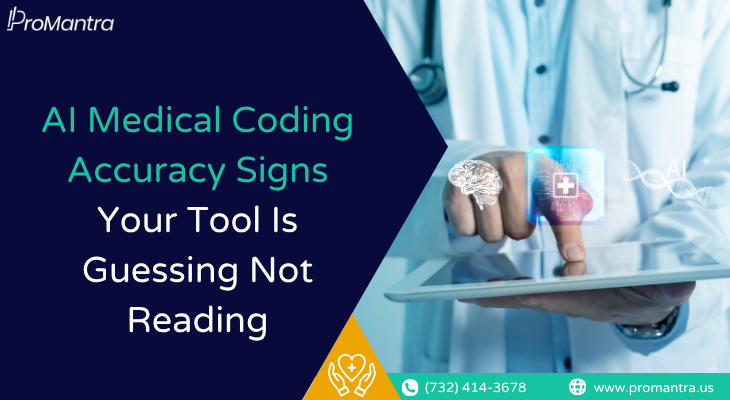
Your AI coding tool assigns a code in under two seconds. It looks confident. The claim goes out clean. Then, three weeks later, a payer denial lands, and the reason has nothing to do with what the physician actually documented.
This is the quiet risk behind AI medical coding accuracy claims that vendors love to print on their homepages. A model can produce a plausible-looking code without ever grounding that code in the actual clinical note in front of it. It pattern-matches. It predicts what usually comes next in similar-sounding notes. That is not the same thing as reading documentation.
For CFOs, practice administrators, and RCM leaders evaluating an AI coding platform, the difference matters more than any accuracy percentage on a vendor slide. Here is how to recognize when your tool is guessing, and what a documentation-first system looks like in practice.
Why AI Medical Coding Accuracy Depends on What the Model Reads
Every large language model based coding engine predicts the most statistically likely output given an input. When that input is a full, detailed clinical note, a well-built system reads specific phrases, cross-references coding guidelines, and produces a code tied directly to documented evidence.
When the input is thin or ambiguous, a poorly grounded model does something different. It fills the gap with whatever code most commonly appears in similar contexts, whether or not the documentation actually supports it. Researchers building fidelity-checking frameworks for clinical coding note that many current systems still lean heavily on statistical association rather than verified extraction from the source note, according to a 2026 clinical NLP paper.
Genuine medical coding services built for documentation fidelity treat every code as a claim that must be defensible against the original note, not a probability to optimize.
The Warning Signs Your AI Coding Tool Is Guessing
Guessing rarely announces itself. It hides behind clean-looking output, but a few patterns tend to surface once you know where to look.
- Identical codes across dissimilar notes. If two encounters with meaningfully different documentation produce the same code set, the model may default to a common pattern instead of reading the specifics.
- No traceable link between code and text. If the tool cannot show which sentence supports a given code, there is nothing to audit. Confidence without a citation is a guess wearing a lab coat.
- Codes that outpace the documentation. When a code implies detail or severity the note never states, the model has filled in missing information rather than flagged it.
- Flat confidence regardless of note quality. A tool reading carefully should behave differently on a thorough note versus a sparse one.
- Silence on contradictions. A system that is actually reading flags conflicting statements. One that is guessing silently picks one and moves on.
A 2026 review of AI coding platforms noted production accuracy benchmarks ranging from 90 to 97 percent, but the same review pointed out that benchmark scores and real-world documentation fidelity are not always measured the same way. See ProMantra’s guide on how NLP is transforming medical coding accuracy for more on what genuine language understanding looks like versus surface-level pattern matching.
The Real Cost of Coding Guesswork
Coding guesswork does not fail quietly. It fails at the claim, the audit, or the payer contract review, usually all at once. A 2026 healthcare finance analysis pegs the annual cost of billing and coding errors to the US system above 210 billion dollars, a figure that includes denials and rework tied to coding accuracy gaps.
Guessed codes fail in three specific ways. First, they generate denials that look like documentation issues but are actually model confidence issues, sending your team down the wrong root-cause path. Second, they create audit exposure, since a guessed code has no defensible trail back to the note if a payer asks for one. Third, they quietly erode internal trust in automation, slowing adoption of tools that could otherwise help.
This is why denial management services increasingly start further upstream than the claim itself, since coding accuracy is now treated as the first line of denial prevention rather than an afterthought once a claim bounces back.
How to Test Your AI Coding Tool for Documentation Fidelity
You do not need to take a vendor’s accuracy claim at face value. A few structured tests reveal whether a tool is reading or guessing, using charts you already have.
Run a blind chart audit. Pull twenty to thirty recent charts your certified coders already reviewed manually. Run them through the AI tool without revealing the expected outcome, then compare line by line, noting where the AI added detail the chart never contained.
Track code-to-note traceability. Ask the vendor to show, for every assigned code, the exact passage that supports it. If the system cannot produce that trail on demand, it is likely operating on pattern prediction rather than grounded extraction. Reviewing how clinical documentation improvement practices intersect with coding accuracy helps frame what strong source documentation should look like before you run this test.
Watch for pattern repetition. Feed the system two notes describing genuinely different severity levels but similar chief complaints. A documentation-reading system differentiates the codes, while a guessing system frequently will not, because it responds to surface similarity rather than the specifics in the note.
Stress-test with incomplete notes. Submit a note missing details a coder would normally query the physician about. A well-built tool flags the gap, while a guessing tool often fills it in anyway, because producing an answer is what the model was optimized to do.
Where Autonomy Should Stop and Review Should Start
Some vendors now market fully autonomous coding as the end goal, but autonomy without verification is exactly where guessing hides best. It is worth understanding where agentic AI in healthcare RCM automation reaches its practical limits before assuming a tool can safely run without oversight on every chart type your practice handles.
Platforms built around medical coding AI solutions that pair automated extraction with certified coder oversight are specifically designed to catch these failure points before a claim ever leaves the building.
Building a Human-in-the-Loop Safety Net
The fix for guessing is not necessarily slower coding. It is coding that knows when to ask for help. The strongest AI coding deployments in 2026 route routine, well-documented encounters straight through automation and send ambiguous or low-confidence cases to a certified coder for verification before submission, rather than removing human coders from the process entirely.
A properly tuned RCM human in the loop model treats confidence scoring as a triage tool, not a rubber stamp. High-confidence charts move fast, while low-confidence or conflicting charts stop for a second set of eyes, protecting both accuracy and speed rather than trading one for the other.
Governance matters as much as the underlying model here. Regular sampling audits and a documented escalation path for flagged charts help confirm a tool is still reading, not drifting back toward guessing as documentation styles or payer rules shift.
This is why intelligent document processing matters just as much as the coding layer sitting on top of it, since a coding engine can only be as reliable as the extraction step that feeds it.
Questions to Ask Your AI Coding Vendor Before You Sign
A short list of direct questions tends to separate documentation-first vendors from pattern-matching ones fast, often within a single sales call.
- Can you show a code-to-text citation for any output, on demand, for any chart?
- How does confidence scoring change between a thorough note and a sparse one?
- What happens when the system encounters contradictory documentation within the same note?
- How often is output compared against certified human coders, and what is the current variance?
- What audit trail exists if a payer or regulator challenges a code months after submission?
Vendors confident in genuine documentation reading answer all five without hesitation, while vendors relying on statistical guessing tend to redirect toward aggregate accuracy percentages instead. The broader shift toward AI in revenue cycle management only works long term if that traceability is built in from day one, not bolted on after the first wave of denials.
How ProMantra Approaches AI Medical Coding Accuracy Differently
ProMantra is a US based revenue cycle management partner built around the principle that automation should accelerate accuracy, not replace it. Every AI-assisted code produced through ProMantra’s workflow is traceable back to the specific documentation that supports it, and certified coders review flagged, low-confidence, and high-complexity charts before submission.
As a HIPAA compliant and ISO 27001 certified organization, ProMantra pairs its RCM AI solutions with the governance structure that documentation-first coding requires, including sampling audits, escalation workflows, and transparent reporting that shows exactly how confident the system was and why on every chart it touches.
Frequently Asked Questions
What is the difference between AI medical coding accuracy and AI medical coding guessing?
Accuracy means the assigned code is directly supported by specific documentation in the clinical note. Guessing means the model produced a plausible code based on common patterns, without verifying it against what the note actually says.
How common is coding guesswork in AI coding tools today?
A 2026 industry review found production accuracy benchmarks ranging widely, with the gap largely explained by how rigorously each vendor grounds output in source documentation rather than pattern prediction alone.
Can a high accuracy percentage still hide a guessing problem?
Yes. Vendor accuracy figures are often measured against curated test sets rather than the inconsistent, real-world documentation your clinicians produce daily. A tool can perform well on a benchmark and still guess on ambiguous or incomplete charts.
What is the fastest way to test whether our current AI coding tool is guessing?
Run a blind audit comparing AI output against charts your certified coders have already reviewed, and ask the vendor to produce a code-to-text citation trail for each result. If that trail does not exist, the system is very likely guessing rather than reading.
Does adding human review eliminate the benefit of AI medical coding automation?
No. A well-designed human-in-the-loop structure lets automation handle the majority of routine, well-documented charts at full speed while routing only the ambiguous or low-confidence cases to certified coders, preserving both speed and accuracy.
Ready to Verify Your Coding Tool Is Reading, Not Guessing?
If your current AI coding platform cannot show a clear trail from code to documentation, it may be costing you more in denials and audit exposure than it saves in labor hours. ProMantra’s certified coding team can run a no-obligation documentation fidelity audit against your existing charts and show you exactly where automation is helping and where it may be guessing.
Contact ProMantra today to schedule your AI coding accuracy review.