Medical coding has always been one of the most detail-driven, high-stakes functions in healthcare. One wrong code can trigger a claim denial, a compliance audit, or a serious revenue loss. And with the sheer volume of patient records, procedures, and diagnoses growing every year, the pressure on human coders has never been greater.
That is where Natural Language Processing (NLP) in medical coding accuracy is changing the game completely.
In this blog, you will learn exactly how NLP technology works in medical coding, why it is becoming a critical tool for healthcare providers, and how it is helping organizations dramatically reduce coding errors, shrink denial rates, and protect revenue.
The Medical Coding Crisis Nobody Is Talking About Loudly Enough
Before we dive into NLP, let us look at the problem it is trying to solve.
Medical coding errors are not a minor inconvenience. They are a systemic financial threat to healthcare providers across the United States.
Here is what the numbers tell us:
- 72% of claim denials are rooted in medical coding errors, and the average hospital loses between $4.9 million and $6.6 million annually to preventable coding errors and denials.
- The American Medical Association (AMA) estimates that up to 12% of medical claims are submitted with inaccurate codes, resulting in claim denials or payment delays.
- Hospitals and health systems are spending an estimated $19.7 billion per year to fight denied claims.
- Industry studies heading into 2026 show that average coding accuracy hovers around 95%, but a 1% inaccuracy rate on $200 million in annual billings still translates to $2 million in lost or delayed revenue. With the 2026 ICD-10-CM update introducing nearly 4,000 new codes alone, the margin for undercoding and documentation errors has only grown wider.
The root causes? Understaffed coding teams, increasingly complex documentation, and a growing ICD and CPT code set that is nearly impossible for any human to master entirely.
This is not a staffing problem alone. It is a systems problem and NLP is emerging as one of the most powerful systems-level solutions available.
What Is Natural Language Processing in Medical Coding?
Natural Language Processing is a branch of artificial intelligence that enables computers to understand, interpret, and extract meaning from human language, including clinical notes, physician narratives, discharge summaries, and radiology reports.
In the context of medical coding, NLP reads unstructured clinical text and converts it into structured, actionable data, specifically the ICD-10-CM, CPT, and HCPCS codes that drive billing and reimbursement.
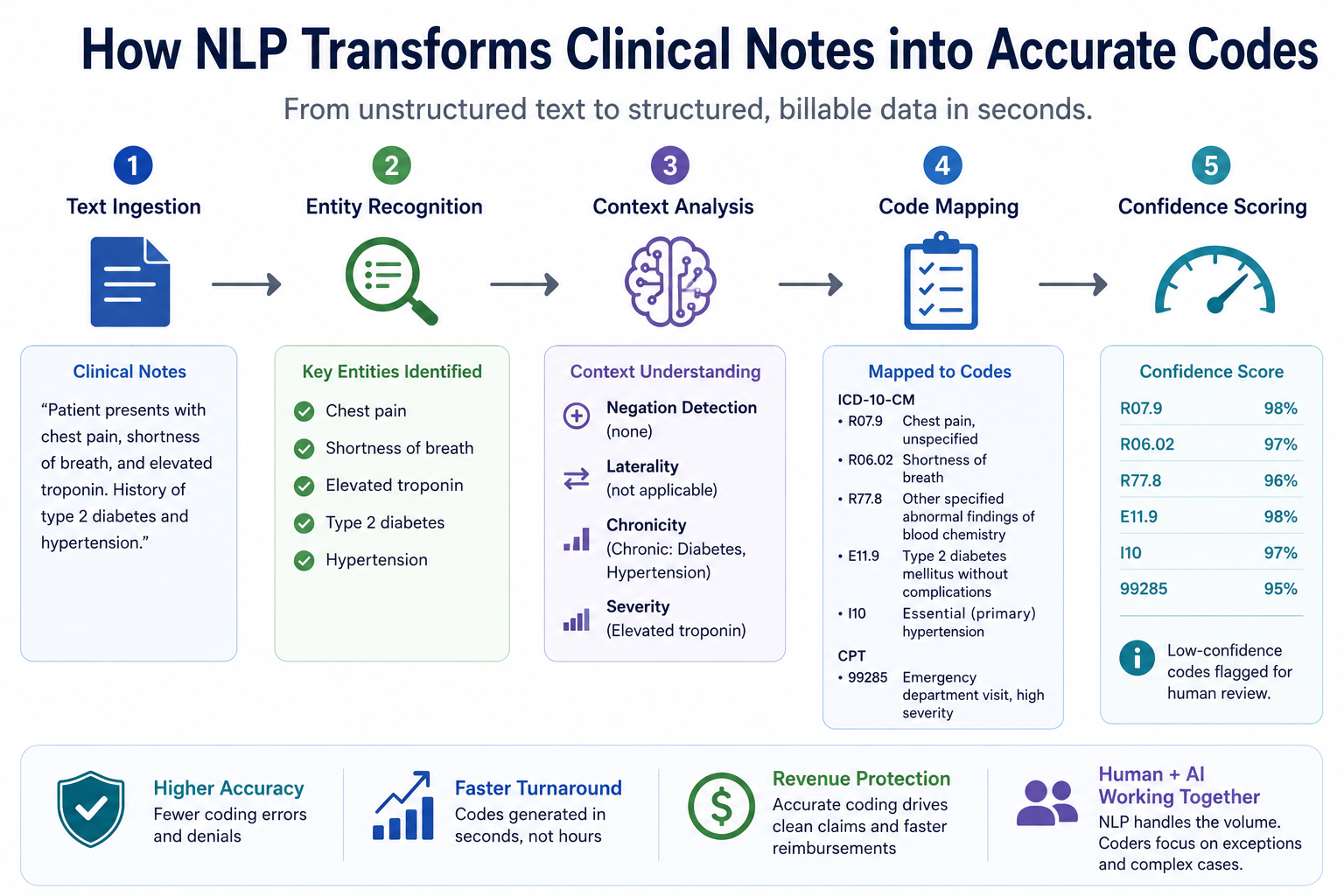
Think of it this way: a physician writes “patient presents with chest discomfort, shortness of breath, and elevated troponin.” A human coder manually reviews this and assigns codes. An NLP-powered system does the same thing in seconds, with fewer errors and far greater consistency.
How NLP Reads Clinical Documentation
NLP does not just keyword-match. It understands clinical context. Here is how the process works:
- Text Ingestion – The system pulls in EHR notes, operative reports, and discharge summaries.
- Entity Recognition – NLP identifies key medical terms such as diagnoses, procedures, symptoms, and medications.
- Context Analysis – The system determines negation (e.g., “no fever” vs. “fever”), laterality, chronicity, and severity.
- Code Mapping – Identified entities are mapped to the most accurate ICD-10, CPT, or HCPCS codes.
- Confidence Scoring – Each suggested code is assigned a confidence level, flagging low-confidence codes for human review.
Key NLP Techniques Used in Medical Coding
- Named Entity Recognition (NER): Identifies clinical concepts like diagnoses, procedures, and medications in free text.
- Relation Extraction: Understands the relationship between entities (e.g., “diabetes with peripheral neuropathy”).
- Negation Detection: Distinguishes between “patient has pneumonia” and “patient has no history of pneumonia.”
- Contextual Embeddings: Uses models like BioBERT to understand domain-specific medical language at a deep level.
How NLP Improves Medical Coding Accuracy Step by Step
Automated Code Suggestion from Clinical Notes
This is NLP’s most direct contribution to Natural Language Processing medical coding accuracy. Instead of a coder reading through 10 pages of clinical documentation and manually selecting codes, NLP systems analyze the entire record and suggest the most appropriate codes instantly.
Studies show that after fine-tuning NLP-based large language models with specialized ICD-10 knowledge, initial fine-tuning increased exact code matching from under 1% to 97%, demonstrating the dramatic improvement NLP can deliver when properly trained.
That kind of accuracy at scale is simply not achievable through manual coding alone.
Real-Time Error Detection and Flagging
NLP-powered systems do not just assign codes. They also catch errors before a claim is ever submitted. ProMantra’s RevvPro’s automation platform applies these real-time checks automatically across every claim before it leaves the building.
The system can:
- Flag codes that do not align with the documented diagnosis
- Identify missing secondary diagnoses that should be captured
- Alert coders when documentation does not support the assigned code level
- Detect potential upcoding or undercoding patterns
According to Becker’s Hospital Review, the average cost to rework a single denied claim exceeds $118. Multiply that by thousands of denials, and the financial impact quickly reaches millions.
Catching errors before submission is always cheaper than correcting them after a denial.
Context-Aware Code Assignment
One of the biggest advantages of NLP over basic keyword-matching tools is its ability to understand context. Medical documentation is messy, full of abbreviations, shorthand, and nuance.
NLP handles:
- Chronic vs. acute conditions (e.g., chronic kidney disease vs. acute kidney injury)
- Laterality (left vs. right procedure)
- Complication specificity (e.g., type 2 diabetes with diabetic chronic kidney disease, stage 3)
- HCC (Hierarchical Condition Category) capture for value-based and risk-adjusted reimbursement
NLP accelerates medical coding automation by surfacing codeable evidence with context, reducing omissions and contradictions, and for value-based care, it strengthens Hierarchical Condition Categories capture and supports accurate risk adjustment.
Real-World Impact: What the Data Says
The proof of NLP’s value in medical coding is no longer theoretical. Real organizations are reporting measurable results.
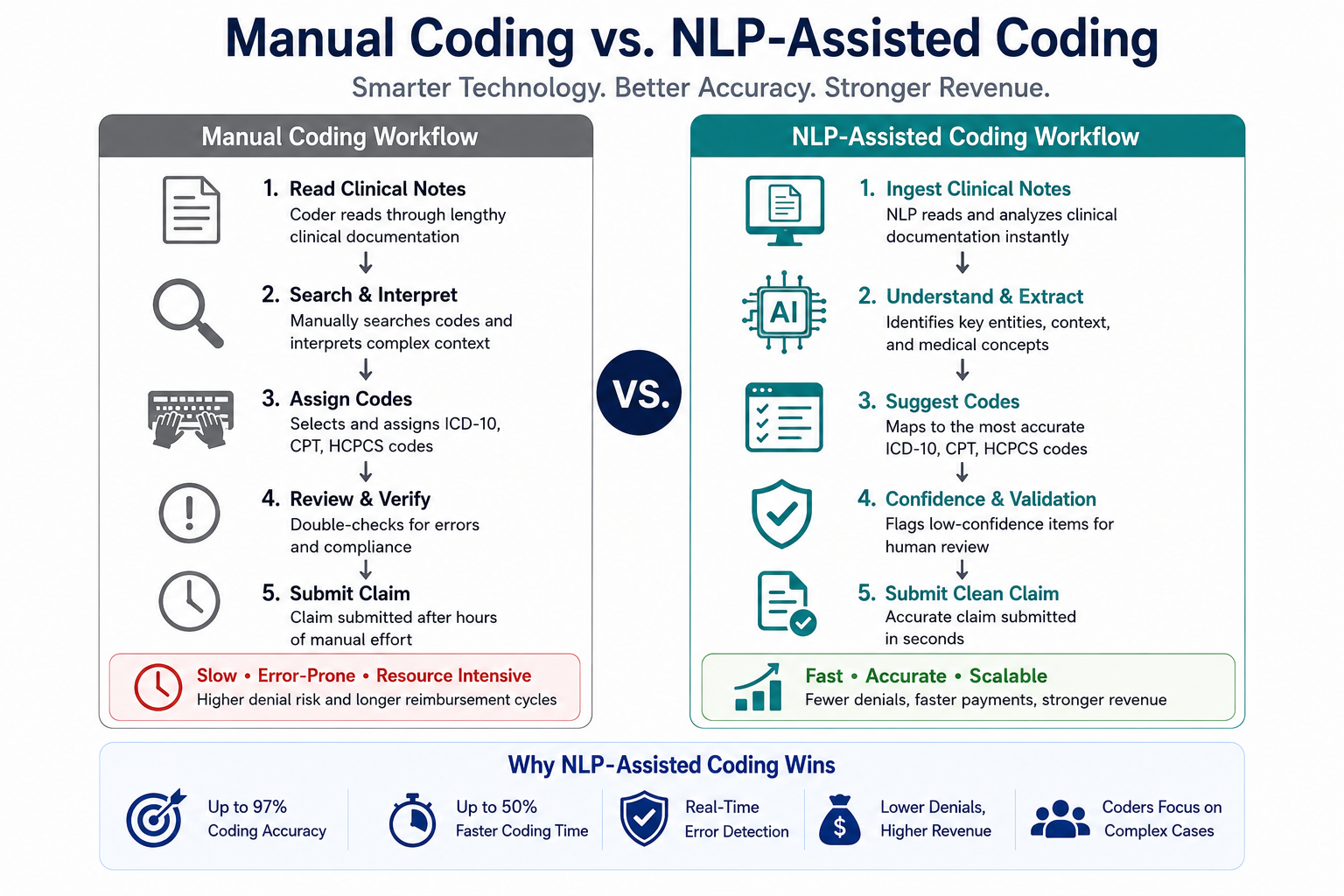
- A TruCode report reveals that autonomous coding systems powered by NLP can reduce coding time by up to 50% while enhancing accuracy. A 2023 Frost and Sullivan report indicates that over 30% of healthcare organizations are already piloting or planning autonomous coding solutions.
- The global AI in medical coding market, valued at $2.63 billion in 2024, is projected to grow to $9.16 billion by 2034 at a 13.30% CAGR, according to Precedence Research.This growth aligns with broader trends in agentic AI in RCM automation reshaping how providers manage the entire revenue cycle.
These numbers reflect a broader industry shift. Providers who delay adopting NLP-assisted coding are not just missing an efficiency gain. They are falling behind on revenue protection.
NLP vs. Traditional Manual Coding: A Clear Comparison
| Factor | Manual Coding | NLP-Assisted Coding |
| Speed | Slow (hours per complex chart) | Fast (seconds per record) |
| Accuracy | 79-88% in complex cases | Up to 97% exact match |
| Scalability | Limited by team size | Scales with volume |
| Error Detection | Post-submission audits | Real-time, pre-submission |
| HCC Capture | Inconsistent | Systematic and thorough |
| Compliance Readiness | Reactive | Proactive |
| Cost Per Claim | High (rework + denial cost) | Significantly reduced |
Manual coding is error-prone for high volumes, often 40% slower than NLP-assisted hybrid approaches, and carries error rates of 12 to 18% in complex cases, creating high risk of denials and payer non-acceptance without human validation.
The best model is not NLP alone. It is NLP combined with human oversight. Skilled coders focusing on exception handling and clinical judgment, while NLP handles the volume, produces the best outcomes.
Challenges of NLP in Medical Coding (And How to Overcome Them)
NLP in medical coding is powerful, but it is not without challenges. Providers and RCM teams need to be aware of these to manage them effectively.
- Data Quality Issues NLP is only as good as the documentation it reads. Poorly structured notes, inconsistent terminology, and abbreviations can reduce accuracy.
Solution: Pair NLP implementation with a strong Clinical Documentation Improvement (CDI) program to improve source data quality.
- Domain-Specific Language Gaps General NLP models may not fully understand subspecialty clinical terminology.
Solution: Use NLP systems trained on healthcare-specific datasets, such as those using BioBERT or similar biomedical language models.
- Compliance and Audit Risk Fully autonomous coding without human review can introduce compliance exposure if errors go unchecked.
Solution: Implement a hybrid model where NLP suggests codes and certified human coders validate high-risk or low-confidence assignments.
- Integration with Existing EHR Systems Connecting NLP tools to legacy EHR platforms can be technically complex.
Solution: Partner with an experienced RCM vendor who already has established integrations with major EHR platforms.
How ProMantra Leverages NLP-Driven Coding for Better RCM Outcomes
At ProMantra, we understand that better coding accuracy is not just a technology question. It is a revenue strategy.
Our Revenue Cycle Management services combine the power of NLP-assisted medical coding tools with the expertise of certified medical coders and compliance specialists. This means:
- Higher first-pass claim rates through cleaner, more accurate code submissions
- Reduced denial rates by catching documentation and coding mismatches before submission
- Stronger HCC capture to support value-based care and risk adjustment models
- Audit-ready compliance with real-time flagging and documentation support
- Faster reimbursement cycles so your cash flow stays healthy
We do not just implement technology. We align NLP capabilities with your specific specialty, payer mix, and documentation workflows to deliver results that stick.
Whether you are a hospital, physician group, or multi-specialty practice, ProMantra’s NLP-integrated RCM services are built to protect your revenue and reduce administrative burden, so your team can focus on patient care.
Frequently Asked Questions (FAQs)
Q1: How does Natural Language Processing improve medical coding accuracy specifically?
NLP improves medical coding accuracy by automatically reading clinical notes, discharge summaries, and operative reports, extracting diagnosis and procedure information, and mapping them to the correct ICD-10 or CPT codes. It also detects negation, context, and clinical specificity that manual coders might miss under time pressure. The result is fewer missed codes, fewer errors, and a higher clean claim rate.
Q2: Can NLP completely replace human medical coders?
Not entirely, and it should not. NLP works best in a hybrid model where it handles high-volume, routine coding while certified human coders review flagged, complex, or low-confidence cases. AI tools scan charts and use NLP and machine learning to assign ICD, CPT, and HCPCS codes, with high-confidence codes auto-posted and low-confidence or flagged cases going to human review, followed by human coder validation to ensure compliance before final submission. This model combines the speed of AI with the clinical judgment of experienced coders.
Q3: What types of coding does NLP support, ICD-10, CPT, or both?
NLP-based medical coding tools can support ICD-10-CM (diagnosis codes), ICD-10-PCS (procedure codes for inpatient), CPT (physician and outpatient procedure codes), and HCPCS codes. The scope depends on the NLP platform and the training datasets used. Leading solutions cover the full range relevant to hospital and physician practice billing.
Q4: How quickly can a healthcare provider expect results after implementing NLP in their coding workflow?
Most organizations that implement NLP-assisted coding within a structured RCM workflow begin to see measurable improvements in coding turnaround time and first-pass claim rates within the first 60 to 90 days. Denial rate reductions often follow within the first two billing cycles as coding accuracy improves upstream.
Ready to Stop Losing Revenue to Coding Errors?
Medical coding errors are not inevitable. They are preventable with the right technology and the right partner.
At ProMantra, our NLP-powered Revenue Cycle Management solutions are helping healthcare providers across the United States reduce coding errors, cut denial rates, and accelerate reimbursements, without adding to your administrative overhead.
Do not let another claim cycle pass with avoidable losses.
Schedule a Free RCM Consultation with ProMantra Today