
Every denied claim, every coder query, and every delayed payment usually traces back to the same ten-minute window: the moment a clinician finishes a shift and moves on before finishing the chart. That small gap between “care delivered” and “care documented” is where most billing rework quietly begins.
This guide breaks down why that gap forms, what it costs your practice in staff hours and delayed cash flow, and the specific end-of-shift documentation habit that high-performing healthcare organizations use to close it. By the end, you will have a practical routine your clinical teams can adopt this week, without adding hours to an already long day.
Why Rework Starts Long Before the Claim Is Ever Submitted
Billing teams tend to think of rework as a coding problem or a payer problem. In reality, most rework is a charge capture and documentation timing problem. A provider sees a patient, performs a service, and mentally files it away as “done.” The note gets finished later, sometimes hours later, sometimes the next morning, and by then the details, and often the charge itself, have softened. Was that a separately billable evaluation, or a bundled follow-up? Did the encounter support the diagnosis code the coder ultimately selected?
When documentation happens well after the encounter, coders are forced to guess, query, or under-code out of caution. Each of those outcomes creates friction downstream, whether it shows up as a coder question sitting in a queue, a claim held for clarification, or a denial that requires a full appeal cycle to resolve. Left unaddressed, this pattern is also one of the most common front-end errors that quietly generate back-end denials weeks after the encounter itself is long forgotten.
The Real Cost of Reworking a Single Denied or Delayed Claim
The numbers here are not small. Industry research consistently places the cost of reworking a single denied claim in the range of twenty five to sixty dollars once staff time, systems access, and follow-up communication are factored in, and hospitals nationally spend billions of dollars a year overturning denials that could have been prevented at the point of documentation. Premier Inc. has estimated that figure at close to twenty billion dollars annually across U.S. hospitals.
That cost multiplies fast in high-volume settings. A mid-size hospital submitting several thousand claims a month, even with a denial rate around the industry average, is looking at a meaningful chunk of staff time spent purely on cleanup rather than new work. Rework is not just a billing department problem, either. It pulls clinical staff back into charts they thought were closed, adds appeal documentation to already full schedules, and slows down the accounts receivable cycle that keeps cash flow predictable across the practice.
What Happens When Charge Capture Waits Until “Later”
Delayed documentation does not just risk missing details. It changes the entire downstream charge capture and billing workflow in three specific ways.
- Charges go missing. A supply used, a device applied, or a brief procedure performed between scheduled tasks is easy to forget once a shift ends and attention shifts elsewhere, and that missed charge capture rarely gets caught downstream.
- Notes lose specificity. Medical necessity language that would have supported a higher-level code gets flattened into a generic summary written from memory rather than from the moment of care.
- Coders default to caution. Without a clear, timely note, coders often select the safer, lower-level code rather than risk an audit flag, which quietly erodes revenue across hundreds of encounters over a year.
None of this reflects poor clinical judgment. It reflects a workflow gap: documentation and charge capture are treated as a separate task rather than a natural extension of the visit itself. Closing that gap is exactly what a denial management program should be measuring, since recurring documentation issues almost always show up first as a pattern in denial data before anyone notices them at the chart level.
The End-of-Shift Charge Capture Documentation Habit, Explained
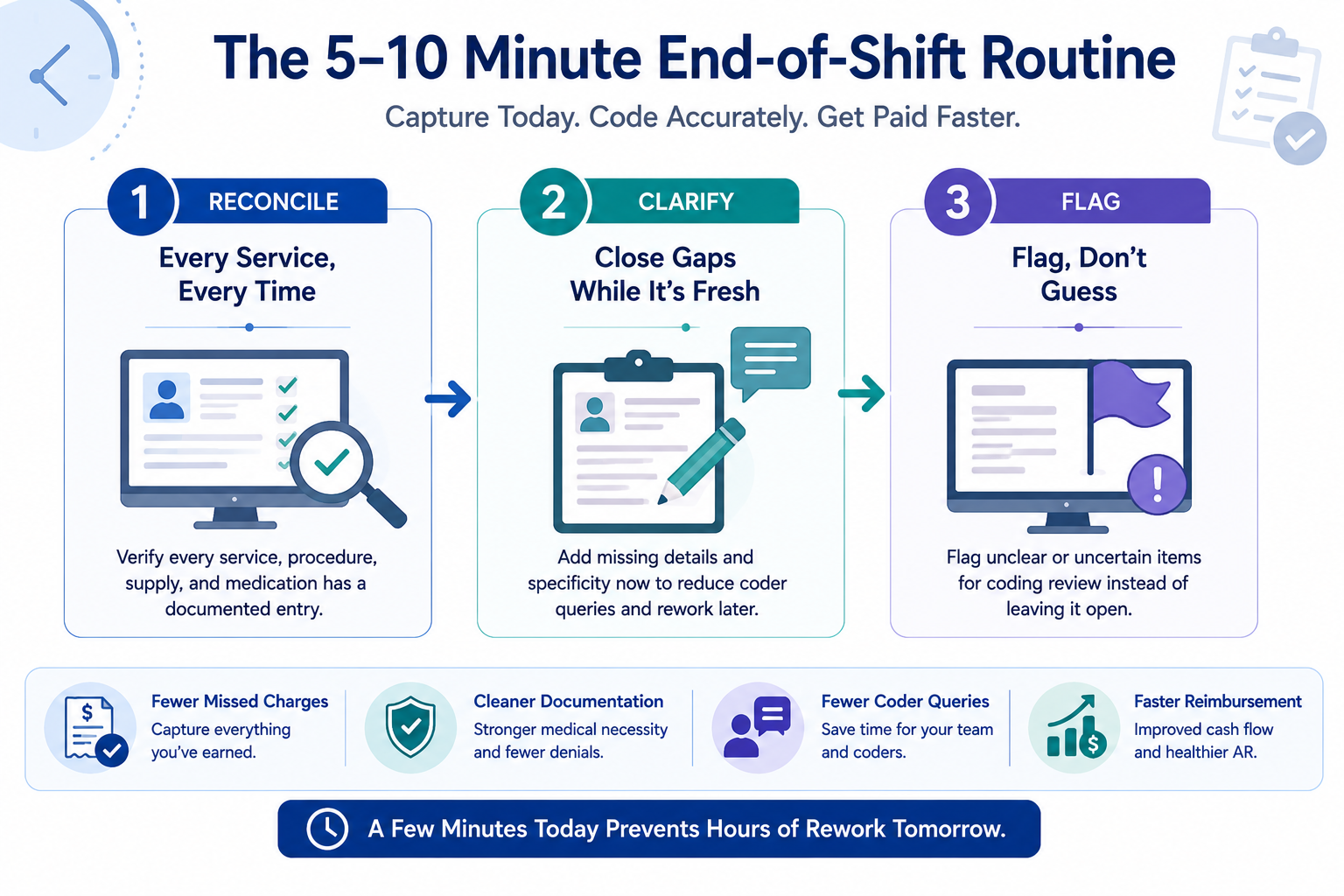
The fix is not a longer documentation process. It is a short, structured five-to-ten-minute charge capture documentation habit performed before a clinician leaves for the day, built around three simple steps.
Step 1: Reconcile Every Service Against the Chart
Before logging off, the clinician runs a quick mental (or checklist-based) pass through every patient seen that shift and confirms that each service, procedure, supply, or medication administered has a corresponding note entry. This single charge capture reconciliation step catches the majority of missed charges before they ever become a downstream problem for the coding or billing team.
Step 2: Close the Loop on Ambiguous Notes Immediately
If a note reads as vague or incomplete, the clinician adds the missing specificity while the encounter is still fresh, rather than waiting for a coder query days later. This is the single biggest driver of reduced coder back-and-forth, because it addresses ambiguity at the source instead of downstream, where a clinical documentation improvement team would otherwise have to chase it manually.
Step 3: Flag, Don’t Guess
For anything genuinely uncertain, whether it is a borderline medical necessity question or an unclear service line, the clinician flags it directly for the coding team rather than leaving it open to interpretation. A flagged note with context takes a coder seconds to resolve. A silent gap can take a coder, and eventually a biller, much longer to untangle.
Why 10 Minutes at Shift’s End Beats 45 Minutes of Cleanup Later
Healthcare finance leaders have documented this exact trade-off. Charge capture reconciliation that gets pushed to the end of a long clinical shift, especially a twelve-hour shift, is unsustainable when it stretches into forty five minutes of retrospective chart combing. That kind of delayed cleanup is exactly what breeds errors, resentment, and eventually staff disengagement from the billing process altogether. Clinicians who dread reconciliation tend to rush it, and a rushed pass through a full day of charts is where the most expensive gaps hide.
A short, immediate habit avoids that trap entirely. Ten minutes spent on charge capture reconciliation and closing documentation gaps while the encounter is fresh is dramatically more accurate, and less mentally taxing, than reconstructing the same information from memory a day or a week later. This is also why automation vendors and revenue integrity teams increasingly focus on real-time charge capture triggers pulled directly from the EHR, feeding cleaner data into medical coding workflows rather than relying on end-of-month audits alone to catch what was missed.
Building the Habit Without Burning Out Clinical Staff
Adoption fails when documentation improvement is framed as one more administrative burden stacked on clinicians who are already stretched thin. It succeeds when it is framed and built as protection for their own time later in the week, since every minute spent on a clean note now is a minute a clinician does not spend fielding a coder query or writing an appeal letter next month.
A few practical guidelines make the habit stick:
- Keep the checklist short. Three to five items maximum. Anything longer gets skipped under time pressure.
- Build it into existing EHR workflows rather than creating a separate parallel process or app clinicians have to remember to open.
- Show clinicians the downstream impact. When staff understand that a missed charge or vague note becomes a query, a delay, or a denial weeks later, the habit stops feeling arbitrary.
- Protect the time. Leadership needs to explicitly carve out those closing minutes rather than expecting clinicians to squeeze documentation in around an already packed schedule.
- Review the pattern, not just the individual claim. Aggregate data on where documentation gaps recur, by provider, department, or shift, tells you far more than chasing one denial at a time. Our guide on building a denial prevention system walks through how to set up that kind of ongoing tracking rather than relying on one-off fixes.
How This Habit Connects to the Bigger Revenue Cycle Picture
An end-of-shift documentation habit is a small, specific fix, but it sits at the front end of a much larger system. Documentation feeds coding accuracy. Coding accuracy feeds clean claim rates. Clean claim rates determine how much staff time gets spent on rework instead of new revenue-generating work. When the documentation habit holds, every stage downstream gets faster and cheaper to run, and the improvement compounds because coders spend less time on clarification and more time on complex cases that genuinely need their expertise.
Organizations that treat charge capture as connected to documentation, rather than as two separate departments working in silos, consistently see the biggest gains in first-pass acceptance rates within the first two or three quarters of making the change. For a closer look at where these gaps most often hide across specialties, see our breakdown of common charge capture blind spots, which walks through the departments and encounter types most prone to missed charges and the practical fixes that close them.
None of this happens automatically, though. It takes deliberate ownership, someone accountable for watching the pattern over time rather than reacting claim by claim, and a workflow that makes the connection between documentation and revenue visible to the people who can actually influence it.
Where Outsourced RCM Partners Fit In
Even with a strong documentation habit in place, healthcare organizations still need a coding and billing team that can catch what slips through, resolve ambiguity quickly, and keep the entire claims cycle moving. This is where a dedicated revenue cycle management partner adds measurable value, especially for practices and hospitals without the bandwidth to build a full internal denial prevention program from scratch. The right partner treats documentation quality as part of its own scope of work, rather than waiting passively for clean charts to arrive before getting involved.
At ProMantra, we work alongside clinical and administrative teams to strengthen the connection between documentation and billing accuracy rather than treating them as separate problems handled by separate departments. Our certified coders review charts with an eye for the specificity payers expect, flagging patterns back to clinical leadership so the same gap does not repeat month after month across the same department or provider.
Our medical billing team scrubs claims before submission to catch what documentation alone cannot, closing the loop before a claim ever reaches a payer and before a preventable denial has a chance to consume staff time later. We are HIPAA compliant and ISO 27001 certified, which means your patient data and billing workflows stay protected at every step of the process.
The goal is not to replace good clinical habits. It is to make sure every well-documented encounter turns into a clean, fully reimbursed claim the first time, building toward genuine revenue integrity that closes the gap between services delivered and revenue collected.
Frequently Asked Questions
- What exactly is the end-of-shift documentation habit? It is a short, five-to-ten-minute routine performed before a clinician logs off, where every service delivered that shift is reconciled against the chart, ambiguous notes are clarified immediately, and anything uncertain is flagged directly for the coding team rather than left open to interpretation.
- How much time does this habit actually take? For most clinicians handling a typical patient load, the full routine takes five to ten minutes. That is a fraction of the thirty to forty five minutes often spent reconstructing missed charges and clarifying vague notes days or weeks later.
- Does this replace the need for a coding audit or CDI program? No. The habit reduces the volume and severity of documentation gaps at the source, but it works best alongside a structured clinical documentation improvement program, periodic chart audits, and ongoing coder feedback loops.
- Which roles benefit most from adopting this habit? Any clinician generating billable charges benefits, but the impact is most visible among providers with high patient volume per shift, such as those in emergency departments, urgent care, and multi-provider outpatient practices, where missed charges and vague notes compound quickly.
- How can a healthcare organization measure whether the habit is working? Track coder query volume, denial rates tied to documentation or medical necessity, and charge capture lag time before and after implementation. A meaningful drop in coder queries within the first sixty to ninety days is usually the earliest and clearest signal.
Ready to close the gap between documentation and reimbursement? Contact us to see how ProMantra’s coding and billing specialists can help your team reduce rework and protect revenue from the point of care forward.