
Your billing team is working hard, but the math still does not add up.
Claims get denied. Staff time disappears into manual eligibility checks. Payment posting takes days. And every hour your team spends on repetitive, rules-based tasks is an hour they are not spending on complex denials or patient-facing priorities.
The solution is not always “hire more people.” In many cases, it is “automate the right things first.”
RCM automation through smart bots and AI-powered workflows is no longer reserved for large health systems with deep IT budgets. Physician groups, specialty practices, and mid-size hospitals are deploying automation today to cut operational costs, accelerate reimbursements, and reduce preventable denials at scale.
But here is what most vendors do not tell you: not all automation investments deliver equal returns. Automating the wrong process first means delayed ROI, disrupted workflows, and staff resistance that slows adoption.
This guide breaks down exactly which RCM processes produce the highest returns when automated, how to sequence your investment for maximum impact, and what a structured automation roadmap looks like in practice.
The Case for RCM Automation Has Never Been Stronger
Before diving into where to start, it is worth understanding the scale of the problem automation solves.
The U.S. healthcare industry could save an additional $25.7 billion annually by fully automating administrative transactions that are still handled manually or semi-electronically, according to the 2025 CAQH Index. That figure represents real money being burned on tasks a well-configured bot can handle in seconds.
Despite this, the adoption gap remains striking. A 2026 Healthcare AI Trends survey found that 59% of executives have not yet implemented AI or automation in their revenue cycle. Only 2% report fully integrating these technologies across their RCM operations. In other words, the organizations that move now have a clear competitive advantage.
The U.S. RCM automation market is currently valued at $8.92 billion and is projected to grow at a CAGR of 12.3% through 2035. Investments in automation and AI rank as the top RCM priority in 2026, according to Medical Group Management Association (MGMA) research, with payer analytics, coding support, and agentic tools for eligibility and prior authorization leading the way.
The financial case is clear. The strategic question is: where do you start?
How to Prioritize: The High-Impact, Low-Risk Framework
Not every RCM process is equally suited to automation. The best candidates share three traits:
- High volume: They happen dozens or hundreds of times per day.
- Rules-based logic: They follow defined, repeatable steps with predictable outcomes.
- Significant error rate or cost when done manually: They generate measurable revenue leakage or staff burden.
Using this lens, five areas of the revenue cycle consistently deliver the strongest ROI when automated first. Here they are in order of recommended priority.
1. Eligibility Verification: Stop Denials Before They Start
Eligibility errors are the single most common cause of claim denials. Patient eligibility errors at intake account for 56% of denials, according to Experian Health’s 2025 State of Claims survey.
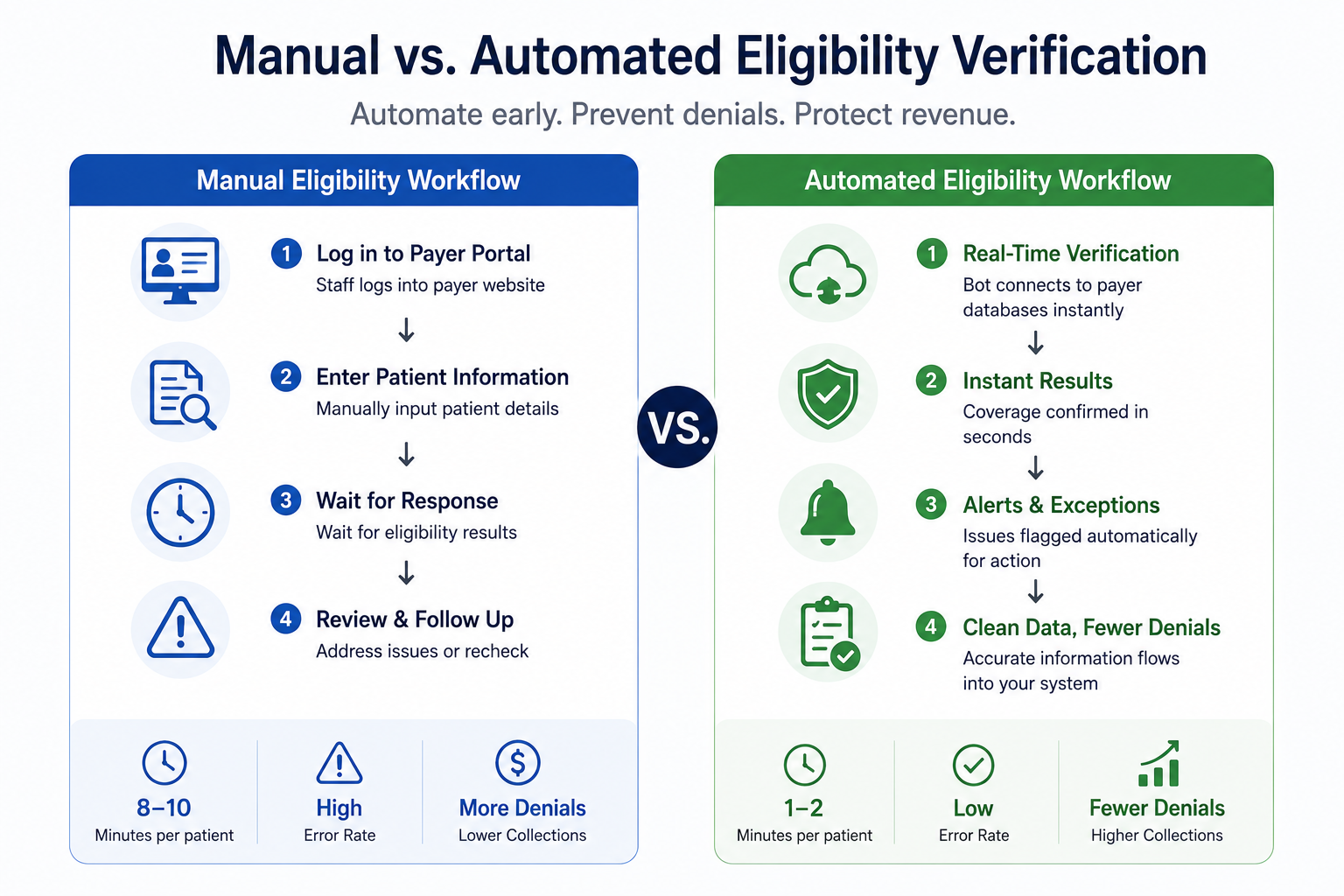
Manual eligibility checking is also time-consuming and error-prone. When staff are verifying coverage for dozens of patients per day by logging into individual payer portals, typos happen, deadlines get missed, and outdated insurance information slips through.
Automated eligibility verification bots solve this systematically. They connect to payer databases in real time, run coverage checks against every scheduled appointment (typically 72 hours in advance), and flag discrepancies before the patient ever arrives. No manual portal logins. No batch-checking the morning of.
What automated eligibility verification delivers:
- Real-time coverage confirmation integrated directly into your EHR scheduling workflow
- Automatic alerts for expired policies, coverage gaps, or plan changes
- Batch overnight verification for next-day appointments without staff involvement
- Reduced registration errors that trigger downstream denials 60 to 90 days later
The 2026 CMS Interoperability and Prior Authorization rule has also raised the stakes for eligibility verification accuracy. Organizations not equipped with real-time eligibility tools face heightened compliance risk as payer requirements become more stringent.
This is the single best place to start your RCM automation journey because errors here compound through every downstream step. Fix them at the front end, and your clean claim rate improves across the board.
2. Prior Authorization: Reclaim 13 Hours a Week Per Physician
Prior authorization is one of the most time-intensive and high-stakes processes in the revenue cycle. Practices complete an average of 39 prior authorization (PA) requests per physician per week, with physicians and staff spending 13 hours weekly on those requests, according to AMA survey data.
The volume alone demands automation. But the consequences of manual PA management are even more compelling. Delayed authorizations directly delay care, trigger avoidable denials, and create the kind of burnout that drives staff turnover. An AMA survey found that 89% of physicians say prior authorization significantly contributes to burnout.
Automated prior authorization platforms change the dynamic entirely. They identify which services require pre-approval, initiate electronic PA requests using payer APIs, track approval status in real time, and flag expirations before they cause denials. Under the new CMS Interoperability and Prior Authorization Final Rule, payers are now mandated to support faster electronic prior authorization, making automated platforms both a compliance requirement and an efficiency lever.
What automated PA delivers:
- Auto-identification of services requiring pre-approval, matched against payer-specific rules
- Electronic submission integrated with your EHR rather than manual payer portal navigation
- Real-time status tracking with expiration alerts
- Reduced “auth not obtained” denials, one of the most expensive and avoidable denial categories
Organizations that have implemented automated PA report dramatic reductions in turnaround time and significant recapture of previously lost revenue tied to missed authorizations.
3. Claims Scrubbing and Submission: Boost Your First-Pass Rate
Every claim that gets denied and reworked costs your practice. Reworking a denied medical claim costs between $25 and $118 depending on complexity, according to HFMA research. At a 12% denial rate for a practice billing $300,000 monthly, rework costs alone can reach $9,000 to $42,000 per month before counting the revenue risk from claims aging past timely filing limits.
Automated claim scrubbing bots address this upstream. They check every claim against payer-specific rules before submission, catching coding errors, missing modifiers, incorrect ICD-10 sequencing, and documentation gaps that trigger denials. The best platforms validate against thousands of payer-specific edits in real time, not just generic clearinghouse checks.
The results are measurable. Practices using an AI-powered RCM automation platform report an average first-pass claim rate of 98.7%, compared to the 78% to 82% industry average for manual processes. That gap translates directly to faster reimbursements, lower rework costs, and improved cash flow.
What automated claims scrubbing delivers:
- Pre-submission validation against payer-specific coding and billing rules
- Real-time correction alerts before claims leave your system
- Higher clean claim rates and lower initial denial rates
- Significantly reduced staff time spent on rework and resubmissions
Automation also handles claim status follow-up after submission, the foundation of a zero-touch claims processing model where bots check payer portals on a schedule, identify stalled claims, and route them for human review before they age into timely filing risk.
4. Payment Posting: End the Manual Reconciliation Bottleneck
Payment posting is one of the most straightforward candidates for automation, yet many practices still handle it manually. Automated payment posting bots read electronic remittance advice (ERA) files, match payments to the corresponding claims in your practice management system, post payments, apply contractual adjustments, and flag underpayments or discrepancies for review.
The operational benefit is significant. Automating claims processing can shrink a task that once required over two minutes per claim to just two seconds and RPA’s role in eliminating revenue leakage extends across payment posting, reconciliation, and beyond.
Manual payment posting is also a source of ongoing compliance risk. When staff are reconciling hundreds of ERAs by hand, errors accumulate quietly. Automated audit trails built into payment posting bots create an unchangeable record of every transaction, supporting both HIPAA compliance and audit readiness.
What automated payment posting delivers:
- Faster reconciliation with fewer manual touchpoints
- Automated identification of payer underpayments against contracted rates
- Clean audit trails for every payment transaction
- Staff freed from repetitive reconciliation to focus on exception handling
5. Denial Management: Let Bots Handle the Recoverable Ones
Denial management is where automation creates some of its most visible financial impact and transforming denial management with AI is now a core operational strategy for high-performing RCM teams. The national claim denial rate currently sits between 10% and 12%, but top-performing organizations keep it below 5% using automated pre-submission prevention combined with intelligent denial workflows on the back end.
Here is the critical insight: not all denials require the same response. Many denials fall into predictable, high-frequency categories (wrong modifier, missing authorization number, demographic mismatch) where the correction is straightforward and repeatable. These are exactly the denials that bots handle best.
Automated denial management systems categorize every denial by reason code, route recoverable denials to automated correction workflows, and escalate complex medical-necessity or documentation denials to human specialists, a model that works best when paired with expert revenue cycle management services. This triage approach means your denial management team is focusing on the high-value, judgment-intensive work instead of spending hours correcting simple data errors.
Providers historically fail to resubmit approximately 60% of denied claims. Automated denial workflows eliminate this leakage by ensuring every denial gets a response within payer-required timelines.
What automated denial management delivers:
- Automatic categorization of denials by reason code and recovery pathway
- Bot-handled correction and resubmission for simple, high-frequency denial types
- Escalation routing for complex denials requiring human review
- Predictive denial scoring that flags high-risk claims before submission
Building Your RCM Automation Roadmap: The Right Sequencing Matters
Most organizations make the mistake of trying to automate everything simultaneously. The result is implementation fatigue, staff resistance, and ROI that takes too long to materialize.
A more effective approach is sequential, building from the front end backward:
Phase 1: Eligibility verification (highest volume, immediate upstream impact on all downstream denials)
Phase 2: Prior authorization (high revenue risk, growing compliance requirement under CMS rules)
Phase 3: Claims scrubbing and submission (directly improves clean claim rate and speeds cash flow)
Phase 4: Payment posting (eliminates reconciliation bottleneck, improves AR visibility)
Phase 5: Denial management (maximizes recovery on unavoidable denials, creates continuous learning loop)
Each phase builds on the previous one. Front-end automation reduces the volume of denials that back-end automation needs to manage. When all five phases are running together, you have a revenue cycle where bots handle the high-volume, rules-based work and your team handles the judgment-intensive exceptions.
The other key principle: choose a partner whose automation integrates with your existing EHR and practice management system and whose healthcare IT infrastructure capabilities support incremental deployment without requiring a full platform migration.
How ProMantra Supports Your RCM Automation Journey
At ProMantra, we help healthcare providers build and operate automation-enabled revenue cycles without the disruption of a full technology overhaul. Our team works as an extension of your billing and RCM operations, combining intelligent automation with experienced human oversight across eligibility, prior authorization, claims management, denial resolution, and payment posting.
ProMantra holds ISO 27001 and HIPAA compliance certifications, giving CFOs and practice administrators the security and compliance confidence they need when outsourcing revenue cycle functions. Our approach is built around measurable outcomes: clean claim rate, days in AR, denial rate, and cost to collect.
Whether you are just beginning to explore RCM automation or looking to optimize an existing program, our team can help you identify the highest-impact opportunities in your specific revenue cycle and build a sequenced roadmap for implementation.
Frequently Asked Questions (FAQs)
Q1. What is RCM automation and how does it work?
RCM automation uses software bots, artificial intelligence, and machine learning to handle repetitive, rules-based tasks across the revenue cycle. These include eligibility verification, prior authorization submission, claim scrubbing, payment posting, and denial management. Automated bots connect to payer systems, EHRs, and practice management platforms to complete these tasks faster and with fewer errors than manual processes.
Q2. Which RCM process should I automate first?
Eligibility verification is typically the highest-impact starting point. Because eligibility errors are the most common root cause of claim denials (accounting for 56% of denials according to Experian Health’s 2025 State of Claims survey), automating this process at the front end prevents problems from cascading through the entire revenue cycle. Prior authorization and claims scrubbing are the logical next steps.
Q3. Will RCM automation replace my billing staff?
No. The goal of RCM automation is to handle high-volume, repetitive tasks so your team can focus on complex denials, payer escalations, and strategic work that requires human judgment. Automation and experienced billing staff work best together, not as substitutes for each other.
Q4. How long does it take to see ROI from RCM automation?
ROI timelines vary based on the processes automated and the baseline performance of your current workflow. However, organizations that automate eligibility verification and claim scrubbing typically see measurable improvements in clean claim rates and denial rates within the first 60 to 90 days of deployment. Payment posting automation often delivers the fastest visible results due to the direct reduction in reconciliation time.
Q5. How do I ensure RCM automation stays HIPAA compliant?
Work with vendors and partners who hold formal HIPAA compliance documentation and maintain documented security controls, including encryption, access controls, and audit trails. ISO 27001 certification is an additional indicator of a vendor’s commitment to structured information security management. Automation platforms should create unchangeable audit trails for every transaction, supporting ongoing compliance and audit readiness.
Ready to Automate Smarter?
RCM automation is not a future consideration anymore. It is a competitive requirement. Organizations that prioritize the right processes, in the right sequence, are already cutting denial rates, shrinking AR days, and redirecting staff effort to higher-value work.
ProMantra’s RCM specialists can help you identify exactly where automation will deliver the fastest ROI in your revenue cycle, and build a roadmap to get there. Contact our RCM team today to schedule a no-obligation consultation.