Your billing team just deployed an AI claim scrubber, and now everyone is asking the same question: how sure does the model need to be before a claim goes out on its own? Set the bar too low and denials creep back in. Set it too high and staff drown in review queues that defeat the purpose of automation.
This is where an AI confidence threshold comes in: the line your system uses to decide whether a claim is clean enough to submit automatically or risky enough to need a biller’s eyes first. Get this calibration right, and you cut denials without burning out your team.
In this guide, you will learn what a confidence threshold measures, why the decision matters more in 2026, and a practical framework for setting your own auto-submit and review rules.
What Is an AI Confidence Threshold in Claims Processing?
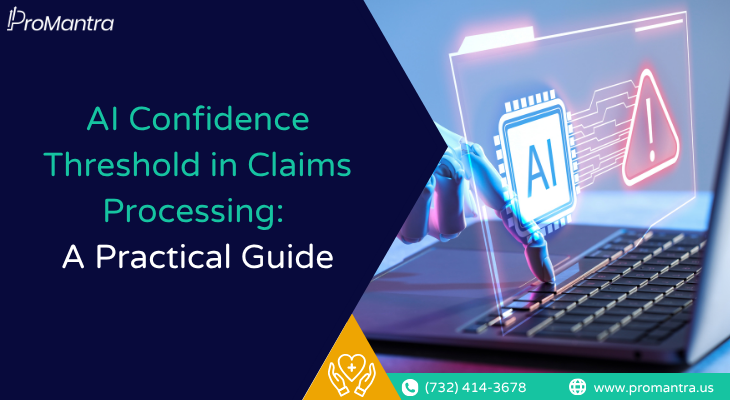
An AI confidence threshold is a numeric cutoff, usually a percentage or probability score, that a claim scrubbing model assigns to every claim before submission. The score reflects how confident the model is that a claim will pass payer edits and be accepted on the first attempt.
Claims scoring above the threshold move straight to the clearinghouse without human intervention. Claims that score below it get routed to a biller for review before they ever reach the payer. The model weighs historical claim outcomes, payer-specific adjudication patterns, documentation completeness, and modifier logic to produce that single number.
The threshold itself is a business decision, not just a technical setting. A hospital system processing thousands of claims daily and a five-provider specialty practice will land on very different cutoffs, since their risk tolerance, staffing, and payer mix are not the same. Our revenue cycle management services are built around this exact calibration, pairing automation with the oversight payers still expect.
Why This Decision Matters More in 2026
Denial rates have not been trending in the right direction. Claim denial rates averaged 11.8% in 2024 and climbed to roughly 12% in 2025, with net revenue leakage from denials growing 25% year over year. Part of that increase traces back to payers running their own automated adjudication engines that reject claims faster than manual teams can respond.
Providers are leaning harder on automation to keep pace, and a recent industry survey found most are already using it to speed up revenue cycle processes, with denials cited as their biggest concern. The organizations getting real value are not the ones auto-submitting everything. They are the ones who tuned thresholds around payer behavior and claim risk, a distinction we unpack in our look at agentic AI and its current limits in healthcare RCM.
The Case for Auto-Submitting High-Confidence Claims
Not every claim needs a human touch, and forcing review on straightforward claims wastes staff time that should go toward accounts that actually need it. Practices that treat every claim as equally risky end up with review queues so large that real problem claims get lost in the noise. High-confidence auto-submission makes sense when the claim matches a payer and code combination with a strong acceptance history, documentation is complete with no missing modifiers, the service line has a clean denial record, and eligibility plus prior authorization are already verified.
Auto-submitting these claims shortens the billing cycle and frees billers for genuinely ambiguous cases instead of rubber-stamping claims that were never actually at risk. This is the same logic behind the shift toward smart, rules-based automation across the revenue cycle, where routine, low-risk work moves without friction so staff time goes toward higher-value review.
When AI Should Flag a Claim for Human Review
A confidence threshold only earns trust if it reliably catches the claims that need a second look before they leave the building. Claims typically get flagged when one or more of these conditions appear:
- Novel payer policy changes. A model cannot catch denials tied to a payer’s newly introduced policy until enough denials have been processed to retrain it, so recent policy shifts should always trigger manual review regardless of score.
- High-dollar claims. Even a small error on a high-value claim creates outsized financial risk, so many practices set a lower automation threshold above a defined dollar amount.
- Modifier or bundling conflicts. These are among the most common denial drivers and the hardest for a model to resolve with full certainty.
- Missing or ambiguous medical necessity documentation. If the clinical note does not clearly support the billed service, no confidence score should override that gap.
- New or infrequently billed procedures. Thin historical data means the model has less to learn from, so scores here deserve more caution.
Our denial management services use exactly this kind of tiered review logic, so claims with elevated risk get expert attention before submission rather than after a denial.
How to Set the Right Confidence Threshold for Your Practice
There is no universal number that works for every organization. Treat threshold calibration as an ongoing process built around your own data. Start by pulling the last 12 months of denials by payer, code, and reason to see where your risk actually lives, then set separate thresholds by payer, since one running aggressive automated adjudication deserves a stricter cutoff than one with a strong acceptance record.
Build in a dollar-value override so claims above a set amount route to review regardless of score, and track override outcomes, not just denial rates, since that feedback loop improves the model over time. Review the threshold quarterly, since payer policies and documentation quality shift.
Governance matters too. Every AI recommendation should be explainable to the reviewer, since that transparency is essential for both compliance and day-to-day staff trust in the system. Our prior authorization services follow this same tiered approach, applying automated checks to routine requests while routing anything unusual to a specialist before it ever reaches the payer.
Risks of Getting the Threshold Wrong
Set the threshold too aggressively and you risk auto-submitting claims that generate denials and, in the worst cases, compliance exposure from documentation that should have been reviewed. Set it too conservatively and you erase the efficiency gains automation was supposed to deliver, since staff review claims that were never at risk.
Both of these failure modes are common in early AI rollouts. Organizations that skip a structured calibration process either lock in an arbitrary threshold at go-live and never revisit it, or let anecdotal staff pushback drive the number down until the system barely automates anything. Neither reflects what the data supports, and both quietly erode gains a well-tuned AI-powered denial management program is meant to deliver.
Building a Human-in-the-Loop Workflow That Scales
A well-tuned threshold is only half the equation. The other half is what happens to a flagged claim once it lands in a reviewer’s queue. Without a clear workflow, flagged claims can sit just as long as they would in a fully manual process, erasing the benefit of automation entirely. Effective workflows rank flagged claims by dollar value and risk, define clear escalation paths, document the reasoning behind every override, and set turnaround targets for how quickly review happens. None of this works if flagged claims pile up faster than staff can clear them, which is why queue design deserves as much attention as the threshold itself, and why staffing plans need to account for review volume rather than assuming automation removes the need for experienced billers altogether.
Our medical coding services operate on this same principle: automation handles the routine volume, and trained specialists handle the judgment calls that a score alone should never be allowed to make on its own. Coders who understand payer-specific nuance are what make the review side of this workflow genuinely reliable, since a flagged claim only gets resolved correctly if the reviewer has the specialty knowledge needed to spot what the model missed.
That specialty knowledge also feeds back into the system over time, since every correction a coder makes on a flagged claim becomes training signal for the next round of scoring. Practices that skip this feedback step tend to see their threshold accuracy plateau within a year, while those that capture it consistently see steady, measurable improvement quarter over quarter as the model learns from real reviewer decisions. This mirrors the broader shift toward zero-touch claims processing, where the goal is not removing humans entirely but making sure they only touch claims that genuinely need them.
How ProMantra Helps Providers Calibrate AI Confidence Thresholds
ProMantra is a U.S.-based revenue cycle management partner built for healthcare organizations that want the efficiency of automation without losing the oversight payers and auditors expect. As a HIPAA-compliant, ISO 27001-certified partner, we combine AI-driven claim scoring with experienced billing specialists who review exactly the claims that carry real risk.
Rather than shipping a one-size-fits-all threshold, our team works with your historical denial data to set payer-specific and specialty-specific cutoffs, then adjusts them as your data grows and payer behavior shifts. A threshold that made sense at go-live can quietly become miscalibrated within months if nobody is watching the override data, which is why ongoing calibration matters as much as the initial setup. Our AI-driven RCM solutions close the loop by feeding remittance outcomes back into the same models that decide what gets auto-submitted next time, keeping the threshold aligned with how payers are actually behaving right now rather than how they behaved last year.
That kind of continuous recalibration is what separates a threshold that ages well from one that quietly drifts, and it is also the piece most vendors gloss over when they demo a claim scoring tool for the first time. A model can look accurate in a sales pitch built on someone else’s historical data, but the real test is whether it keeps improving once it is scoring your claims, against your payers, month after month. That feedback loop is what separates a threshold that stays accurate from one that quietly falls out of date, an approach we detail further in our guide to predictive analytics in revenue cycle management.
Frequently Asked Questions
- What is a good starting confidence threshold for claims auto-submission? Most organizations start conservatively, often in the 90 to 95% confidence range, then adjust based on actual first-pass acceptance results over the following months.
- Can a confidence threshold be different for each payer? Yes, and it should be. Payers vary widely in how aggressively they apply automated adjudication, so a single organization-wide threshold usually underperforms payer-specific ones.
- Does a high confidence score guarantee a claim will not be denied? No. A confidence score reflects the likelihood of acceptance based on historical patterns, not a guarantee. Novel payer policy changes can still result in denial even at a high score.
- How often should confidence thresholds be reviewed? Quarterly reviews are a reasonable baseline, though thresholds should also be revisited after a major payer policy change or a shift in denial patterns.
- Does relying on confidence thresholds reduce the need for skilled billing staff? No. It changes what skilled staff spend their time on. Instead of reviewing every claim, they focus on the smaller set the model flags as genuinely uncertain, which requires more judgment, not less.
Ready to Calibrate Your Claims Automation the Right Way?
Setting the right AI confidence threshold is not a one-time configuration. It is an ongoing partnership between your data, your payer mix, and a team that knows when automation should step back. If you want a revenue cycle partner who can help you find that balance, contact us to talk through where your claims process stands today.