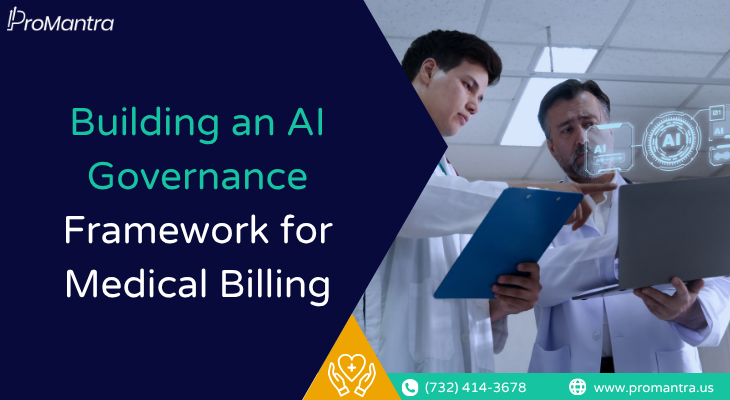
Your billing team just deployed an AI coding engine that processes claims in seconds instead of minutes. Denials are down. Turnaround time is up. Then, three months in, a payer flags a pattern of upcoded claims nobody caught, because nobody was actually watching. This is the moment every healthcare finance leader eventually faces: AI without a governance framework isn’t efficiency, it’s exposure.
This guide covers what an AI governance framework for medical billing actually looks like, why human oversight has to sit at its center, and how to build one your compliance team and your auditors will sign off on. By the end, you will have a practical structure you can start implementing this quarter.
Why AI Governance Matters More Than Ever in Medical Billing
AI adoption in revenue cycle management has moved from experimental to mainstream almost overnight. A large share of health systems are now exploring or actively running AI across coding, claims scrubbing, and denial prediction, and investment in healthcare AI has climbed sharply year over year. That pace of adoption is exactly why governance cannot be an afterthought.
Regulators are paying attention too. The FDA continues expanding guidance on AI-enabled software functions, and the NIST AI Risk Management Framework now offers a widely referenced baseline for validating and monitoring AI systems. There is no single federal law governing AI in medical billing yet, but organizations that can document oversight will be in a far stronger position than those that cannot.
The billing-specific risk is concrete. Insurance-side AI systems have been documented denying claims at rates far higher than a human reviewer would produce, because the models scan for keyword and code matches rather than evaluating medical necessity in context. Provider-side AI has the opposite failure mode risk: overconfident coding on complex, ambiguous, or multi-diagnosis charts. The same pattern shows up in workflows like AI-driven prior authorization, where an unreviewed gap can delay patient care as easily as it delays payment. Either direction, without a human checkpoint, becomes a financial and compliance liability that compounds with every claim the system touches.
What Is an AI Governance Framework in Healthcare RCM?
An AI governance framework is the documented set of policies, roles, thresholds, and review processes that determine how artificial intelligence is allowed to operate inside your billing workflows, and exactly when a human must step in. It is not a single policy document. It is an operating system for accountability.
The Core Components Every Framework Needs
A working framework for medical billing typically includes:
- Ownership and structure: a named governance committee with representation from compliance, RCM leadership, IT, and clinical documentation, plus executive sponsorship that gives the group real authority.
- Escalation thresholds: clear, configurable rules defining which claims, dollar values, or prior authorization scenarios always require human review before submission.
- Validation and bias testing: a process for auditing AI coding and denial-prediction outputs against real outcomes before and after deployment.
- Transparency requirements: a standing rule that every AI-influenced billing decision must be explainable and traceable back to the documentation or payer policy that supports it.
- Vendor evaluation criteria: a checklist your organization applies before onboarding any new AI tool, covering data handling, model transparency, and audit capability.
- Ongoing monitoring: scheduled review cycles that track model drift, denial pattern shifts, and escalation-rate trends over time.
Groups like the AMA have published governance toolkits that walk health systems through many of these same building blocks, which is a useful cross-check when you are assembling your own version.
The Real Risks of Ungoverned AI in Billing
Algorithmic Denial and Coding Spikes
When AI operates without oversight, small model errors do not stay small. A misconfigured coding rule or an outdated payer-policy reference gets applied identically across thousands of claims before anyone notices the pattern. What would have been a single billing mistake becomes a systemic one, which is exactly why AI-powered denial management needs a validation layer rather than a set-and-forget deployment, especially once volume scales past what a small team can spot-check manually.
Compliance and Audit Exposure
Federal auditors and the OIG do not treat “the algorithm did it” as a defense. If your organization cannot produce a clear, document-level trail showing why an AI system assigned a specific code or flagged a specific denial reason, you carry the compliance risk of that decision as though a person had made it without review.
Patient Trust and Financial Transparency
Patients and referring providers increasingly expect visible, meaningful human oversight of AI in their care and their billing, not just a disclosure buried in a privacy notice. This is especially true anywhere medical coding AI directly shapes what a patient is billed. Consumer research on healthcare AI consistently finds that trust depends on oversight being visible, not just present on paper.
Human-in-the-Loop: The Non-Negotiable Layer
The single most important design decision in any AI governance framework is where the human sits in the loop, and current healthcare-AI research organizes this into three practical models: Human-in-the-Loop, where a person actively reviews and approves every AI output before it takes effect; Human-on-the-Loop, where AI acts autonomously but a person monitors continuously and can intervene; and Human-in-Command, where a person retains ultimate authority over whether the system operates at all.
For medical billing, most mature organizations land on a hybrid model, often described as RCM Human in the Loop: routine, low-risk claims move through AI-on-the-loop monitoring, while complex coding decisions, high-dollar denials, and anything touching medical necessity require a licensed or certified professional’s direct sign-off before submission. A five-pillar compliance approach used across practices today frames this as a formal, required workflow: a qualified professional must review and validate any AI output that affects patient care or reimbursement, full stop.
This is not about slowing AI down. It is about making sure the speed AI provides on the 80% of routine claims frees your team’s attention for the 20% that actually need it.
Building Your AI Governance Framework: Step by Step
1. Establish Governance Structure and Ownership
Name a governance lead and a cross-functional committee before you sign a single AI vendor contract. Without a clear owner, oversight becomes everyone’s job and therefore no one’s job.
2. Define Escalation and Human Review Thresholds
Set explicit rules for what always gets human review: claims above a defined dollar value, anything flagging a medical-necessity question, first-time payer denials, and any coding scenario the AI itself flags as low-confidence.
3. Build Transparency and Audit Trails
Every AI-assisted billing decision should be traceable: what documentation supported it, what payer policy applied, and who reviewed it if it crossed a threshold. This applies just as much to denial management decisions as it does to coding, since a denial overturned on appeal needs the same clear record as the original claim. This is the record that protects you at audit.
4. Create Vendor Evaluation Criteria
Before onboarding any AI billing tool, require vendors to answer specific questions about model training data, update frequency, explainability, and how their system supports rather than replaces human review.
5. Monitor, Retrain, and Recalibrate Continuously
Governance is not a one-time setup. Schedule quarterly reviews of denial trends, escalation rates, and coding accuracy, and adjust your thresholds as your payer mix and claim volume evolve. This should sit alongside the same discipline covered in guidance on securing RCM data in an automated environment.
Measuring Success: KPIs for AI Governance in RCM
A governance framework only earns its keep if you can measure it. Track:
- Percentage of claims escalated for human review versus processed autonomously
- Denial rate trend before and after each governance adjustment
- Time from AI flag to human resolution on escalated claims
- Coding accuracy rate across both AI-processed and human-reviewed accounts
- Audit findings tied to AI-assisted decisions, ideally trending toward zero
These metrics give your CFO and compliance team a shared, concrete language for evaluating whether your AI governance is actually working, not just documented.
How ProMantra Builds Governance Into Every AI Deployment
At ProMantra, governance is not a bolt-on policy, it is the operating model. This matters most where automation reaches its limits, a topic we cover in our piece on agentic AI and where RCM automation still needs a human. Complex coding decisions, high-dollar denials, and compliance-sensitive accounts are always routed to certified specialists before anything is finalized. Every AI action and every human override is logged in a complete, auditable record, so your compliance team is never staring at a black box when a payer or auditor asks a question. That routing decision, not the AI’s raw processing speed, is what actually determines whether a deployment scales safely or quietly accumulates risk over time.
We built this approach because governance failures are expensive in ways that go beyond a single denied claim. Weak oversight tends to show up later as a wider compliance bill, the kind our healthcare compliance cost guide breaks down in detail, covering everything from audit preparation to corrective action plans. That is the cost a real governance framework exists to prevent, and it is the reason certification alone was never going to be enough.
Our own governance approach was built from more than two decades of real revenue cycle operations, not a theoretical framework, and it starts with the same regulatory foundation every healthcare organization should demand from an AI partner. ProMantra maintains full HIPAA compliance and holds ISO 27001 certification. Whether you are evaluating a first AI pilot or trying to formalize oversight on tools you already run, our team can help you build escalation thresholds, audit trails, and vendor criteria that hold up under scrutiny.
Frequently Asked Questions
Does an AI governance framework slow down billing operations?
No. A well-designed framework speeds up routine claims by letting AI handle them with minimal friction, while reserving human attention for the smaller share of complex or high-risk accounts where oversight actually adds value.
Who should own AI governance inside a healthcare organization?
A cross-functional committee works best, typically combining RCM leadership, compliance, IT, and clinical documentation representatives, with a named executive sponsor who has authority to enforce the framework.
What is the difference between Human-in-the-Loop and Human-on-the-Loop?
Human-in-the-Loop means a person actively reviews and approves each AI decision before it takes effect. Human-on-the-Loop means AI acts independently while a person monitors continuously and can step in when needed. Most billing operations use a mix of both depending on claim risk.
How often should an AI governance framework be reviewed?
Quarterly reviews are a reasonable baseline for most organizations, with immediate review triggered any time you onboard a new AI tool, see a denial-rate spike, or experience a compliance flag.
Can smaller practices realistically implement AI governance, or is it only for large health systems?
Smaller practices can and should implement scaled-down versions of the same principles: a named oversight owner, clear escalation rules, and an audit trail. Outsourcing to an RCM partner with governance already built into its AI model is often the most practical path for smaller organizations.
Ready to put real human oversight behind your AI-driven billing operations? Contact ProMantra to talk through where your current AI governance stands and where it needs to go.