

Your patients are not just patients anymore. They are consumers: informed, price-conscious, and willing to switch providers for a better financial experience.
This is the new reality of consumerism in healthcare, and if you are a CFO at a hospital, health system, or physician practice, it is reshaping the financial landscape beneath your feet right now.
Out-of-pocket spending by patients grew 5.9% to $556.6 billion in 2024, according to the Centers for Medicare and Medicaid Services (CMS). At the same time, hospitals are reporting a staggering $48 billion in net revenue losses in 2025 from claim denials and uncollected patient balances, which is a 25% increase from 2024, per Kodiak Solutions.
Something has fundamentally shifted in how patients relate to paying for care. How well you respond to that shift will determine whether your collections go up or your bad debt keeps climbing.
In this blog, we break down what consumerism in healthcare actually means for your revenue cycle, what patient payment trends CFOs need to track today, and what steps your organization can take to stop leaving money on the table.
What Is Consumerism in Healthcare?
Consumerism in healthcare describes a shift where patients behave more like retail shoppers: researching costs, comparing providers, demanding transparency, and making value-based decisions about where to spend their healthcare dollars.
This movement did not happen overnight. Rising deductibles, high-deductible health plans (HDHPs), and out-of-pocket costs have pushed patients into the financial driver’s seat. They are now responsible for a larger share of the bill and they are acting accordingly.
According to a McKinsey and Company 2024 report, patients are ‘more motivated than ever’ to choose healthcare options based on experience, quality, and value. In fact, 90% of health executives and 100% of CMOs in one survey identified healthcare consumerism as a top priority for their organizations.
| For CFOs, this means one thing clearly: the revenue cycle must adapt or suffer. |
The Hard Numbers: Why CFOs Cannot Afford to Ignore This
Let us look at what the data says about patient payment behavior in 2025:
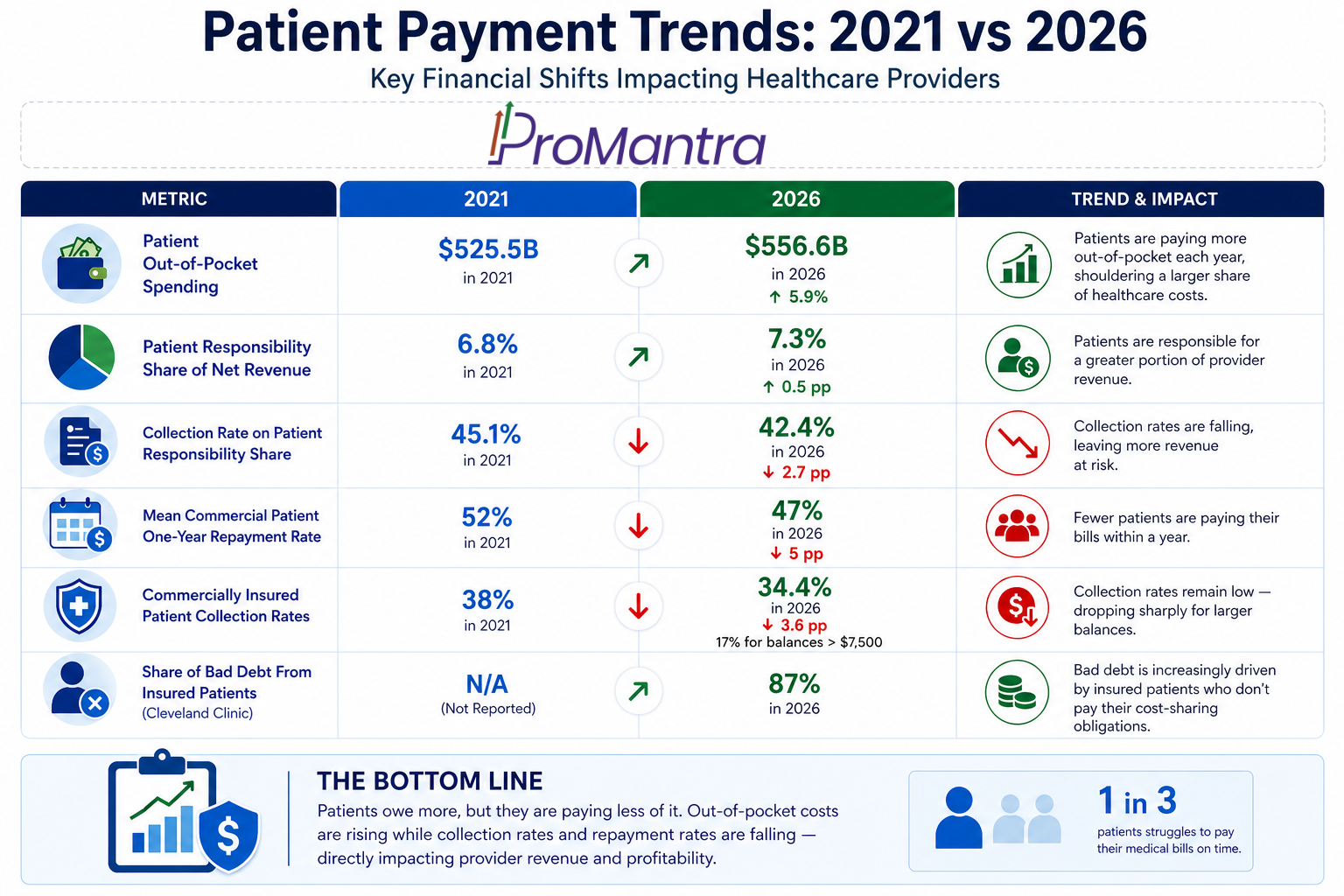
- $556.6 billion: Patient out-of-pocket spending in 2024 (CMS National Health Expenditure Data)
- $48 billion: Net revenue losses from denials and uncollected patient balances in 2025, up 25% from 2024 (Kodiak Solutions)
- 7.3%: Patient responsibility share of net revenue in 2025 (up from 6.8% in 2024), while collection on that share dropped from 45.1% to 42.4% (Kodiak Solutions)
- 47%: Mean commercial patient one-year repayment rate in 2023, down from 52% in 2021 (JAMA Health Forum, 2025)
- 34.4%: Commercially insured patient collection rates in 2025; for balances over $7,500, this drops to just 17% (Human Medical Billing, 2025)
- 87%: Share of Cleveland Clinic’s bad debt in 2024 that came from insured patients who did not pay their cost-sharing obligations
The numbers tell a consistent story: patients owe more, but they are paying less of it. And that gap is landing directly on your bottom line.
5 Key Patient Payment Trends Reshaping Healthcare Finance
Understanding consumerism in healthcare starts with understanding how patient expectations and behaviors are changing. Here are the five trends every CFO should have on their radar.
1. Patients Expect Price Transparency Before They Book
The days of the mysterious medical bill are numbered. Patients are now demanding to know what things cost upfront. This reflects broader medical billing trends reshaping how providers communicate costs.
A 2024 report cited by CareCredit found that 87% of patients accessed education about services, price estimates, and copays through provider websites in 2024, up from 69% in 2023. Patients comparing prices by region jumped from 40% in 2023 to 82% in 2024.
If your practice still cannot give patients a clear cost estimate before their appointment, you are already behind. Worse, you risk patients delaying care altogether, which hurts both outcomes and collections.
2. High-Deductible Health Plans Are the New Normal
HDHPs are now the dominant plan type for employer-sponsored coverage. When patients have a $3,000 or $5,000 deductible, the responsibility to collect shifts squarely to the provider. Understanding patient financial responsibility is now a core competency for every billing team.
This is not just a trend. It is a structural reality. Providers who treat HDHP patients like traditional copay patients and wait to bill until after services are rendered are setting themselves up for bad debt accumulation.
3. Patients Want Flexible Digital Payment Options
Consumerism in healthcare is also showing up in how patients want to pay. Just as they shop online, patients expect:
- Online bill pay portals
- Text-to-pay and mobile payment options
- Payment plan flexibility and installment plans
- Buy Now, Pay Later (BNPL) options; 29% of consumers have used BNPL in the past 12 months (HealthLeaders Media, 2024)
Practices that offer only paper bills and phone-based payments are seeing dramatically lower collection rates. Digital engagement is no longer optional. It is a competitive advantage. Read our recent blog on why automated medical billing is becoming a game-changer for providers.
4. Patient Financial Experience Directly Affects Loyalty
Here is something CFOs often miss: consumerism in healthcare means billing is now part of the patient experience.
A confusing bill, an unexpected balance, or a difficult payment process can prompt a patient to leave your practice. With consumerist trends weakening traditional patient loyalty, financial experience is becoming a real driver of retention and revenue. Building a patient-centric revenue cycle is now a strategic imperative, not an afterthought.
5. Rising Bad Debt Is Concentrated in the Insured Population
Perhaps the most counterintuitive shift is your insured patients are now a major source of bad debt.
Cleveland Clinic’s example is not unique. The growth in bad debt is not primarily from uninsured patients. It is from commercially insured individuals who have met their deductibles on paper but cannot or will not pay out-of-pocket balances.
This demands a shift in how providers approach patient financial conversations: earlier, more empathetically, and with more flexibility.
What This Means for Your Revenue Cycle Strategy
The rise of consumerism in healthcare demands that CFOs rethink the revenue cycle from a patient-first lens. Here is what needs to change:
Collect Earlier in the Patient Journey
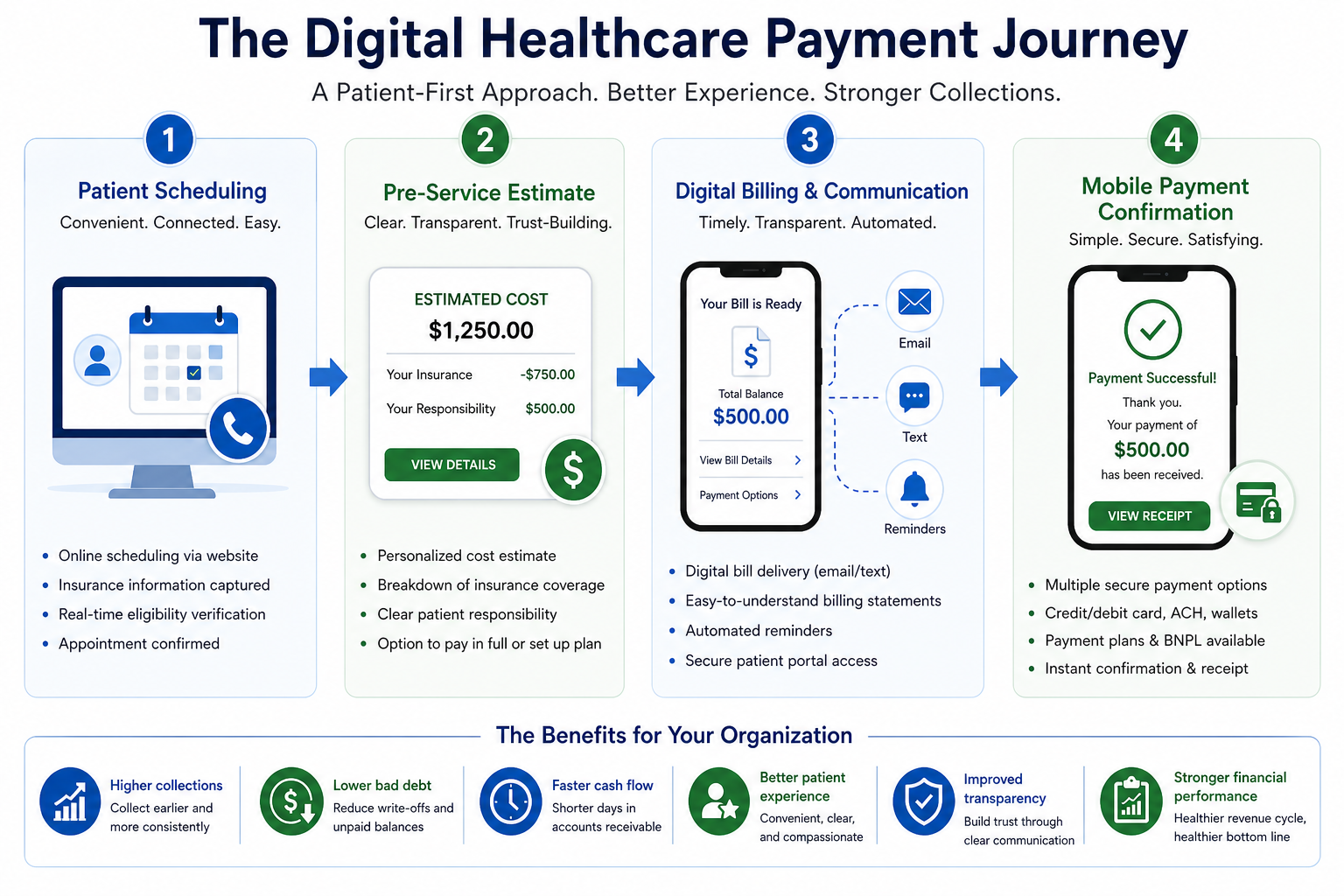
Pre-service financial conversations are no longer nice-to-have. Verifying insurance, estimating patient responsibility, and collecting copays or partial payments before the appointment dramatically improves collection rates.
Waiting until after the service is delivered means you are chasing a patient who has already received care and may have moved on mentally. Get the conversation started at scheduling or pre-registration.
Invest in Real-Time Eligibility Verification
Many collection failures start with a simple eligibility error. If a patient’s insurance has lapsed or their plan has changed, finding out after the claim is filed is costly and time-consuming.
Real-time eligibility checks at the point of scheduling catch these issues early, before they become denials, appeals, or write-offs.
Offer Patient-Friendly Financial Counseling
Patients do not always understand their benefits, their deductibles, or their payment options. Proactive financial counseling, whether through a front-desk team member or a digital self-service tool, reduces confusion, builds trust, and improves payment rates.
Leverage Automation and AI in Collections
Manual follow-up on patient balances is expensive and inefficient. Automated payment reminders, intelligent segmentation of patient accounts by payment likelihood, and AI-driven workflows can significantly improve patient collections without adding headcount.
More than 60% of healthcare organizations are already using AI in some function of their revenue cycle (Human Medical Billing, 2025). Those who are not adopting these tools are falling behind.
How ProMantra Helps Healthcare Providers Adapt to the Consumer Era
At ProMantra, we understand that adapting to consumerism in healthcare is not just about adding a payment portal. It requires a comprehensive revenue cycle strategy built around the modern patient’s financial experience.
Our Revenue Cycle Management (RCM) services are specifically designed to help healthcare providers:
- Verify eligibility in real time to catch coverage gaps before they become denials
- Automate patient billing workflows to reach patients via email, text, and online portals
- Reduce days in AR by streamlining the entire claims and collections cycle
- Provide pre-service cost estimation support so patients understand their financial responsibility upfront
- Improve clean claim rates to minimize denials and accelerate reimbursements
- Track KPIs that matter, including patient collection rates, net collection rate (NCR), and bad debt trends
We work with hospitals, physician groups, and specialty practices across the United States, helping them build revenue cycle operations that are not just efficient but genuinely built for the consumer era.
The CFO’s Checklist: Are You Ready for Healthcare Consumerism?
Use this quick checklist to evaluate where your organization stands today:
- Do you offer real-time price estimates to patients before appointments?
- Is eligibility verification happening at the time of scheduling and not after?
- Do patients have access to digital payment options (online portal, text-to-pay, installment plans)?
- Is your front-desk team trained on financial conversations and patient responsibility?
- Are you tracking patient collection rates separately from insurance collection rates?
- Is your bad debt trending up, and do you know the root cause?
- Are you using automation or AI in any part of your patient billing workflow?
| If you checked fewer than four of these boxes, your revenue cycle is vulnerable to the pressures of consumerism in healthcare. |
FAQs: Consumerism in Healthcare
Q1. What does consumerism in healthcare mean for a CFO?
For CFOs, consumerism in healthcare means that patients are now a significant payer class, one that requires the same strategic attention as commercial insurers. As deductibles rise and patients shoulder more of the financial burden, revenue cycle operations must be retooled to collect more effectively at the patient level. This includes pre-service collections, digital billing, price transparency, and financial counseling.
Q2. Why are patient collection rates dropping even for insured patients?
Rising high-deductible health plans mean that even insured patients face hundreds or thousands of dollars in out-of-pocket costs before their insurance kicks in. Many patients either do not understand their financial responsibility or simply cannot afford to pay it. A JAMA Health Forum study of 24.5 million patient episodes found that the average repayment rate for privately insured patients dropped from 54% pre-pandemic to 46% by 2023.
Q3. How can hospitals reduce bad debt caused by consumerism in healthcare?
The most effective strategies include: collecting partial payments before service delivery, verifying insurance eligibility in real time, offering flexible payment plans and digital payment options, providing proactive financial counseling, and using automation to send timely billing reminders. Hospitals that implemented digital transformation strategies have seen bad debt reductions of up to 20%, per a LifeBridge Health case study (Flywire, 2023).
Q4. What role does price transparency play in healthcare consumerism?
Price transparency is central to consumerism in healthcare. Patients are increasingly comparing costs across providers before making care decisions. According to Kyruus Health’s 2025 consumerism trends report, an 81% inconsistency rate in provider directory entries still undermines many transparency efforts. Providers who invest in clear, accessible cost estimates earn patient trust, reduce billing disputes, and see better collection rates because patients are not blindsided by unexpected bills.
Final Thoughts: The Revenue Cycle Is Your Competitive Edge
Consumerism in healthcare is not a trend that will reverse. Patients will continue to demand transparency, flexibility, and value. Their willingness to pay depends heavily on how well your organization meets those expectations.
For CFOs, the message is clear: the revenue cycle is no longer just a back-office function. It is a front-line patient experience and a direct driver of financial performance.
The organizations that win in this environment will be those that combine proactive financial engagement, smart automation, and an RCM partner who understands what modern healthcare billing really requires.
Ready to Strengthen Your Revenue Cycle for the Consumer Era?
ProMantra helps healthcare providers build a revenue cycle that works in today’s patient-first environment. From real-time eligibility verification to automated patient billing and denial management, we bring the expertise and technology you need to improve collections, reduce bad debt, and stay ahead of the shift.
Contact ProMantra today for a free RCM assessment